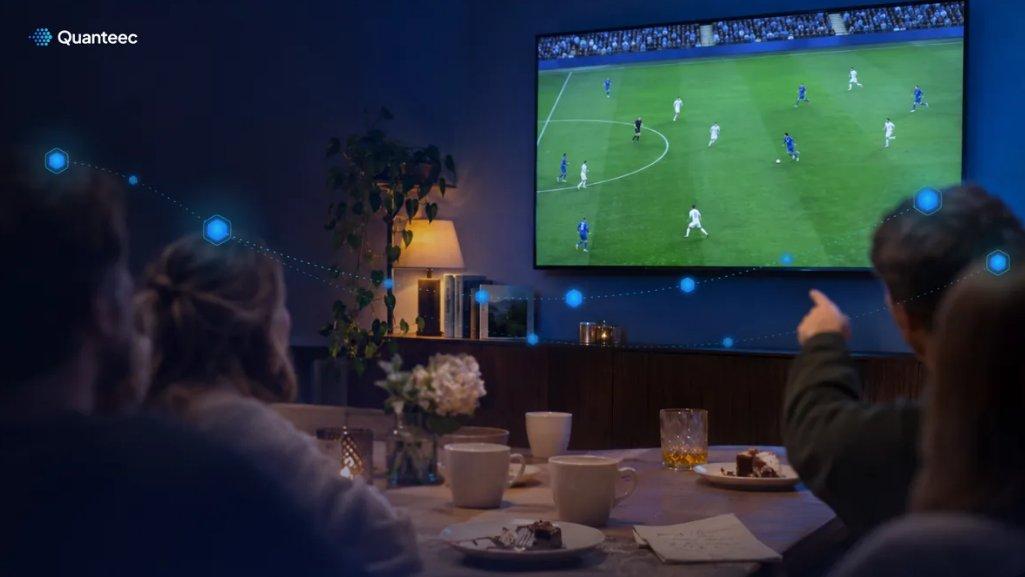
There’s one question I get asked at almost every family gathering or dinner with friends. Sometimes five minutes in, sometimes once the coffee is on. But it always comes up, almost word for word:
“Wait, so when I’m watching the game… what exactly gets shared?”
It’s the question that sets everything off, half curiosity and half fear. And that fear almost always comes from the unknown: things nobody ever bothered to explain out loud. Whether it pops up with regular folks or kicks off a deep dive with some of the most seasoned (and most conservative) engineers in the industry, the answer is much shorter than anyone expects: the game. A few seconds of what they’re already watching, encrypted, while they’re watching it. That’s it.
But while we’re here, the rest is worth telling: why live streaming requires building far more servers than it needs, how peer-assisted delivery changes that, and what it means for the people watching. And yes, feel free to add some whiskey to your coffee.
A million copies of the same match point
Picture a final. A million people watching the same stream, at the same second. With the classic model, each one gets their own copy, sent by a CDN (short for content delivery network: the fleets of servers spread around the world whose job is to get video to your screen). A million identical copies of the same match point, crossing the same networks at the same time.
To hold up, streaming platforms and networks build capacity for the peak: those few hours a year when everyone watches the same thing. The rest of the year, much of that capacity sits waiting, lurking in the dark.
On the other side of the screen, the exact opposite happens. Every viewer’s home has an upload connection (the one that runs from the home to the internet) that is installed, paid for, and practically empty. According to OpenVault, the average subscriber uses about 0.4% of their upload capacity over a month.
Oversized servers on one side, millions of idle connections on the other. I call that waste, and it is the gap peer-assisted delivery is built to close.
How peer-assisted delivery works, in two paragraphs
Online video travels in small pieces of a few seconds each, called segments, and the player stitches them back together as you watch. Quanteec adds what we call a peer-assisted layer, peers being the viewers themselves: while someone watches, their player can pass a few of those pieces to nearby viewers watching the same thing. It all happens inside the video player the platform already uses, through a small piece of code (373 kB on web, lighter than most photos on your phone). Nobody installs anything.
The consequence is counterintuitive, and here’s my favorite part: the more viewers there are, the more capacity there is. Just keep this in mind: with a CDN, every new viewer requires extra capacity. With Quanteec, every new viewer can add capacity. And the CDN is still there as backup: if a segment is slow to arrive from another viewer, the player fetches it from the CDN and the game goes on without anyone noticing.
Tested where it hurts most
By then, my uncle has grabbed the whiskey instead of the coffee and asks, a little offended: “That’s all well and good in theory, but in practice it must be chaos.” I take a breath, smile, and answer: “It’s been in production for years.”
In case the millions of posts never reached you, or, like my uncle, you don’t use LinkedIn much, here it is: it works, and at scale. Our favorite example is France Télévisions. Because we’re in France, because it’s public television, and because they were the first to come and tell us, straight up: “I want P2P, I know what it is.” They’ve been running Quanteec on france.tv for years, and big sporting events are exactly where it shows.
Take Roland-Garros 2026: three weeks of tennis live on france.tv, from the qualifying rounds to the final. By our own measurements on that deployment, at the peak 82% of the video traveled from viewer to viewer, and the viewers themselves multiplied delivery capacity by more than six. Rebuffering, the spinning wheel that freezes the image right on match point, was cut almost in half: 0.27% of viewing time with Quanteec against 0.51% on the CDN alone. And delivery used 46% less energy.
Our data from the Six Nations and the Winter Olympics showed the same pattern: large audiences, with the servers carrying only part of the load.
So, what really gets shared?
My uncle has dozed off over his whiskey, so let’s get back to where it all started.
What travels between viewers are those small pieces of the game they’re already watching, encrypted. No account data, no personal files, nothing that says who’s who. And we’re strict about the rules.
The viewer’s connection always comes first. Our software keeps an eye on how busy the connection is and only uses the spare capacity (engineers call this congestion control). The moment someone starts a video call or an online gaming session, that traffic takes priority and we step aside. On cellular data, sharing is off by default, so no one’s data plan pays for it.
The device barely notices. Sharing uses at most 3% of the processor and less than €1 a year in electricity. On a phone, it adds 0.40% to battery use at most, and below 10% battery it stops sharing altogether.
And nothing, absolutely nothing, is stored on the device. The content passes through memory and moves on. When the game ends, so does the sharing.
“Isn’t this just like BitTorrent?”
That’s when my cousin jumps in. He’s 40-something, my uncle’s son, and back in the day, a prolific downloader of Britney songs.
They have one thing in common: users exchange data directly. But that’s about where the resemblance ends. A torrent moves entire files, between strangers, and keeps running after you close the download. Here, a few seconds of the game travel from memory, between people watching the same game, and only while they watch it.
For whoever owns the broadcast rights, what matters is this: viewers only pass along encrypted pieces, never the watchable video. Every piece is checked before it plays, so nobody can slip in altered content. And the locks platforms have already deployed stay exactly as they are: DRM, the copy protection behind paid streaming services, plus time-limited access keys and country restrictions.
GDPR, no fine print
The family’s lawyer, my aunt, had been sharpening her claws since before her husband opened his mouth. So when her son backed down, she struck: “Nice, but is all this GDPR compliant?”
To connect nearby viewers, we process two pieces of data: the IP address (the number that identifies each internet connection, a bit like a street address) and the city it belongs to. In less than a second, the IP is hashed, meaning it’s swapped for a scrambled code, and it’s never shared with anyone. We don’t know who the viewers are, and as a matter of fact, we don’t need to.
Legally speaking, the whole thing rests on what the GDPR calls legitimate interest, so platforms don’t need to add one more consent pop-up window to the pile. What they do need is to tell viewers it happens, and one paragraph in the privacy policy covers it. Quanteec is directly accountable for that data, as what the law calls an independent data controller. I know that paragraph by heart, so I jot it down on a napkin for my aunt.
How to tell viewers is up to each platform: a line in the terms and conditions or a switch in the app. We recommend the switch, for a reason that’s coming up next.
If viewers share, let it show
With dessert, my niece looks up from her phone, for once, and fires away: “Okay, so do I get something for sharing?”
Now that’s the question I had been waiting for the entire evening. If viewers carry part of the delivery, they move to the very center of how the game gets delivered. They become part of the infrastructure, and it’s fair to ask what they get in return.
Our answer to that is StreamBoost.
We won’t make many friends saying this, but I think peer-assisted delivery points to a new business model for streaming, one that adds value for every party involved instead of concentrating it in the same few places. In StreamBoost, viewers opt in from the player, see an estimate of the energy, water, and CO2 their sharing helps save, and earn points as they share.
The switch that informs viewers becomes a way to take part. And for the platform, it opens a direct relationship with its most engaged audience.
Bottom line
Spoiler replay: WE DON’T NEED THAT MANY SERVERS. It’s not an eco-activist slogan, nor the media’s latest stunt. It’s sheer math: the capacity is already there, in every home watching the game. Write that one down. It’ll be on the exam.
And what gets shared when you watch? A few seconds of the game you’re already watching, encrypted, using a connection that would otherwise sit unused.
In return, the game streams in higher quality, to more viewers, on fewer servers built for three hours a year. Sounds like a good deal to us.
If you have any other questions in mind (and I hope you do), the FAQ is at quanteec.com/faq. And if your question isn’t there, you’re invited to the next family dinner. Or write to me at pvazquez@quanteec.com.

