
The C-band question stopped being "whether" on July 22, 2026. That day the FCC adopted its Report and Order for the upper C-band: 160 MHz between 3.98 and 4.14 GHz goes to auction by the July 2027 statutory deadline set in last year's One Big Beautiful Bill Act, satellite operators file transition plans by November 5, 2026, and clearing is complete by the end of 2030 in the top 75 markets and June 30, 2031 everywhere else. Those are the dates. They are not negotiable, and they are not far away.
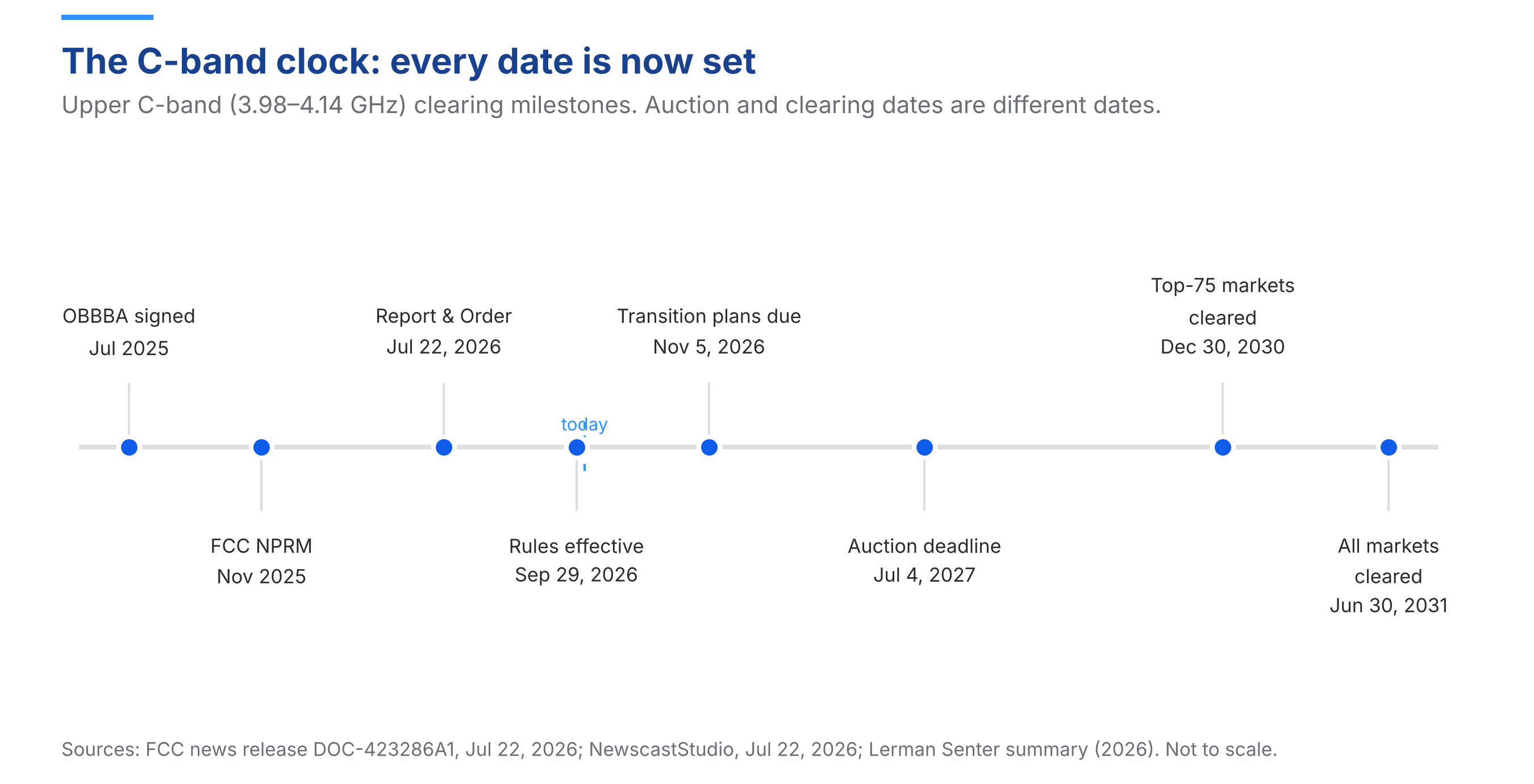
Figure 1. Upper C-band clearing milestones. FCC news release DOC-423286A1, 22 July 2026; NewscastStudio; Lerman Senter. Not to scale.
Most of the conversation since has been about protocols. SRT or RIST? ST 2110 or MoQ? Those are real questions, and we will get to them. But they are the second question. The first is what the satellite transponder has been quietly doing for broadcast distribution for forty years, and what has to replace each of those functions when the feed moves to terrestrial IP.
Four jobs you never had to think about
A transponder is a dumb pipe in the best sense. It did four things, and it did them without a configuration screen.
It gave you a deterministic path. The signal went up, the signal came down, and the delay was the same every time, within microseconds. No routing decisions, no congestion, no "sometimes."
It gave you fan-out for free. One uplink reached every dish in the footprint. Adding the hundredth receive site cost the same as adding the first: nothing.
It gave you a predictable bill. Transponder capacity was a fixed lease. The cost did not change when the audience grew or when a storm hit.
And it gave you one party to call. If the feed was down, the satellite operator owned the problem end to end.
Every one of those is a property of the network, not of the video format riding on it. That is why "which protocol" is the wrong first question. A team leaving satellite is not shopping for a new video format. It is shopping for a network that reproduces those four properties on the ground.
What each job becomes on terrestrial IP
The deterministic path becomes a measured path. The public internet does not promise latency or loss on any route; it promises best effort. The substitute is a network operator who measures every path continuously, runs more than one of them, and steers traffic before a degradation becomes a dropout. Our own Media Substrate runs diverse paths under every feed and merges them with time-aligned de-duplication; in our own blackout test, when one path was taken completely dark, the merged output lost nothing. Our median latency runs about 1.7 times the fiber-path floor, and 1.2 times on the best corridors. Those are our figures from our network, and every operator you evaluate should be able to give you theirs.
Fan-out becomes a relay architecture. On IP, every receive site is a separate stream unless something in the network replicates the feed close to the edge. That replication is what CDNs do for ABR video. For professional distribution, where endpoints are affiliates and MVPDs rather than phones, the replication has to happen at a protocol layer that preserves the feed's timing and quality. This is where Media over QUIC enters, and we will come back to it.
The predictable bill becomes a billing model you have to read carefully. On any usage-billed network, a bad network day, with retransmissions and failover traffic, can change the invoice. Our Media Substrate is metered by tenant and flow at standard rates, with egress billed separately. Whatever provider you pick, ask in writing what happens to the bill when a path fails.
One party to call becomes a question of who owns the network. If your transport provider rents its paths from someone else, the person you call cannot fix the path. Ask whether the provider runs its own autonomous system and controls its own routing. If not, you have added a layer, not replaced one.
The spectrum picture, for context
The upper C-band auction follows the 2021 lower C-band auction, which cleared 280 MHz between 3.7 and 3.98 GHz and raised about 81 billion dollars. The new order creates a contiguous 440 MHz "super band" from 3.7 to 4.14 GHz, leaves a 20 MHz guard band from 4.14 to 4.16 GHz, and keeps 4.16 to 4.2 GHz for satellite. Incentive payments to clear the band are smaller than last time: about 5.6 billion dollars to SES, 504 million dollars to Eutelsat and 189 million dollars to Telesat, per the FCC's final order as reported by Via Satellite, against 9.7 billion dollars in the prior round.
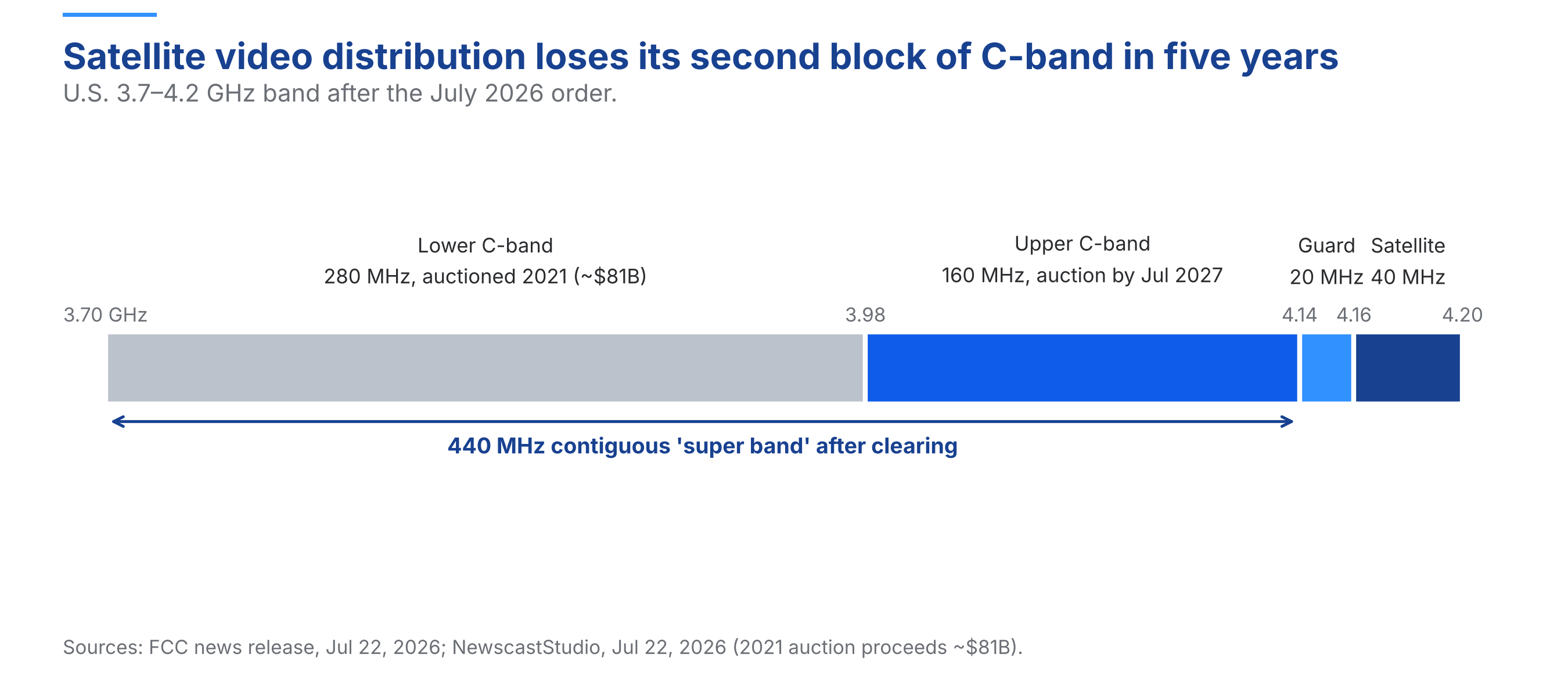
Figure 2. The U.S. 3.7 to 4.2 GHz band after the July 2026 order. FCC and NewscastStudio.
The practical meaning is that satellite capacity for video distribution is shrinking for the second time in five years, and what remains will be more contested. Disney's David Johnson, speaking at NAB in April, said that "there is not one silver bullet solution that gives us what we have today." He was right. The replacement is a system, and the system has to be designed.
Where MoQ fits, and where it does not yet
Media over QUIC is the IETF's effort to standardize low-latency media transport over QUIC with native support for relays. The transport draft reached revision 22 on October 1, and the working group's milestone is to request publication in December. It is not an RFC yet. Seven implementers have committed to the October interop event, and Red5 counted eleven announced MoQ demonstrations for IBC in September, with Zattoo and Netskrt among others showing their own.
The property that matters for distribution is the relay. A MoQ relay takes one incoming track and serves many subscribers without the publisher sending the feed once per subscriber. In our own test with four relays, one relay distributed sixteen times as much video while consuming the same backbone capacity as serving a single viewer. That is fan-out moving into the network layer, which is the transponder's second job coming back.
Two cautions. First, MoQ itself guarantees neither latency nor the absence of dropped frames; it gives the network a better tool, and the network still has to be good. Second, the latency case is strongest at the low end. Zattoo's IBC prototype cut latency by more than 80 percent against its 10 to 13 second production ABR path, targeting about two seconds. For affiliates and MVPDs that is a meaningful gain. For a service already at five seconds with no plan to go lower, CDN77's Michal Hošna put it plainly: MoQ currently "would only bring integration churn." Know which case you are in.
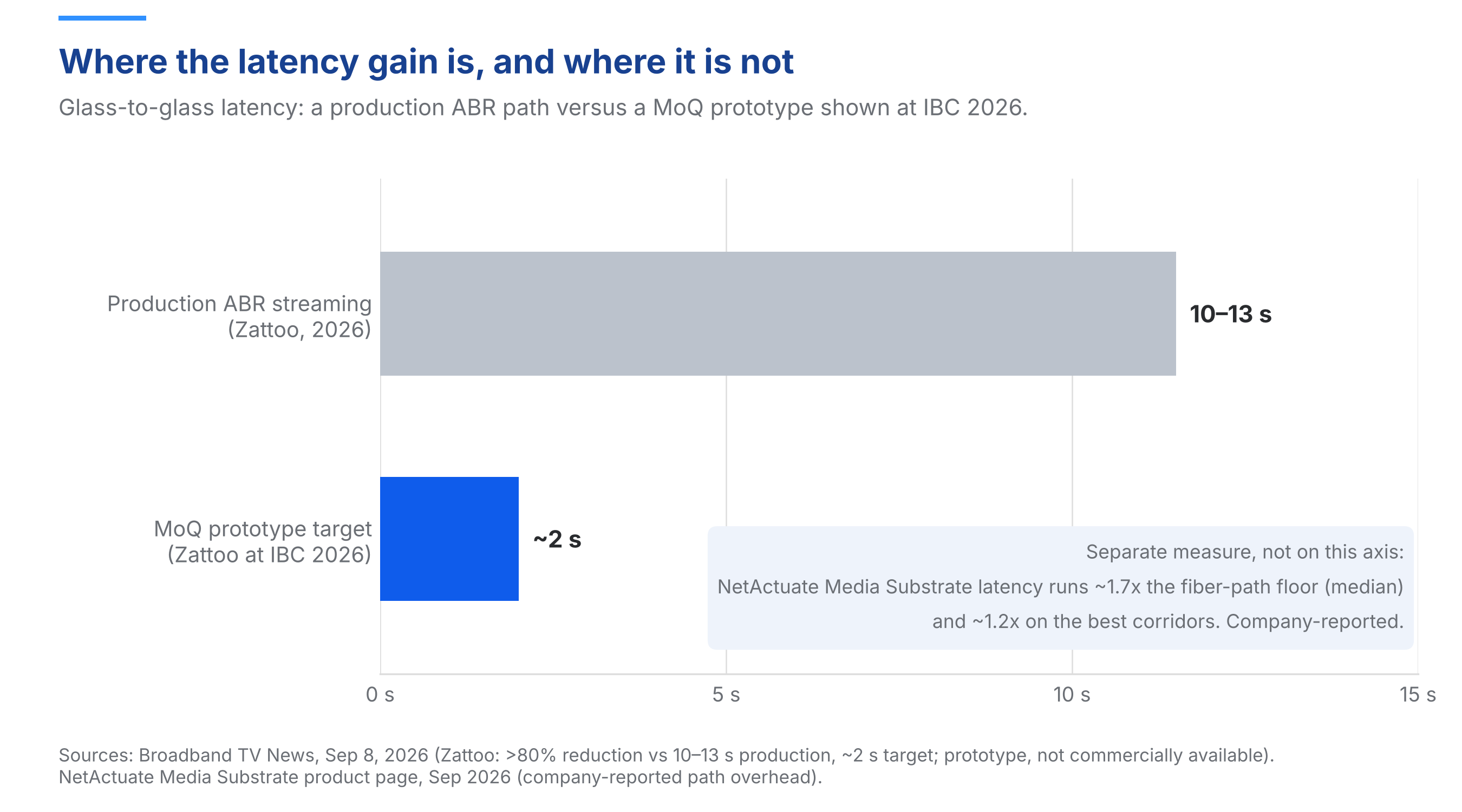
Figure 3. Glass-to-glass latency, production ABR versus a MoQ prototype (Zattoo via Broadband TV News, 8 September 2026). NetActuate's path-overhead figures are company-reported and shown separately.
What to do before November 5
The satellite operators' transition plans are due November 5. Your plan should be due to yourself before that, because once their plans are public, the capacity and the integrator calendars will fill.
Inventory every feed still on C-band and classify it: contribution, primary distribution, or backhaul. Each has a different latency budget and a different fan-out shape.
For each class, write down the four transponder properties and the terrestrial substitute you will accept. Measured path with what loss and latency bound? Fan-out through what mechanism, and at what cost per additional endpoint? What billing model, and what happens on a bad day? Who owns the network, and what is their escalation path?
Test the substitute with the protocol you actually run today. What you test is what you would run. Protocol migration can come later, on its own schedule, once the network under it has proved itself.
The dates are set. The protocol debate is interesting. The network is the decision.

