
For two years "sovereign cloud" lived mostly in policy papers. In 2026 it turned into procurement mechanics with dates and point scores attached. That changes the question an infrastructure buyer has to answer. It is no longer whether to run a controllable stack inside the region. It is how fast one can be stood up, and what "controllable" has to mean at the hardware and control-plane layers for the answer to count.
This post walks through what changed, what sovereignty requires below the marketing layer, and why the workloads forcing the decision first are the ones that cannot tolerate a far-away region: real-time video, game servers, DNS, and now inference.
What changed in 2026
Three things, in order of hardness.
Money. Gartner forecast in February that European spending on sovereign cloud infrastructure-as-a-service would rise from 6.9 billion dollars in 2025 to 12.6 billion in 2026 and 23.1 billion in 2027. Worldwide, Gartner puts 2026 sovereign IaaS at 80.4 billion dollars. By Gartner's breakdown, about 20 percent of the forecast increase is workloads moving to local providers and 80 percent is new or modernized workloads being placed sovereign from the start. Forecasts, not invoices, but the direction is not in dispute.
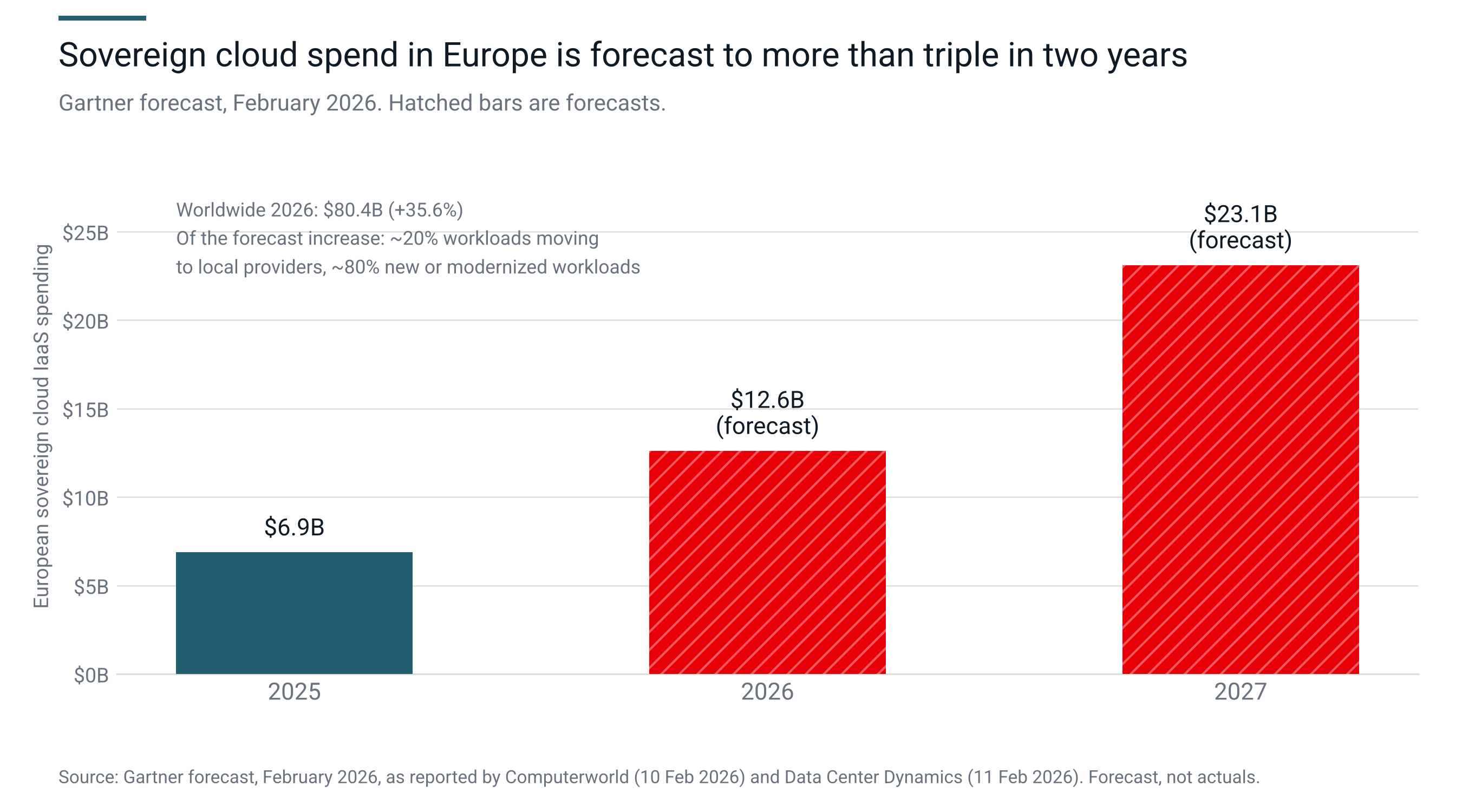
Figure 1. European sovereign cloud IaaS spending, Gartner forecast, February 2026, as reported by Computerworld and Data Center Dynamics.
Law. The European Commission proposed the Cloud and AI Development Act on 3 June 2026. It sets four assurance levels for public-sector cloud procurement, from self-assessment at level 1 to third-party audit at levels 2 through 4 of where staff are located, whether provider data is used to train AI, software supply-chain security, and EU cybersecurity certification at "substantial" or higher. It generally limits public bodies to EU-established providers. The European Parliament referred the file to a joint ITRE/IMCO committee on 17 September. On 23 September the European Economic and Social Committee adopted its opinion, asking that "Union added value" weighting in public procurement rise from 15 to 40 points out of 120 and that SMEs receive 25 percent of relevant public contracts. None of this is law yet. All of it is moving.
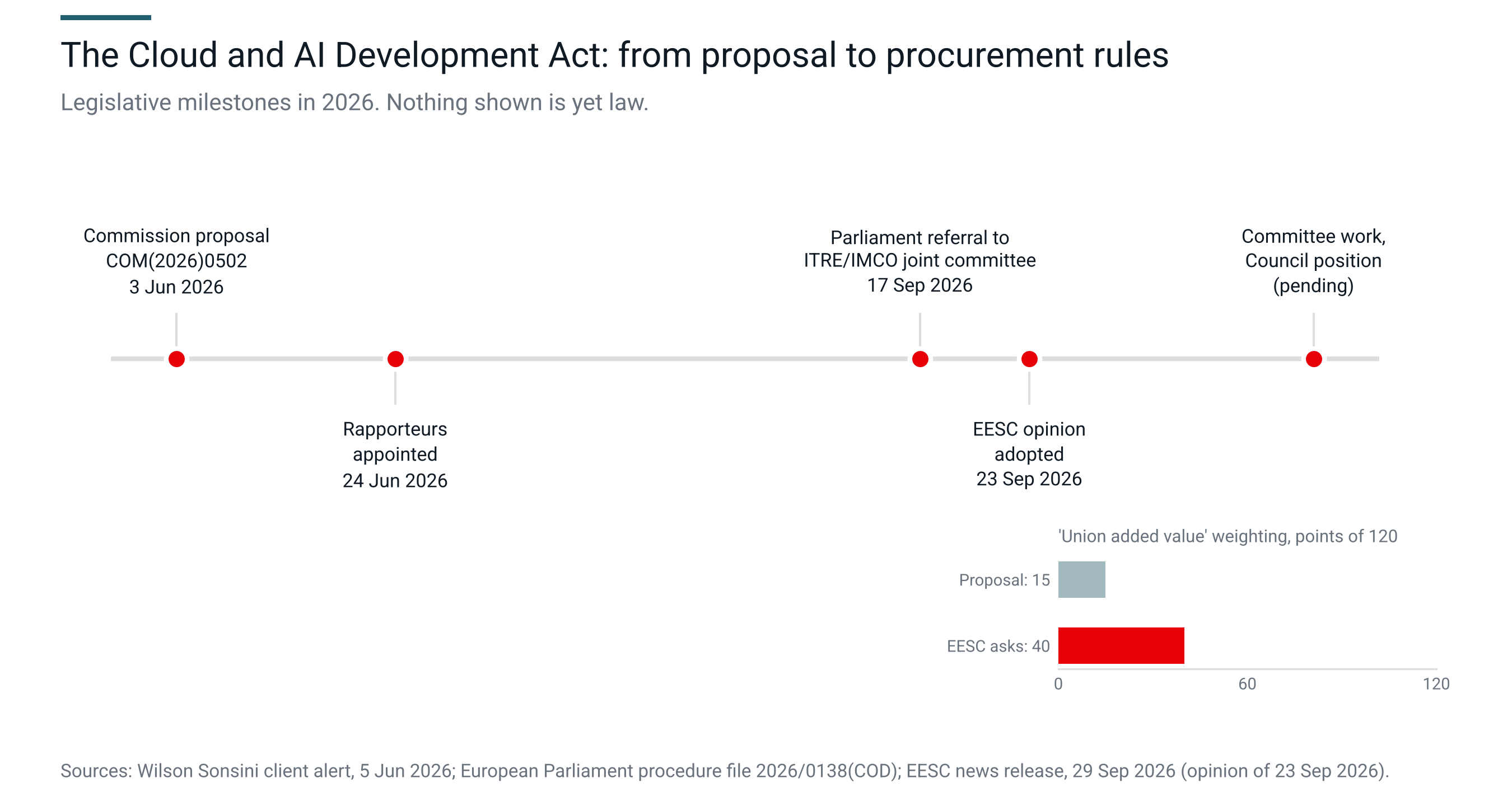
Figure 2. Cloud and AI Development Act milestones in 2026 and the EESC's proposed change to procurement weighting.
Workloads. Gartner's August forecast has inference spending on AI-optimized infrastructure surpassing training in 2026, at 23.3 billion dollars against 19 billion, and reaching 59 percent of the total in 2027. Training can run anywhere with cheap power. Inference runs next to the user, with latency and data residency both in play. It is the first AI workload class with the same placement constraints that game servers and live video have always had.
What "sovereign" has to mean at the infrastructure layer
Residency is where the servers sit. Sovereignty is who can run them, who can compel access to them, and whose control plane they answer to. A rack in Frankfurt operated through a control plane headquartered elsewhere is resident. It is not sovereign in the sense the assurance levels describe.
Working down the stack, the tests look like this.
Hardware ownership. Who holds title to the servers and the network gear, and under which jurisdiction is that entity established?
Network path. Does the traffic between your sites and your users cross a backbone the provider owns and routes, or one it rents? A rented path has a third owner who can change terms.
Control plane. When you provision a server or a cluster, which software issues the instruction, where does it run, and who maintains it? If the answer is a proprietary service in another jurisdiction, the control plane is the dependency that undoes everything below it.
Staff and support. Who has administrative access, and where are they?
Exit. Can you take the workload elsewhere without rewriting it? Open interfaces and open-source control planes are what make exit real rather than contractual.
The CADA assurance levels formalize roughly these tests. The useful part for an engineer is that they are checkable before procurement, not after an incident.
Why time-to-cluster is the new metric
Here is the trap. A fully sovereign stack built by hand (bare metal procured, operating systems installed, a control plane deployed and hardened, networking configured) takes weeks per site. The workloads driving the demand do not have weeks. A game launch needs servers in a new region before launch day. A streaming service needs capacity near a live event. An inference endpoint needs to be where the users are before the product ships.
So the practical question becomes: how fast can a controllable, in-region cluster exist? That is what we worked on with OpenNebula under the EU's IPCEI-CIS program. As of OpenNebula 7.4, i3D.net Bare Metal Cloud is a native provider in OneForm, OpenNebula's cluster-provisioning service. You pick the location, the server configuration, and the quantity. OneForm provisions the servers, installs OpenNebula, and hands back a working cluster. In our testing that takes under ten minutes. That timing is our measurement; OpenNebula has confirmed the integration but has not published its own timing.
The point is not the integration. The point is what it demonstrates: a stack where nothing depends on a control plane you did not choose and do not run can also be a stack that stands up in minutes. Those two properties have usually been in tension. The integration is one piece of evidence that they need not be.
The workloads forcing the decision
Real-time video and game servers never had the option of a distant region. Independent routing research by James Bensley found that our network reaches 65 percent of the internet's IPv4 prefixes without crossing a Tier-1 transit network, a figure we track because latency-sensitive customers measure every hop. When SIDN, the operator of the .nl domain, announced in March that it would host one of its authoritative DNS anycast platforms with us, the stated reasons were a change in its former provider's bare-metal services and a preference for a European foundation. DNS is as latency-sensitive and as sovereignty-sensitive as workloads get.
Inference is now joining that list. Positron AI, whose Atlas inference systems we operate in our European data centers under a partnership announced in June, closed an 875 million dollar round on 10 September and named us as an Atlas production customer alongside Jump Trading. We mention it because it illustrates inference becoming a placement decision: tokens generated in-region, on hardware whose ownership and control plane pass the tests above.
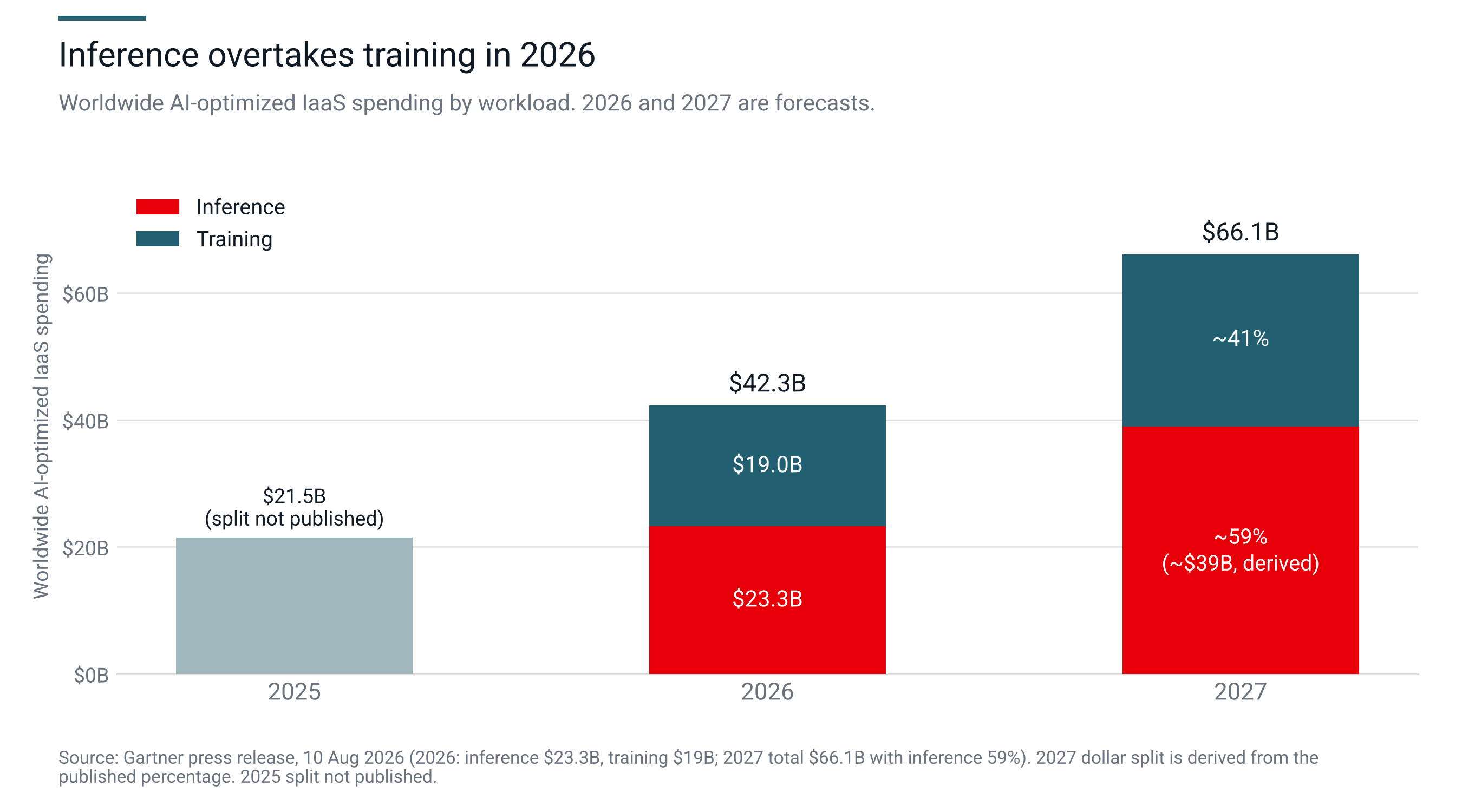
Figure 3. Worldwide AI-optimized IaaS spending by workload, Gartner, 10 August 2026. 2027 split derived from the published percentage.
What to do now
If you are in the public sector or a NIS2 high-criticality sector, read the CADA assurance levels against your current providers and write down which level each one could pass today. Do it before the Parliament's committees finish, not after.
For any latency-sensitive workload, measure your current time-to-cluster for a new region. If the answer is weeks, that is the number to fix, independent of sovereignty.
Then run the five tests above on every candidate stack. A provider that passes on hardware and fails on control plane is not sovereign. A provider that passes on both and takes a month to provision is not useful. Both tests have to be passed, and in 2026 both can be.

