TL;DR: FAST programming volume is now growing faster than channel count, which means the hard problem has moved from launching channels to running ads reliably inside them. Server-guided ad insertion (SGAI) is one architecture built for that job, and the 2026 World Cup gave us one of the first large-scale measurements of how it holds up. Our numbers from that deployment are encouraging. The gaps are real.
The channel count stopped being the story
According to Nielsen's Gracenote Data Hub, the July 2026 count put the number of FAST channels worldwide at 2,172, up 17.5% in a year. That is still growth, but look at what grew faster. Sports channels grew 13.8% while sports titles grew 31.2% and games and events grew 37.5%. News and commentary channels grew 52.9%, per The Desk's breakdown of the same data.
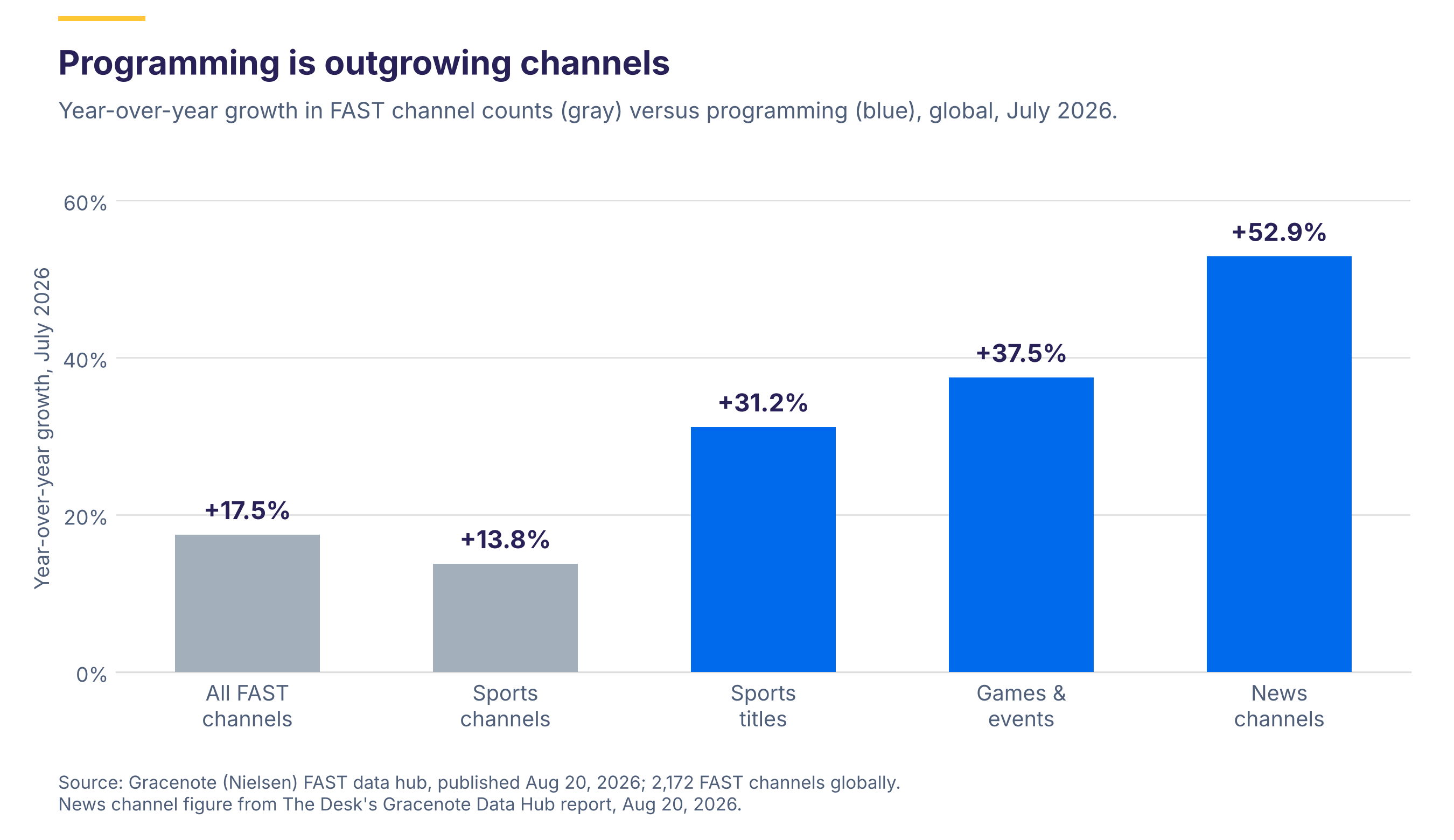
Figure 1. Year-over-year growth in FAST channel counts versus programming, July 2026. Gracenote via Nielsen, 20 August 2026; news channel figure via The Desk.
Read that as an operations chart, not a market chart. Each channel is carrying more programming, more live events, and more ad breaks per hour than it did a year ago. A sports FAST channel in 2026 is not a loop of highlights. It is a live schedule with pod structures that change by event, rights holders who want make-goods, and viewers who expect the ad break to behave like television.
Our own Video Developer Report, published in September with 486 respondents across 94 countries, shows where the revenue sits. AVOD leads monetization at 69% of respondents. Linear ads are at 67%. FAST and SVOD tie at 54%. Pause ads are at 45%. Those are our survey numbers, so treat them as a view of our respondent base rather than the industry. But the shape matches Gracenote's: advertising is the primary engine, and it runs inside live and linear workflows.
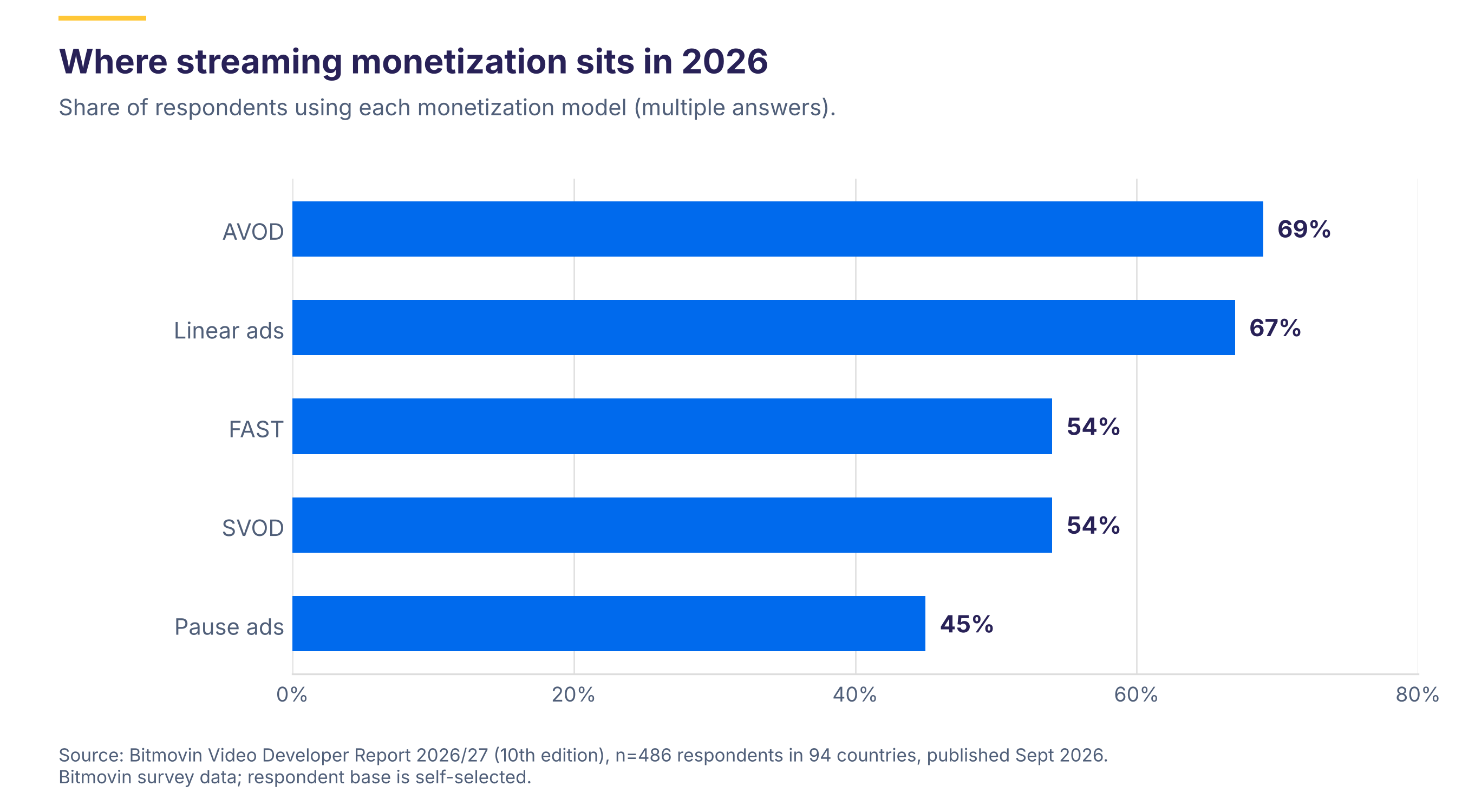
Figure 2. Monetization models in use, Bitmovin Video Developer Report 2026/27 (n=486). Bitmovin survey data.
When ads are the revenue and the channel is live, ad performance and playback performance become the same operational problem. A missed ad is lost revenue. A stalled ad is a lost viewer. Nobody in the chain can fix one without touching the other.
Three generations of ad insertion
Client-side ad insertion (CSAI) asks the player to pause content, fetch an ad from an ad server, play it, and resume. It is simple and it is blocked by ad blockers, inconsistent across devices, and prone to buffering at the transition.
Server-side ad insertion (SSAI) stitches ads into the content stream before it reaches the player, so the viewer receives one continuous stream. It defeats ad blockers and smooths transitions. The cost is that every viewer needs a personalized manifest, which means a stitching server generating and maintaining per-session manifests for the entire audience. At World Cup concurrency, that is a large, stateful fleet whose capacity must be provisioned for the peak, and whose failure modes show up as every viewer's problem at once.
Server-guided ad insertion (SGAI) splits the difference. The server publishes one shared manifest for everyone, with markers (HLS Interstitials, or the DASH equivalent) that tell the player where ad opportunities are. The player resolves each opportunity at the moment of playback by calling the ad decisioning service. The ad is personalized, the content manifest is shared, and the stitching fleet goes away. Playback stays continuous because the player, not a remote server, manages the transition.
The trade is that the player has to be good at this. SGAI moves responsibility to the client, and the client runs on hundreds of device models with different decoders, firmware, and ad SDK behaviors. The architecture is cleaner. The engineering is not free.
What a World Cup run looks like
RTBF, the Belgian public broadcaster, ran its Auvio platform on standards-based SGAI through the 2026 World Cup, with our player and the Ad Insertion Platform's AdBlendr handling ad decisioning, Red Bee Media as systems integrator, Dotscreen as application developer, and RMB on ad sales. The deployment was an IBC 2026 Innovation Awards finalist and was Highly Commended at the CSI Awards. The deployment is independently confirmed; the performance figures that follow are ours, and nobody outside the project has yet published their own.
Over the tournament the platform logged more than 50 million plays and more than 80 million ad impressions. Successful ad plays and viewability stayed in the 90 to 98% range. Ad completion was around 90%. Median startup time stayed under one second. Impressions per play were about four on Android TV, about three on iOS, and just over one on web.
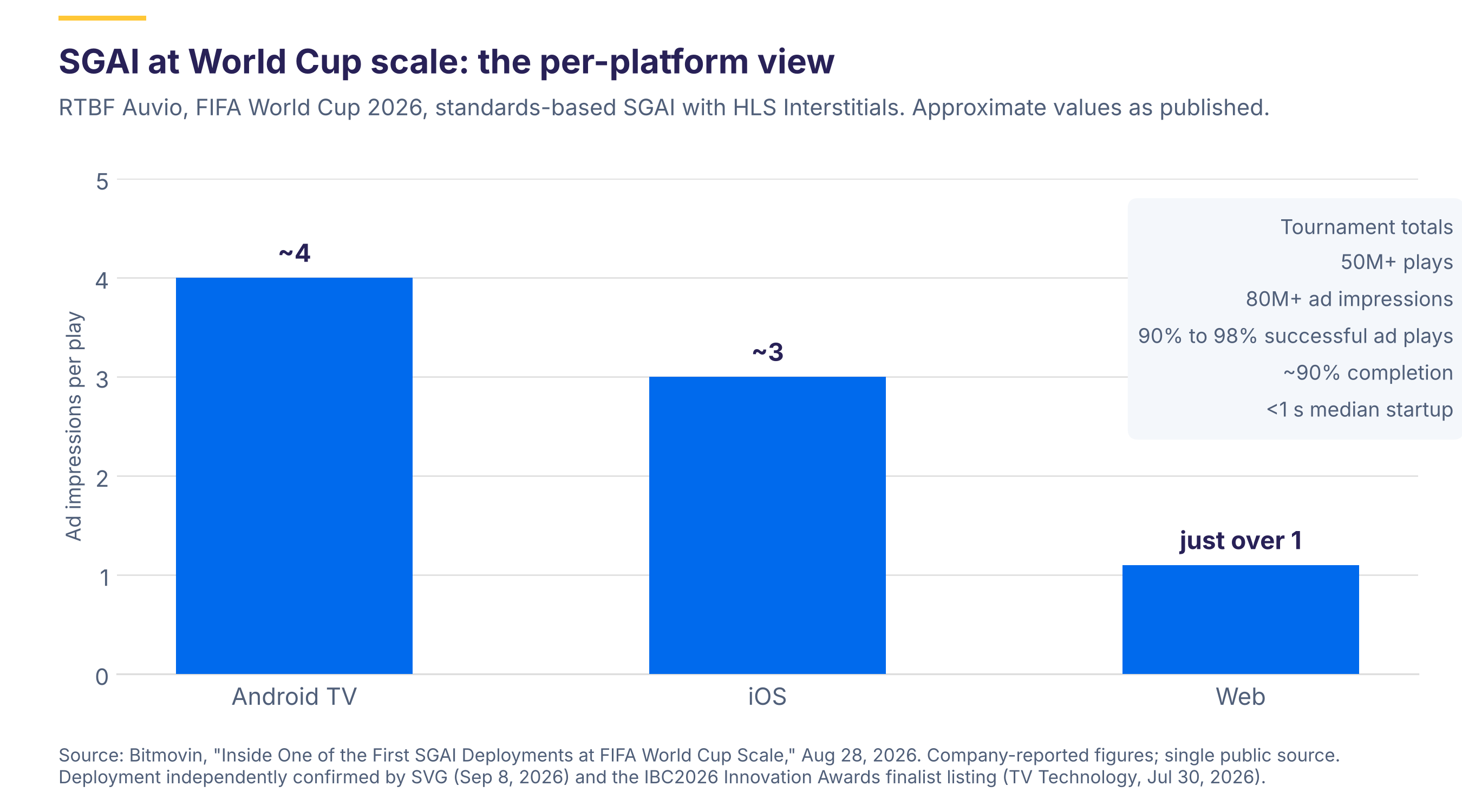
Figure 3. RTBF Auvio SGAI deployment, FIFA World Cup 2026: ad impressions per play by platform. Bitmovin-reported figures, 28 August 2026.
That last row is the one worth studying. The spread between platforms is not a defect in the ad logic. It reflects session length and viewing behavior on each device: TV sessions run longer and cross more breaks. But it also shows why "SGAI works" is not a single claim. It works per platform, and the per-platform number is the one to monitor.
What to instrument
If you are moving a live or FAST service to SGAI, the measurements that matter are not the ones you tracked under SSAI.
Fill rate per break per platform. Under SGAI, an unfilled opportunity is a player-side event, so it can be measured where it happens rather than inferred from a stitching log.
Successful ad play rate. A decision that returns an ad the player cannot render is a failure the ad server never sees. Only the player knows.
Completion rate by ad position. Early-pod drop-off on one device type usually points at a decoder or SDK issue, not at creative.
Startup and transition time. The viewer experiences the ad break as part of playback. If the interstitial adds a second of black, the player is doing SGAI wrong even if every impression is counted.
Our survey found only 9% of respondents can find the root cause of a quality-of-experience issue within an hour, and 29% take 12 to 24 hours. Under SGAI, where ads and playback are one system, that lag applies to revenue as well as to quality.
What is not solved
Device coverage. HLS Interstitials are well supported on Apple platforms and in modern web and Android players, but set-top boxes and older smart TVs vary. Any SGAI plan needs a fallback for devices that cannot resolve interstitials, which usually means running SSAI in parallel for a long tail.
Measurement standards. Because the player resolves each ad, viewability and impression counting happen client-side. Reconciling those counts with sell-side systems built around server logs is work, and the industry does not yet have a single agreed method.
Adoption. Our survey asked about SGAI, and the share of respondents with it in production is small; we have found no independent adoption statistic to set beside our own. The fair reading is that SGAI is early, with one large live-sports deployment now measured.
The point
FAST operators spent four years learning to launch channels. The next four are about operating them, and operating a FAST channel means operating its ad breaks. SGAI makes the ad break a first-class part of playback rather than a process that runs beside it. Our measurements from RTBF say it can hold at live-sports scale on the platforms where it is well supported. The gaps say the work now is in the player and in measurement, not in the manifest.

