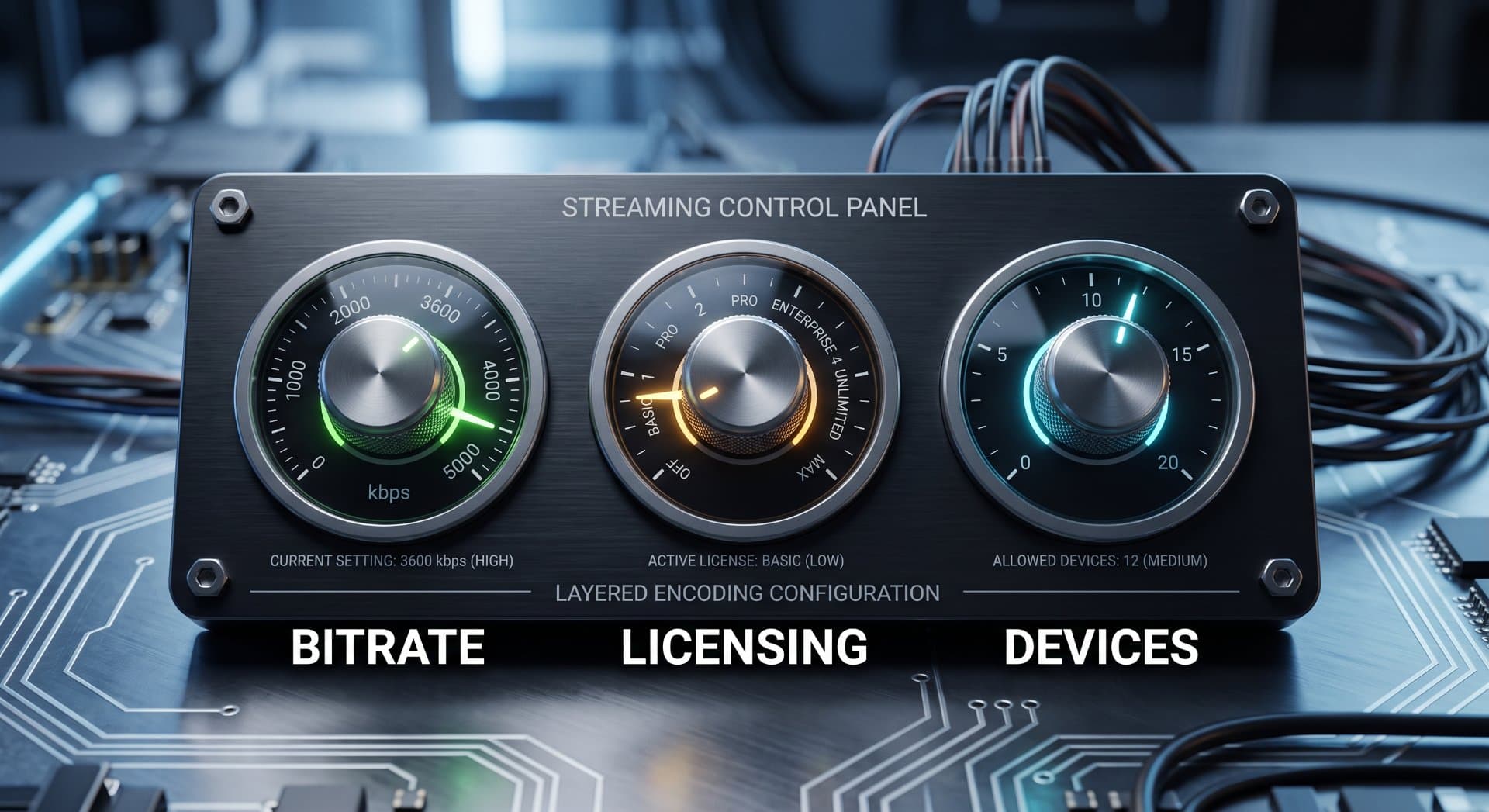
For twenty years the codec question had one axis. Each new generation promised roughly half the bitrate of the last, and the only debate was when the device base would be ready to receive it. Two events in the past sixty days show that the question has grown two more axes, and that an operator who plans on bitrate alone is planning with a third of the picture.
The first event is a court docket. The second is a shelf of set-top boxes in Brazil.
What happened in Europe
On 3 August, Broadband TV News reported that Disney+ had removed 4K UHD and HDR from its Premium tier in eleven European countries, following injunctions granted to InterDigital by the Unified Patent Court over HEVC-related patents. Dolby Vision and 3D had been withdrawn earlier in the year. The affected markets were Austria, Belgium, Denmark, Finland, France, Germany, Italy, the Netherlands, Portugal, Romania and Sweden. By 25 September the same outlet reported a third injunction granted earlier that month. Premium subscribers in France were still paying €15.99 for a tier without HDR or Dolby Vision, and the consumer group UFC-Que Choisir had issued a formal notice. Disney restored 4K by switching to VP9. HDR and Dolby Vision remained off in the affected countries at the time of writing.
The details of that dispute belong to the parties. The lesson does not. A premium tier that millions of households paid for was switched off, not because the network could not carry it or the encoder could not produce it, but because the legal weather around one codec changed. Bitrate efficiency was never the constraint. Licensing predictability was.
That is the second axis. It has always existed, and HEVC's fragmentation across multiple patent pools has made it hard to read for a decade. What is new is that the cost of misreading it is now visible to subscribers.
What happened in Brazil
Brazil's presidential decree of 27 August 2025 made DTV+ (TV 3.0) the country's next-generation terrestrial broadcast system, with VVC as the base codec and MPEG-5 LCEVC as a mandated enhancement layer. Globo began DTV+ broadcasts in Rio de Janeiro, São Paulo and Brasília in June 2026, in time for the World Cup. The first set-top boxes went on sale on 8 June at about R$685 to R$695, according to Canaltech. By 28 September, Meio & Mensagem reported more than 10,000 converter boxes sold, with the first stock gone within days and integrated TVs expected from mid-2027.
The engineering target behind the launch is a 6 MHz terrestrial channel carrying 4K HDR at roughly 10 Mbps. In test material we published in August, VVC alone needed 16.58 Mbps for the 4K HDR test sequence and VVC with LCEVC needed 7.59 Mbps, a 54% reduction. Triveni Digital, which supplied Globo's signalling chain, has independently reported the 7.59 Mbps result; the baseline and the percentage are ours. The figure comes from one test set and should be read as a test result, not a guarantee across all content. The range we reported at SET Expo in August for real-time broadcast scenarios was 35 to 50%.
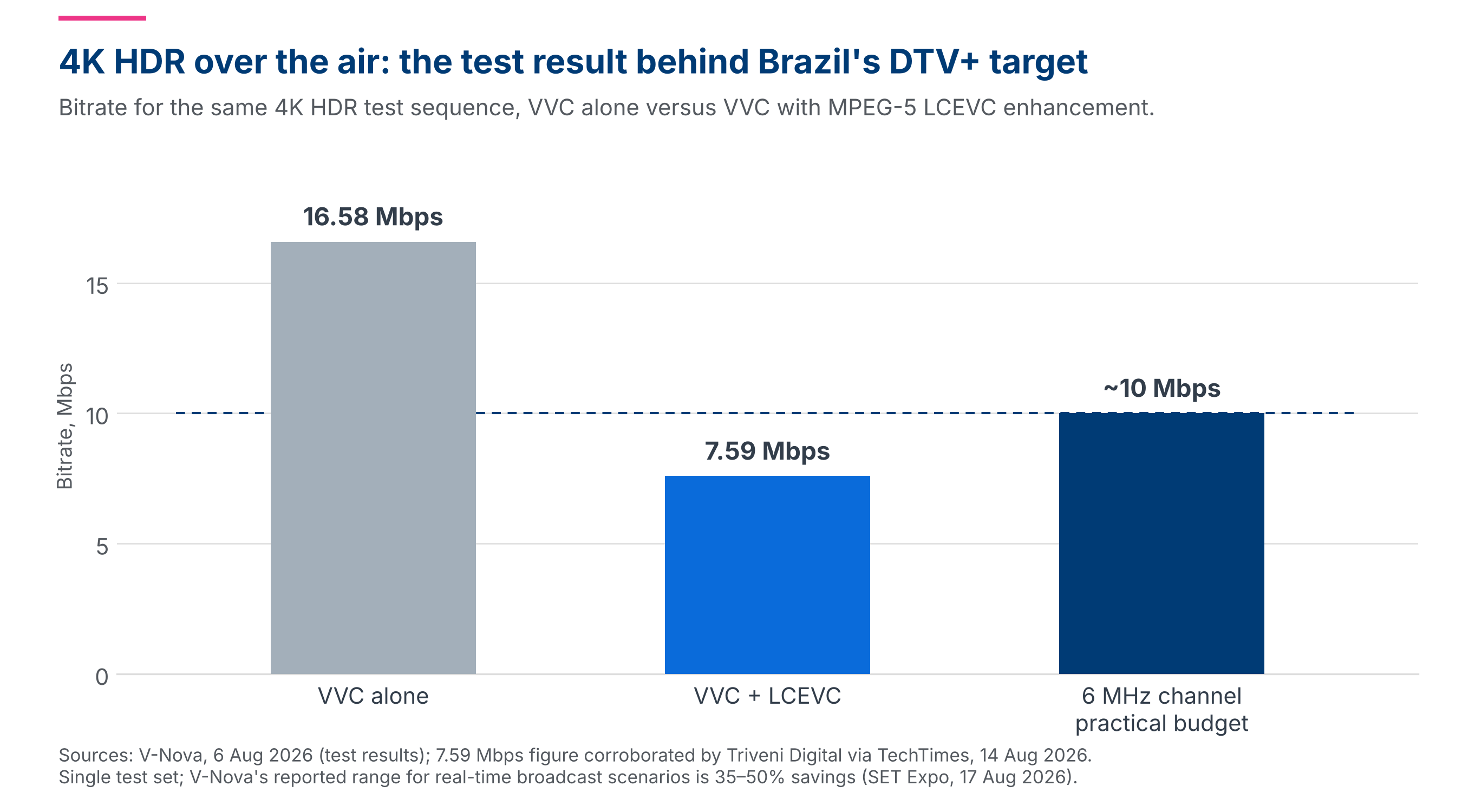
Figure 1. Bitrate for the same 4K HDR test sequence, VVC alone versus VVC with LCEVC. V-Nova test results, 6 August 2026; the 7.59 Mbps figure is independently reported by Triveni Digital via TechTimes, 14 August 2026.
The point for this discussion is not the number. It is the timeline. A national standard went from decree to receivers in shops in under ten months, and the device makers (Intelbras, Century and Aquario for set-top boxes, Hisense for TVs that have yet to ship, on Amlogic and Realtek silicon) built to a mandated baseline. That is the third axis: device reach. A codec decision is a decision about which chips will be in which living rooms, and when.
Why the three axes pull against each other
Bitrate efficiency, licensing predictability and device reach are not independent. Each gain on one axis tends to cost something on another.
The newest codec is the most efficient and the least deployed. Bitmovin's developer survey in September put VVC at 5% of respondents in production against 85% for H.264. Among the first mobile chipsets with hardware VVC decode, MediaTek's Dimensity 9600 Pro, reached phones in China in late September. An operator who standardizes on VVC today buys bitrate efficiency and waits several years for device reach to catch up, while carrying H.264 or HEVC in parallel.
The most deployed codec is the least efficient and, in H.264's case, has the longest-settled licensing history. HEVC sits between them: well deployed, materially more efficient than H.264, and the codec whose licensing is spread across several pools and independent holders. The Disney+ episode happened on that axis.
So the honest version of the codec question is not "what do we migrate to?" It is "which combination of base codec and enhancement gives us the bitrate we need, on the devices we have, with licensing we can forecast?"
Where an enhancement layer fits
MPEG-5 LCEVC (ISO/IEC 23094-2) is a standardized enhancement layer that sits on top of any base codec. The base codec, H.264, HEVC, AV1 or VVC, carries a lower-resolution picture; LCEVC carries the residual detail needed to reconstruct the full resolution. The decoder reassembles the two. Because the heavy lifting stays in the base codec, LCEVC runs in software on existing devices and in silicon where it has been adopted.
That architecture changes the trade-off on each axis. On bitrate, published evaluations on AVC or HEVC bases typically show 30 to 40% savings for OTT content, and the Brazil test shows the effect on top of VVC. On device reach, an operator can add LCEVC to an H.264 or HEVC service through a player update rather than a hardware cycle; we publish integrations for GStreamer, Shaka Player, ExoPlayer, VLCKit, dash.js and others. On licensing, LCEVC has a single published licensing program with rates linked to service size or device volume, and caps.
Two caveats belong here. First, LCEVC is itself licensed. It is not free, and "predictable" is a different claim from "zero." Second, LCEVC would not have changed the facts of the InterDigital case, which concerned HEVC patents. An operator running HEVC with LCEVC on top is still running HEVC. The enhancement layer is a way to get more from the base codec you have chosen, not a way to avoid choosing one.
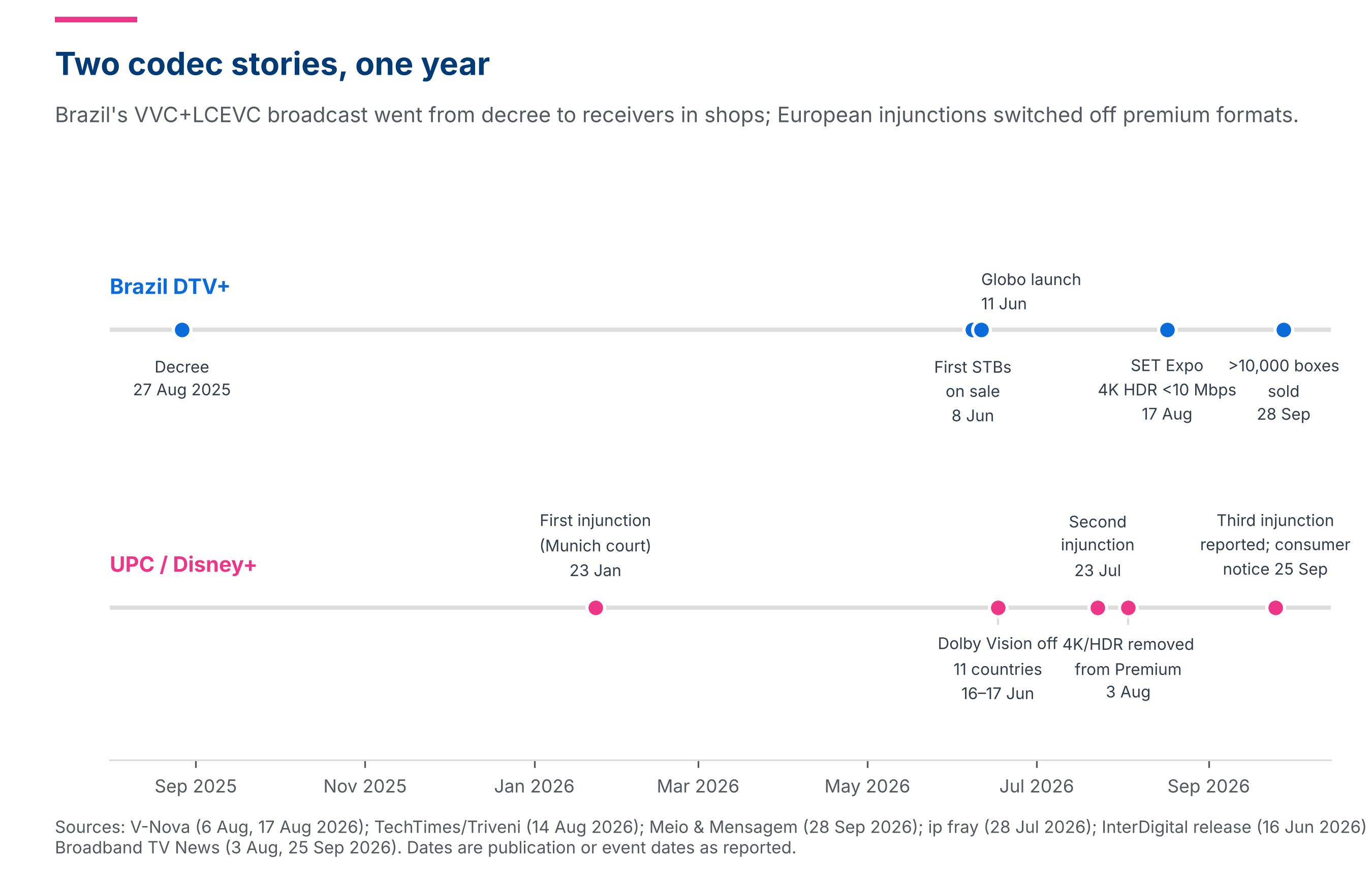
Figure 2. Brazil's DTV+ milestones against the European injunction sequence, August 2025 to September 2026. Dates are event or publication dates as reported by the sources listed on the chart.
The demand side keeps compounding
None of this would matter if traffic were flat. It is not. Ericsson's September update to its Mobility Report put global mobile data traffic above 220 exabytes per month in the second quarter of 2026, up 23% year on year, with video around three quarters of mobile traffic at the end of 2025. Every percentage point of bitrate efficiency is applied to a base that grows a quarter each year.
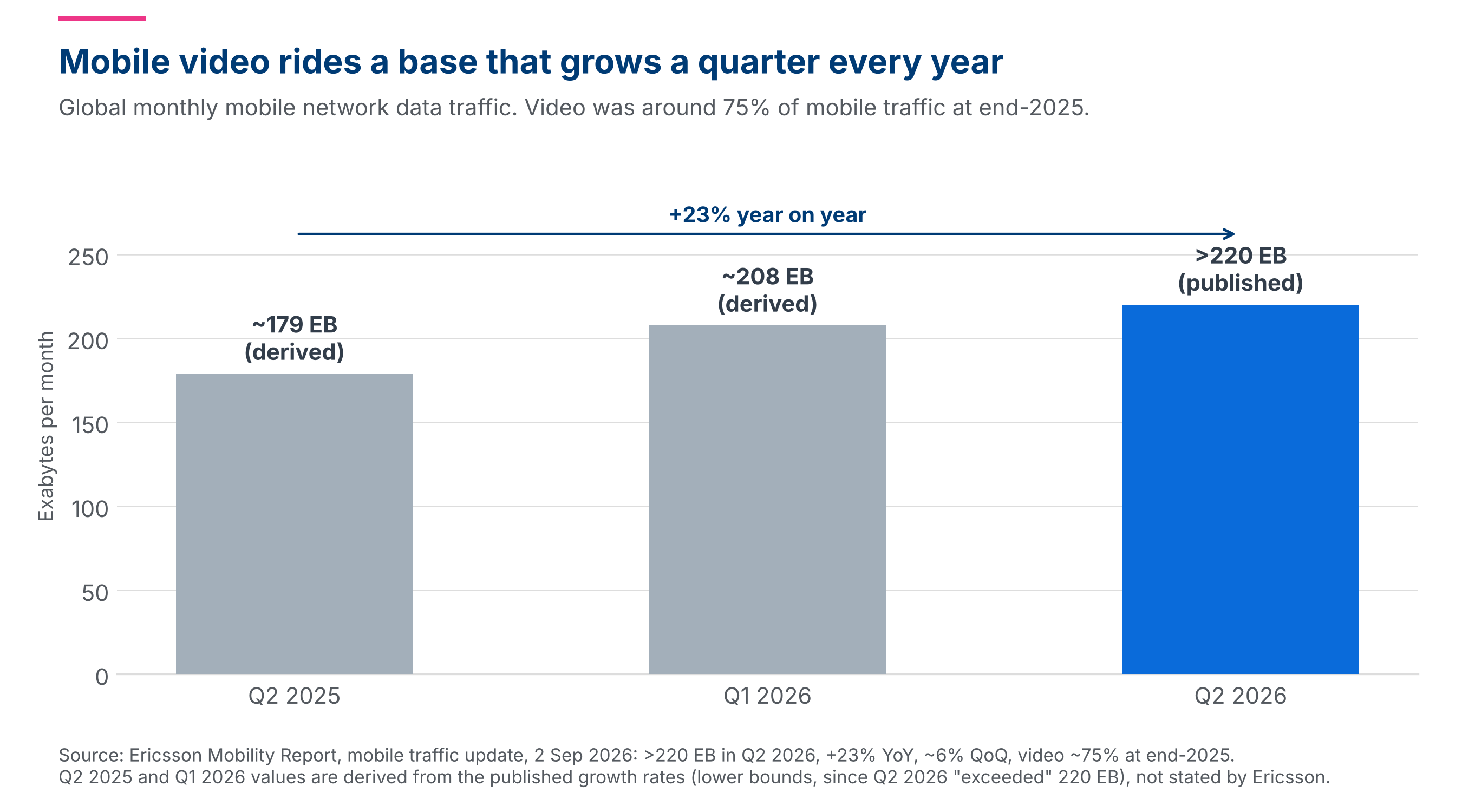
Figure 3. Global mobile network data traffic, Ericsson Mobility Report update, 2 September 2026. Q2 2025 and Q1 2026 bars are derived from published growth rates.
That growth is what makes a three-axis decision unavoidable. The bitrate axis cannot be ignored because the delivery bill keeps rising. The device axis cannot be ignored because the installed base turns over slowly. The licensing axis cannot be ignored because, as the past sixty days showed, it can switch a service off.
A practical way to run the decision
Start with the devices you serve today and will serve in three years, by codec capability. That is the constraint everything else works within.
Then take each candidate architecture and score it on all three axes with numbers, not adjectives. Bitrate: your own content, your own ladder, rate-distortion curves. Devices: the percentage of your installed base that can decode each option today and in each of the next three years. Licensing: the published rates, the number of licensing parties, and the exposure if any one of them changes terms.
Finally, ask whether the architecture lets you move the base codec later without a second device cycle. Brazil chose VVC plus LCEVC. A European OTT service might choose H.264 plus LCEVC today and HEVC or AV1 plus LCEVC later. The enhancement layer is the part that stays constant while the base moves underneath it.
Codec strategy has become a business decision. The business decision is to measure all three axes before committing to any one of them.

