The tournament had 104 fixtures. By the time those matches reached viewers through services MediaKind supported, they had become 1,738 match streams for more than 20 customers, across four cloud platforms, from HD to UHD with Dolby Vision and Atmos. Across those services, by our own count, more than 3 billion streams were delivered, with more than 20 million viewers watching at the same time at peak.
The number people remember is the last one. The number that explains the summer is the first ratio: 104 into 1,738.
Scale used to mean a bigger audience
For most of streaming's history, "scale" meant one thing. More viewers on the same stream. The engineering problem was concurrency: enough origin capacity, enough CDN capacity, enough headroom for the moment everyone pressed play at once. Important, well understood, and largely solved by throwing bandwidth at it.
The 2026 World Cup was not that problem. Or rather, it was that problem and a different one layered on top. Nielsen figures reported by Axios put more than 62.8 million US viewers on the final, the most-watched football telecast in US history, with Fox up 132% and Telemundo up 166% on the 2022 final. YouTube reported 27 million peak concurrent viewers for its coverage of the final. The audience was enormous. That was the familiar part.
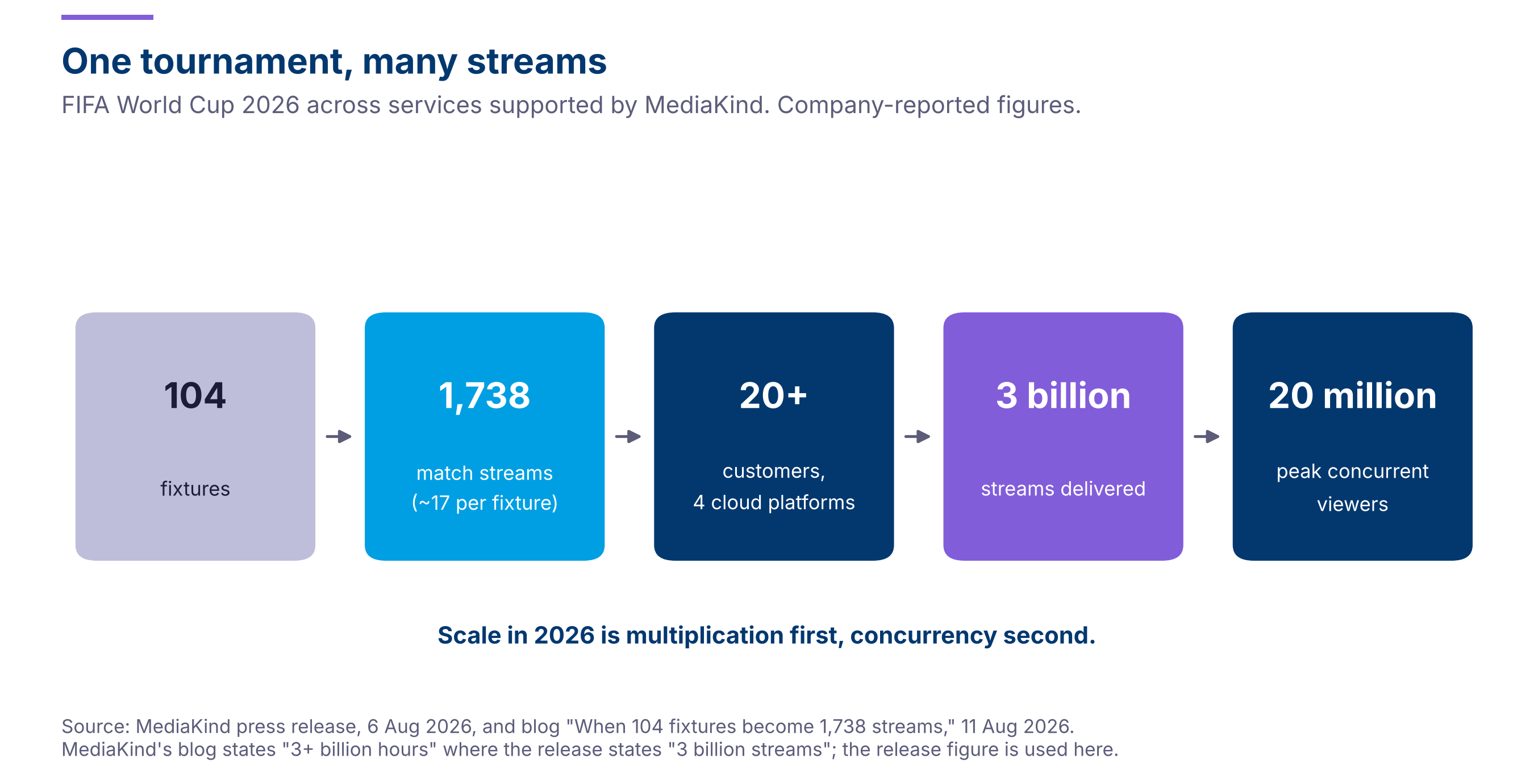
Figure 1. FIFA World Cup 2026 across services supported by MediaKind. Company-reported figures from the 6 August release and 11 August blog.
The unfamiliar part was multiplication. Each fixture became a different stream for each rights holder, each language, each territory, each device class, each ad market, each quality tier, and each latency target. Sixteen or seventeen streams per match, on average, every one of them a separate service that had to start on time, hold its latency, carry its own ads, and fail independently of the others.
That is a workflow and architecture problem before it is a bandwidth problem. Bandwidth was the easy part.
Where the audience went
NBCUniversal reported that 48% of its Telemundo World Cup audience came through streaming, against 30% in 2022, with 77.2 billion minutes consumed across its platforms, 79% more than the 2018 and 2022 tournaments combined. The final drew a streaming average-minute audience of 13.9 million on Telemundo's platforms, more than four times the 2022 final.
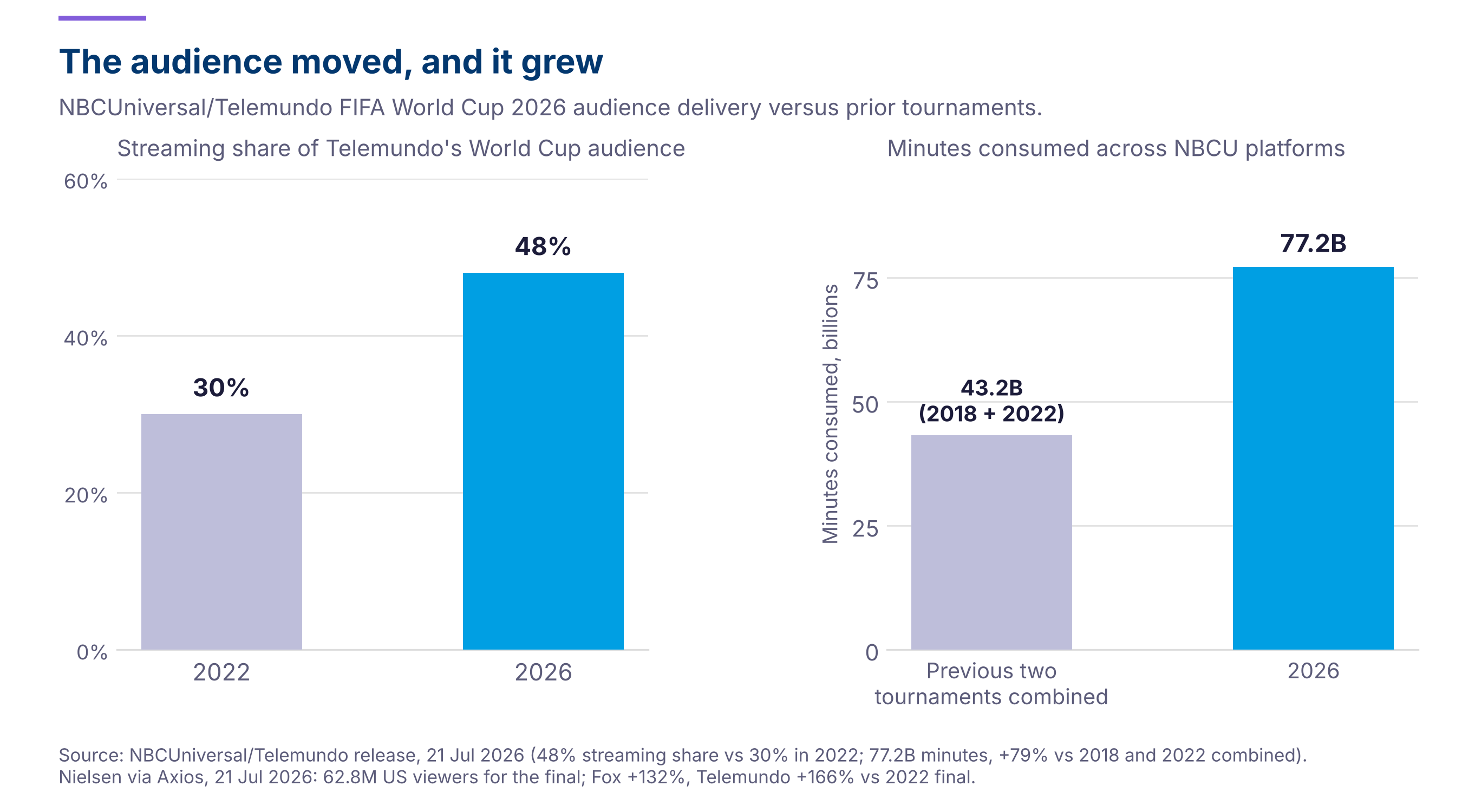
Figure 2. NBCUniversal/Telemundo World Cup audience delivery versus prior tournaments, 21 July 2026; Nielsen final-audience figures via Axios.
Set that beside Nielsen's The Gauge. In June 2026, the last edition before Nielsen recalibrates its methodology, streaming took 48.5% of US television time, broadcast 19.8% and cable 19.5%. YouTube alone was 13.5%, Netflix 7.9%. The World Cup did not create that shift. It arrived into it, and it set the expectation for what live streaming has to deliver.
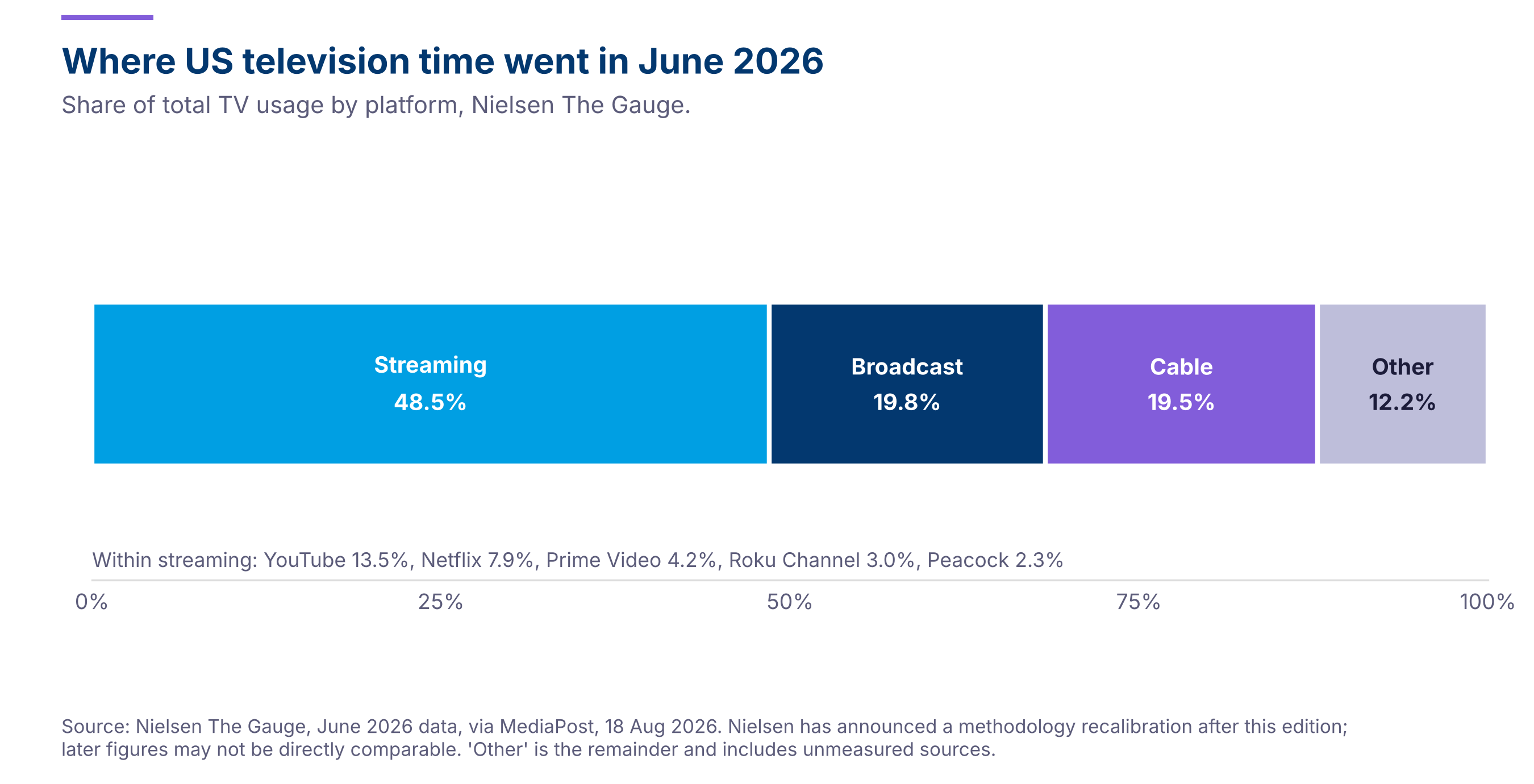
Figure 3. Share of U.S. television time by platform, Nielsen The Gauge, June 2026, via MediaPost, 18 August 2026.
And the money is following. Ampere Analysis forecast last November that global sports rights spending would top 78 billion dollars by 2030, a fifth higher than 2025, with the US market at 30.5 billion in 2025 heading past 36 billion. Rights holders paying those sums will not accept a streaming product that is a step behind the broadcast.
Latency stopped being a trade-off
Which brings us to the second thing the summer settled. For years, low latency and high quality were presented as a trade-off: you could have a stream close to the broadcast, or you could have a stream that looked good and never buffered, and the honest advice was to pick one.
During a World Cup match in Brazil, Globoplay reached a five-second delay behind the satellite feed while MediaKind VOS360 delivered to millions of concurrent viewers. Seven DTV+ lighthouse stations, three of them Globo's, broadcast the tournament on MediaKind XOS, and that deployment included the first 4K DTV+ playout, on MediaKind Spectrum. Those are our deployment figures. The latency figure has not been independently measured. We present it as what we delivered, not as an industry benchmark.
The point is general even if the number is ours. Low latency no longer has to mean accepting a lesser viewing experience. Once that is true, every rights holder will ask for both, and the architecture that delivers both is not the architecture that was built to deliver one.
Three bolt-ons, or one designed system
Here is the shape of the problem for anyone planning the next big event.
Latency, service multiplication and monetisation were three separate projects in most streaming organisations. A low-latency initiative owned by the video engineers. A channel-variant process owned by operations. An ad-insertion project owned by the commercial team. Each was bolted onto a delivery chain designed before any of them mattered.
When a single match becomes seventeen streams, each at broadcast-grade latency, each carrying its own ads, the three projects are the same project. A service variant that is late is a latency failure. An ad break that stalls is a quality failure. A latency target that only one variant meets is a monetisation failure, because the rights holder paid for all seventeen.
The architecture that works treats them as one designed system. Service variants are created as configuration rather than as new deployments. Latency is a property of the whole chain rather than a tuning exercise per stream. Ad insertion lives inside the playback path rather than beside it. One service we supported combined inserted advertising in first halves with a food-delivery partnership, social promotion and subscription discounts, and by its own account the campaign helped it triple its subscriber base during the tournament. Advertising inside the playback path was one part of that.
The hot content problem, briefly
One more lesson from the summer that applies to the ordinary weeks between tournaments. A small slice of a catalogue, often around 5 to 10%, drives most of the delivery traffic. Live events, catch-up in the first hours, fresh recordings, and the handful of on-demand titles everyone is watching. The rest is cold. Treating the two the same way means paying cloud delivery rates for an archive nobody is streaming, or paying for on-premises capacity sized for a peak that lasts a weekend.
The World Cup was the extreme case: a few weeks in which almost everything was hot. The same principle that applies in a quiet month, hot content on origins close to the audience and cold content in the cloud with assets moving between them automatically, produces a cost model that follows real consumption rather than worst-case assumptions.
What to carry into the next event
Count your streams, not your matches. The ratio tells you what kind of problem you have.
Set one latency target for the whole chain and measure every variant against it. A target one variant meets is not a target.
Put ad insertion inside the playback path before the next event, not after it.
And remember what the audience remembers. The best live-video technology still disappears behind the event. Millions of viewers are watching. Expectations are high. And every decision about how video is delivered becomes immediately visible.

