Ask a streaming operator what a live channel costs and the first answer is a software licence fee. At Scalstrm we hear it in most first conversations. It is the number on the invoice, so it is the number people remember. It is also, in 2026, the smallest of the moving parts. The cost of a live channel is now set by three things that tightened at once this year: the rack units it occupies, the kilowatts it draws, and the jurisdiction it has to run in.
This piece is about how to build a cost-per-channel model that reflects that, and why the denominator matters more than any single line.
Three Constraints, One Year
Space first. CBRE's North America Data Center Trends report for the first half of 2026, published on 27 August, put primary-market vacancy at 1.4%, a record low, with Northern Virginia at 0.2%. There was 7,481 MW under construction, up 24.8% during the half, and 80.4% of it was already pre-leased. Data Center Frontier's read of the same report noted that all Northern Virginia capacity scheduled to deliver in 2026 was already committed. Europe is behind on the same curve: Cushman & Wakefield put EMEA operational capacity at 12.1 GW on 25 September, with vacancy below 10% in most markets, and CBRE's European midyear outlook, updated in early October, revised its forecast for end-2026 vacancy to about 6%, below the previous all-time low.
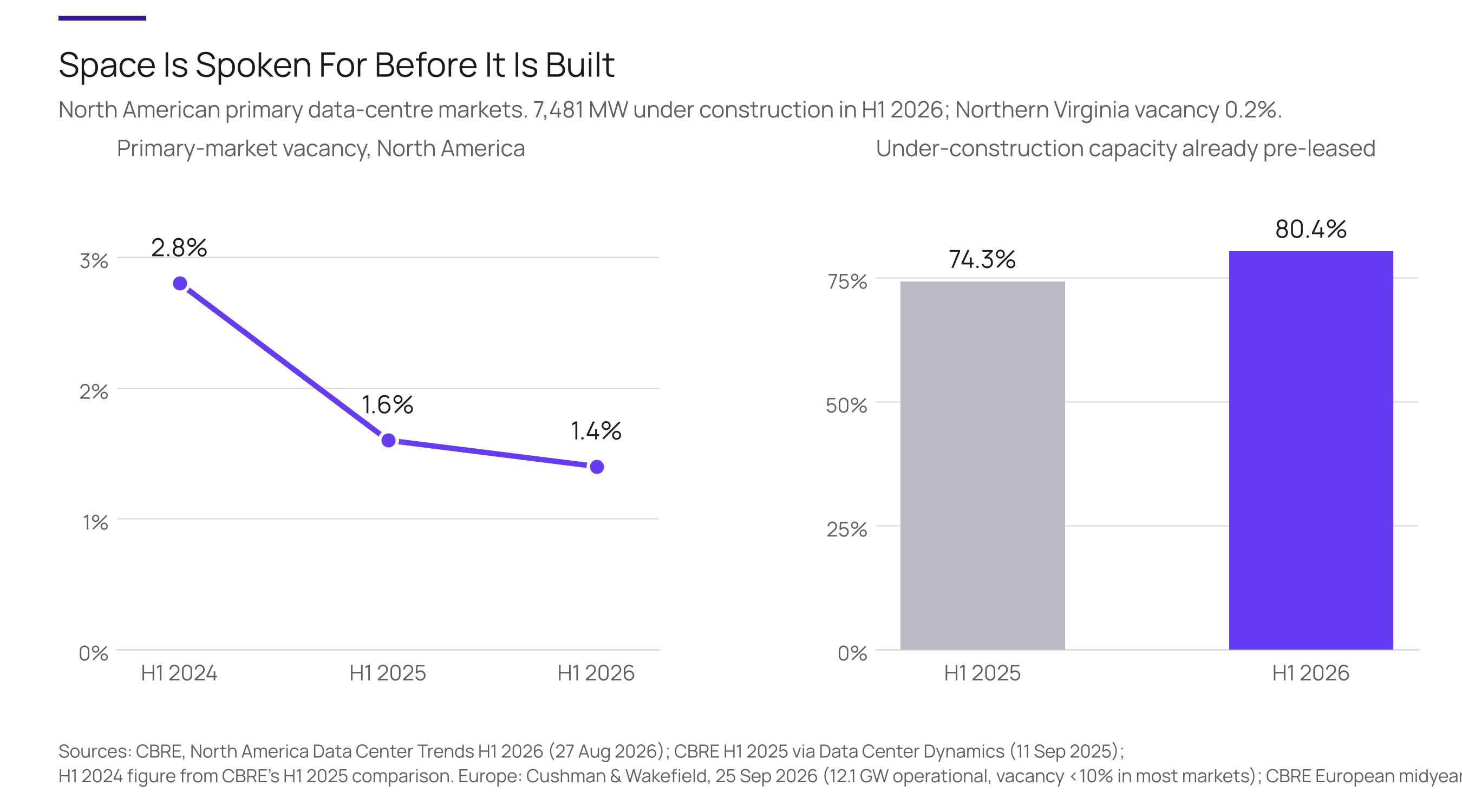
Figure 1. North American primary-market data-centre vacancy and pre-leasing, CBRE H1 2024 to H1 2026.
Power second. CBRE's asking-rate data shows the price of a kilowatt rising fastest for the deployment sizes a video operator actually uses: 7.9% in the first half for 500 kW to 3 MW and 8.3% for 3 to 10 MW. Rents in Northern Virginia for large deployments reached 160 to 185 dollars per kilowatt per month. Rent is charged per kilowatt, and the kilowatts are scarce.
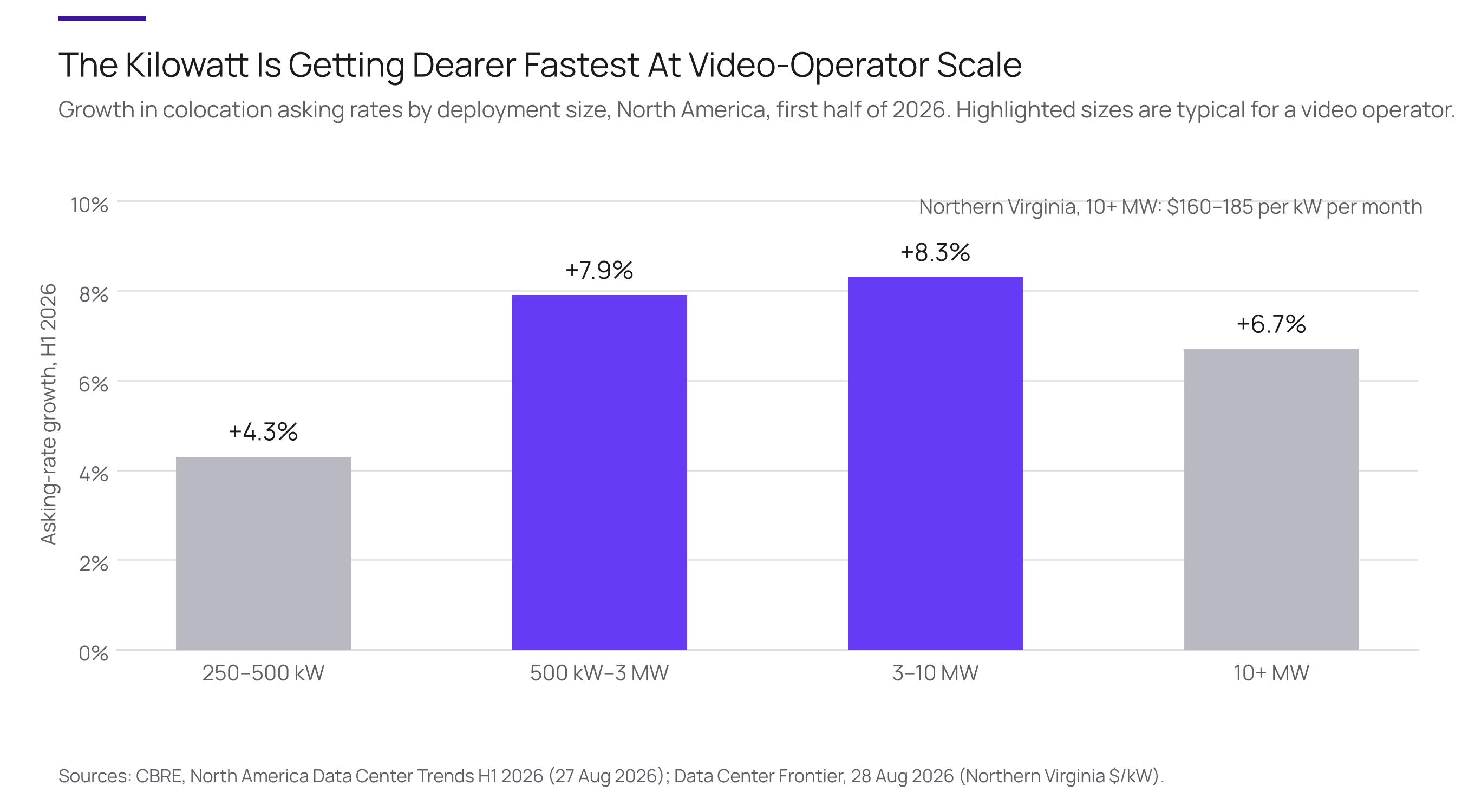
Figure 2. Colocation asking-rate growth by deployment size, North America, H1 2026. CBRE; Data Center Frontier.
Jurisdiction third. From 12 January 2027, Article 29 of the EU Data Act prohibits switching charges between cloud providers; until then they are limited to direct costs. The Act already requires a maximum two-month notice period, a 30-day transition window and functional equivalence for infrastructure services. In June the European Commission explained how its Cloud Sovereignty Framework, with assurance tiers scored across 48 criteria in eight categories, had been applied in the EUR 180 million institutional cloud tender awarded in April. Residency controls where data sits. Sovereignty controls who can legally compel access to it. Operators serving public broadcasters, regulated telcos or governments will be asked which they have.
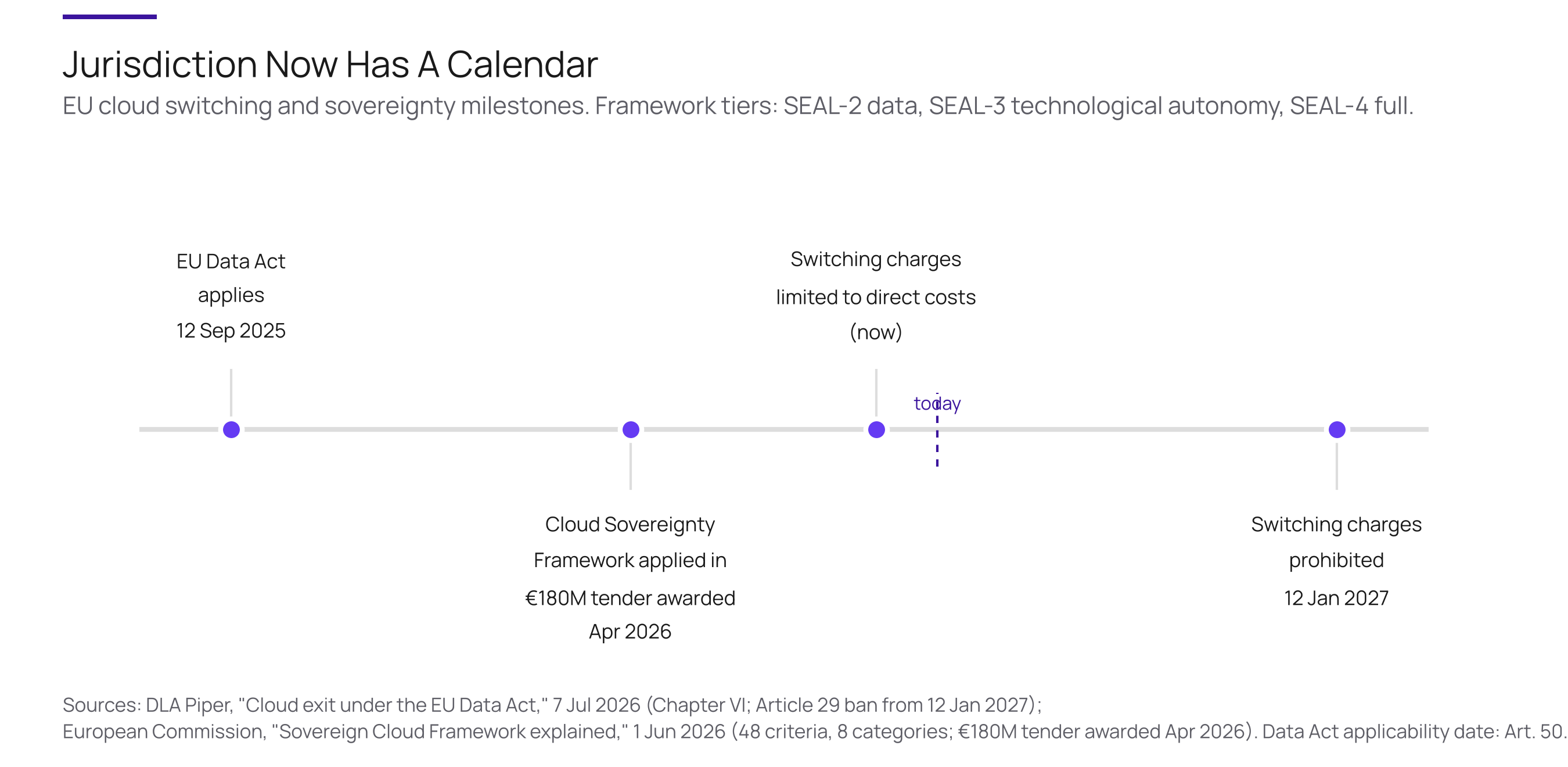
Figure 3. EU cloud switching and sovereignty milestones. DLA Piper, 7 July 2026; European Commission, 1 June 2026. Not to scale.
Six Budget Lines, One Denominator
A live channel's cost sits across at least six budget lines: hardware capital, software licences, colocation, power, cooling and operations time. Each line gets optimised in isolation. Nobody owns the total.
The fix is to change the denominator. Instead of asking what each line costs, ask what each line costs per rack unit, then ask how many channels a rack unit carries. Everything collapses to one number.
Colocation is charged per rack or per kilowatt; both scale with rack units. Power and cooling are charged per kilowatt; a denser rack unit draws more, but far less per channel than the servers it replaces. Operations time scales with the number of boxes a team patches, monitors and replaces. Hardware capital is the box count times the box price, and in 2026 the box price is under pressure from a memory supply shortage its makers expect to last through 2028. Only the software licence is indifferent to rack units, and even that is often priced per server.
So the question that decides the model is: how many broadcast-grade channels can one rack unit transcode and package? Double that number and five of the six budget lines fall with it.
What Density Looks Like in Practice
At IBC this September we showed our transcoding and packaging software running 110 broadcast-grade live HD channels on one 1U server with NETINT video processing units. On our own accounting that corresponds to up to 50% lower total cost of ownership and about 80% less power and rack space than the conventional deployments it replaces. Those are our figures from our deployments. Broadband TV News interviewed us about the configuration on 18 September, but no independent party has yet benchmarked it. Treat it as one worked example rather than a market constant.
The general lesson survives without the specific number. Density is not something a platform can be upgraded into. It is a property of how the platform was designed. The same silicon appeared on many stands at IBC. In our view the difference between vendors running the same chips is software: legacy code written for a world where silicon was cheap and plentiful carries overhead that a modern chip cannot hide. We have argued elsewhere that faster chips stopped rescuing slower software, and the show floor did not change our mind.
For an operator building the model, that means asking each vendor three questions. How many channels per rack unit, at what resolution and ladder, measured how? What fraction of the platform's features work in hardware-accelerated mode rather than falling back to the CPU? And how long did it take the vendor to ship the latest codec once the silicon supported it?
Portability Is the Sovereignty Lever
The third constraint, jurisdiction, is where the denominator pays twice.
An operator facing a sovereignty requirement has three postures. Wait, and hope the rules do not apply. Buy an EU region from a hyperscaler and call it sovereignty, which addresses residency and not control. Or pay the sovereign premium: run in a provider or facility that passes the assurance tests, which generally costs more per kilowatt and per rack unit than the alternatives.
The premium is paid per rack unit. A workload that needs 20 rack units pays it twenty times. A workload that needs two pays it twice. Density is therefore a lever on the sovereign premium, because it shrinks the footprint the premium applies to.
The second half of the lever is portability. A platform that runs identically on-premises, in any public cloud and in a hybrid of the two can move when the switching-fee ban takes effect in January, when a sovereign facility opens, or when a hyperscaler changes terms. A platform that only runs on one provider's managed services cannot, whatever the Data Act says. Our platform runs on standard infrastructure anywhere; the density figures above apply when it is paired with VPU hardware, and on standard cloud instances you keep the freedom to move but not those numbers. Any operator should ask every vendor the same question and expect an equally specific answer.
Building the Model
Start with rack units as the denominator and channels per rack unit as the measured input. Put all six budget lines against it. Add a jurisdiction column: for each candidate placement, the assurance tier it passes and the premium per kilowatt it charges.
Then run the model forward to 2027, when the switching-fee ban applies, when CBRE expects European vacancy near 6%, and when the memory market, on the suppliers' own account, is still tight.
Most operators know their price. The ones who know their cost will be the ones who chose the denominator first.

