Every video platform budgets for growth in servers. The arithmetic is familiar: estimate peak concurrent channels, divide by the channels each server can carry, add headroom, and place the order. For most of the past decade the price of the server itself was the stable term in that equation. In 2026 it is not.
Memory is the reason. DRAM contract prices have climbed every quarter this year, and the suppliers who make it say the shortage will outlast 2027. For anyone running live transcoding at scale, that changes which number in the capacity plan matters most. When each server costs more, the count of servers you need is the lever that moves the budget. Encode density stopped being only a power story and became a hedge against component inflation.
For the past year our conversations with video platforms centered on power and rack space. This fall they keep turning to memory, and it is worth explaining why.
What happened to memory
The 2026 memory shortage is a byproduct of the AI buildout. Samsung, SK hynix, and Micron are shifting wafer capacity toward high-bandwidth memory (HBM), the stacked DRAM that sits beside AI accelerators. TrendForce estimates that HBM consumed about 18 percent of the top three suppliers' DRAM wafer input at the end of 2025, will reach about 22 percent by the end of 2026, and about 30 percent by the end of 2027 (TrendForce, June 2, 2026). Every wafer that goes to HBM is a wafer that does not become the DDR5 RDIMM in a transcoding server.
The effect on contract prices has been steep. In February TrendForce forecast server DRAM contract prices up around 90 percent quarter over quarter in the first quarter of 2026 and called it the largest quarterly increase on record (February 2, 2026). The final tally for conventional DRAM came in at 93 to 98 percent (June 1, 2026). The second quarter added another 58 to 63 percent (March 31, 2026 forecast). Server DRAM specifically was projected to rise 13 to 18 percent in the third quarter (July 9, 2026), and on September 30 TrendForce forecast a further 10 to 15 percent increase for conventional DRAM in the fourth quarter, with server DRAM expected to remain undersupplied. Chaining the midpoints of those four quarterly figures yields roughly a fourfold increase in DRAM contract pricing across calendar 2026. That compounding is an illustrative calculation from the published ranges, and it mixes one server-DRAM quarter with three conventional-DRAM quarters. It is not a TrendForce figure.
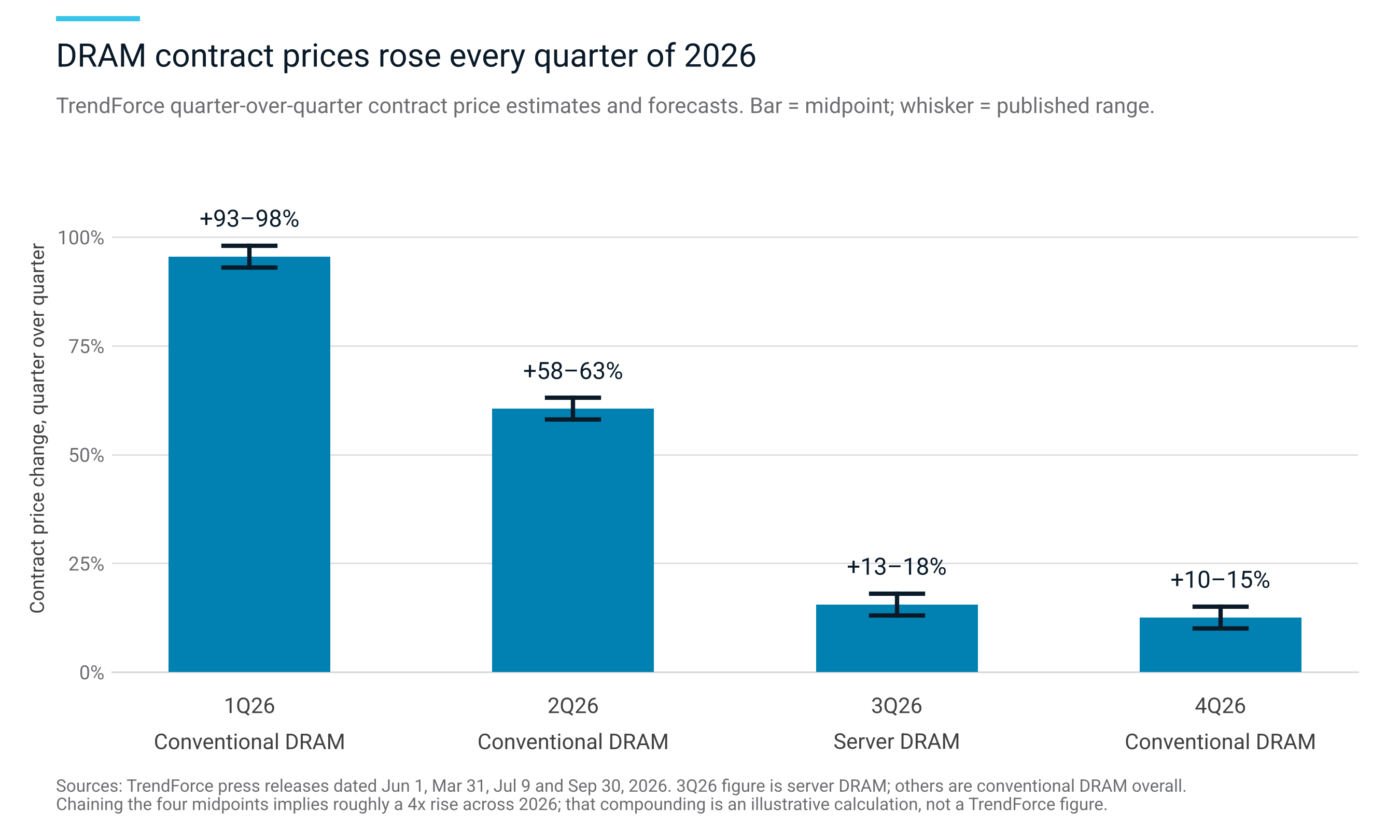
Figure 1. TrendForce quarter-over-quarter DRAM contract price estimates and forecasts for 2026. Bars show the midpoint of each published range; whiskers show the range.
The suppliers do not expect quick relief. On Samsung's second-quarter earnings call on July 30, Jaejune Kim, Executive Vice President of Memory, said supply constraints "are expected to become even more severe in 2027 than 2026," and that the shortage will persist through 2028. Earlier in the year, SK Group Chairman Chey Tae-won told an audience at Nvidia GTC that industry-wide wafer supply trails demand by more than 20 percent and that closing the gap takes four to five years (Tom's Hardware, March 18, 2026).
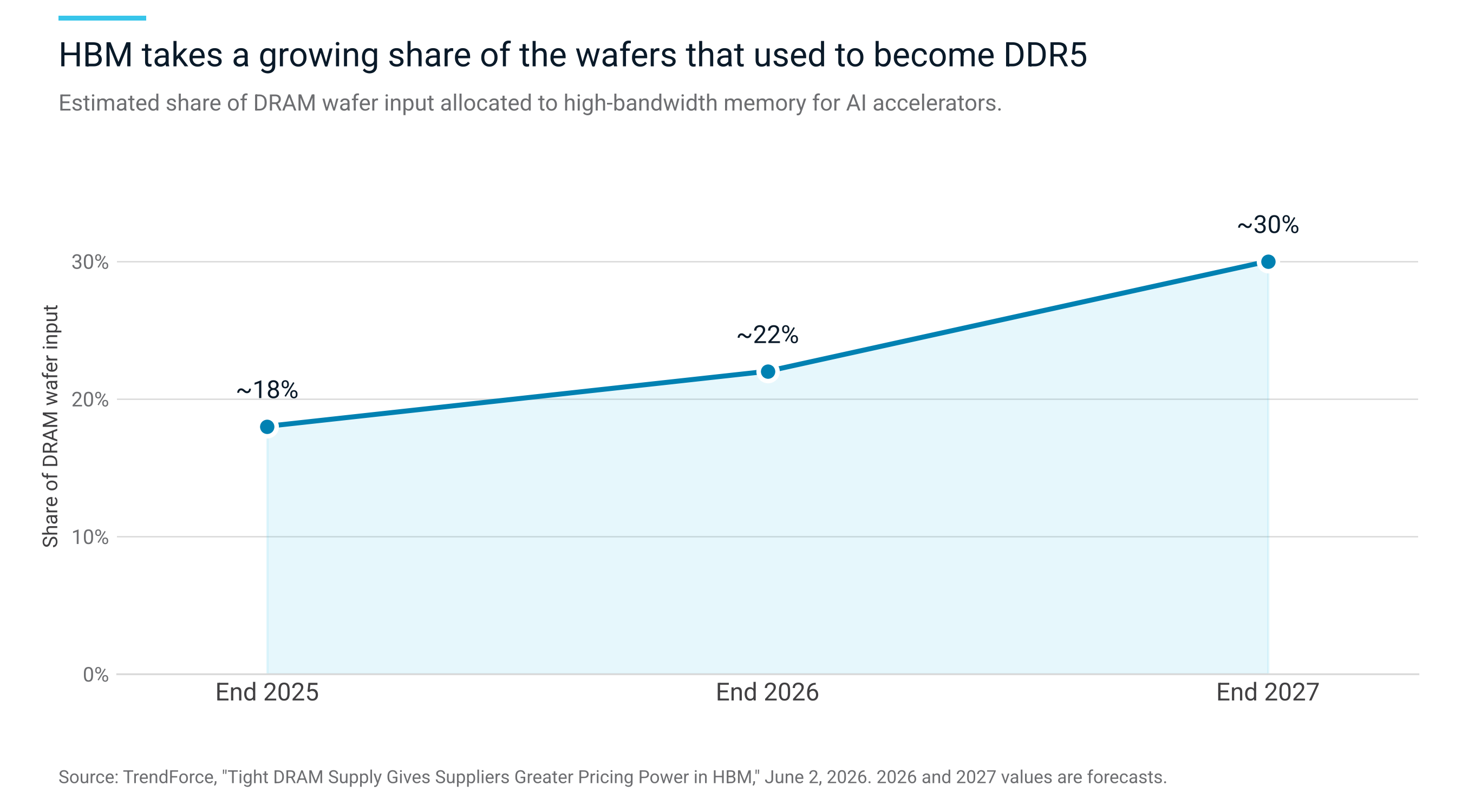
Figure 2. Share of the top three suppliers' DRAM wafer input allocated to HBM. Source: TrendForce, June 2, 2026. 2026 and 2027 values are forecasts.
How memory inflation lands in a transcoding server
A live transcoding server built on general-purpose CPUs is a memory-heavy machine. Software encoders hold multiple frames per stream in flight, keep reference frames for motion estimation, and buffer the output ladder. Each additional channel raises the memory footprint, and operators size RDIMM capacity generously to avoid swapping under peak load. In 2025 that was a modest line item. In 2026 it is the line item moving fastest.
The scale of the move is visible in street pricing. DatacenterDisk, a component price tracker, reports that a 64 GB DDR5-4800 RDIMM that sold for about 380 dollars in early 2025 traded at 820 to 890 dollars by the second half of 2026, and that 256 GB of DDR5 ECC memory for a server refresh, budgeted at 800 to 1,200 dollars in early 2025, now runs 2,000 to 3,500 dollars (August 17, 2026, updated October 1). Those are single-source figures, directional rather than definitive, but they move the way the TrendForce contract data does.
Memory is not the only component under pressure. TrendForce's September 30 note put NAND flash up 15 to 20 percent in the fourth quarter, with enterprise SSDs the one category still accelerating. Memory and storage are inflating at the same time.
Here is the point that matters for capacity planning. Component inflation multiplies by server count. If your plan calls for 100 servers and memory adds 2,000 dollars per server, the exposure is 200,000 dollars. If the same channel count fits in 25 servers, the exposure is 50,000 dollars. Nothing about the memory market changed between those two sentences. The architecture did.
Density as a hedge
This is the lens through which to read density figures, including ours. NETINT's installed base passed 225,000 video processing units (VPUs) and 1.1 trillion minutes of encoded video in September. A single Quadra T1U or T1A encodes up to 32 simultaneous 1080p streams, and a fully loaded Quadra Video Server carries 320 channels in one rack unit at about 500 watts. Those are our numbers, and the right way to test them is the method set out in the VPU buyer's guide published in September: ask for rate-distortion curves and measured frame latency under production concurrency, and run the test on your own content before you accept a spec-sheet figure. The same standard applies to every encoder vendor, software or hardware.
Zapping, a Latin American streaming TV operator with more than 600,000 subscribers and over 500 channels, is the most complete public example in our customer base. In a case study published September 2, co-founder and CTO Nacho Opazo described moving live encoding from roughly 100 CPU-based servers to 25 VPU servers, a 75 percent reduction in server count. Encoding power fell from about 60 kilowatts to about 6 kilowatts across the fleet. Each VPU server carries 50 to 60 channels with six to eight ABR profiles per channel. These are Zapping's reported figures, and the case study is the single public source for them.
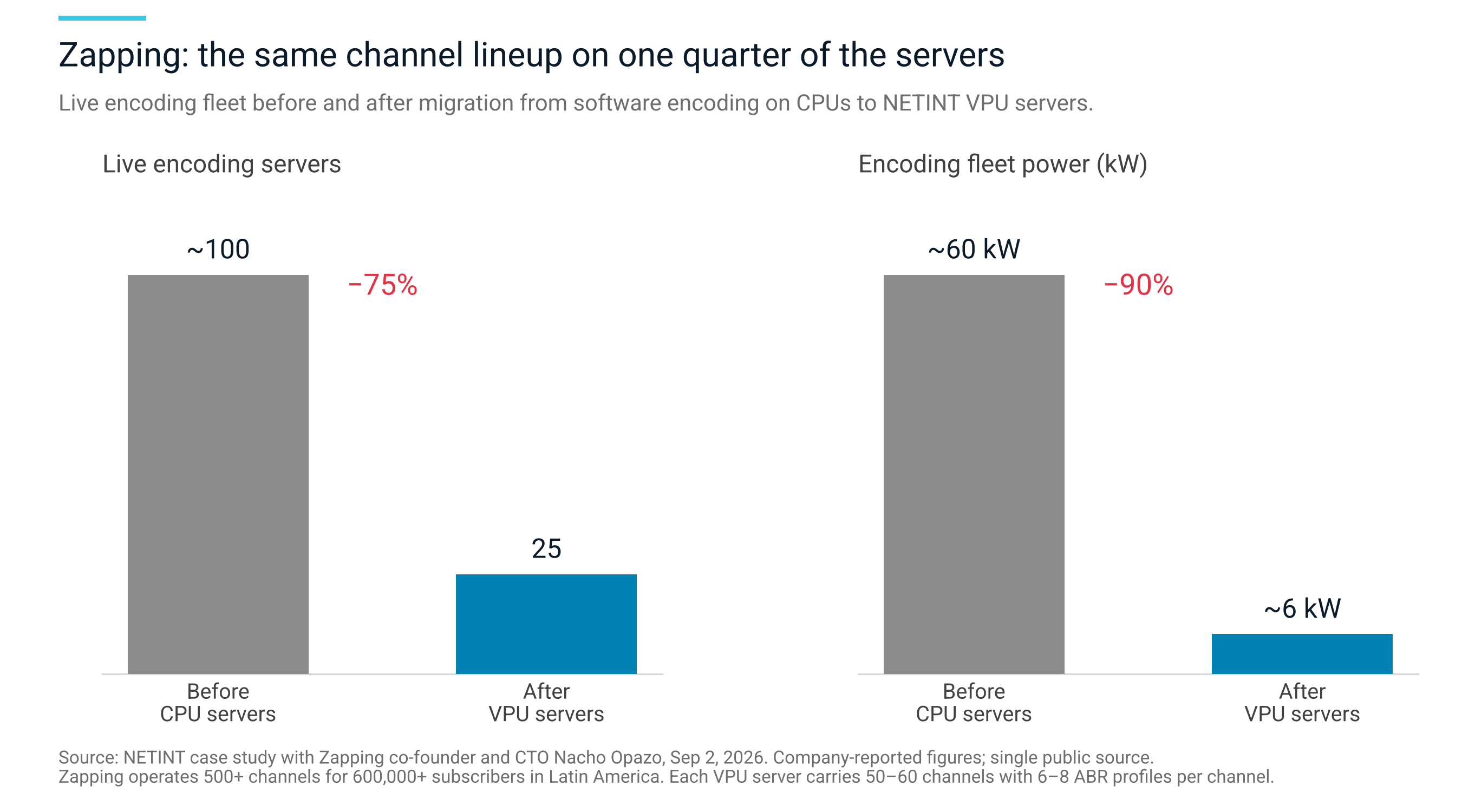
Figure 3. Zapping's live encoding fleet before and after migrating to VPU servers. Company-reported figures from the NETINT case study, September 2, 2026.
In 2024 the headline from a consolidation like that was power. In 2026 the 75 servers Zapping did not have to buy, refresh, or populate with memory at this year's prices deserve equal billing. The energy saving did not go away. It gained a second column on the spreadsheet.
Be clear about the limit. A VPU server still has a CPU, still has DRAM, and still has storage. Hardware encoding does not make a platform immune to component inflation. It reduces the number of machines the inflation is multiplied by. The saving is proportional to the consolidation ratio, and it is largest for operators whose workloads are dense enough to fill a VPU server. Operators with smaller channel counts have other levers: trimming per-channel memory through encoder configuration, consolidating ladders, or moving to any accelerator, GPU or ASIC, that raises channels per server. The principle is the same. Fewer servers, less exposure.
When you cannot wait for a hardware cycle
There is a second response to component scarcity: do not procure the server at all. NetActuate announced on September 10 that it has expanded its VPU-as-a-Service offering to 15 points of presence worldwide, attaching a NETINT VPU to a customer's virtual machine or Kubernetes node through passthrough. Akamai has offered NETINT VPUs in its cloud since March 2025. In both models the server, and the memory inside it, is procured by the infrastructure provider rather than the video platform.
That matters because of a detail in the TrendForce data. The July 9 note observed that major cloud providers have signed multi-year supply agreements that cap their price increases, and that the primary source of server DRAM price increases will therefore shift toward customers without such agreements. A mid-sized video platform ordering servers on the spot market is on the wrong side of that line. Consuming encode capacity from a large provider, or consolidating onto fewer servers, are two ways to step back across it.
What to do with this
Rerun the capacity model with 2026 component prices, not the prices in last year's template. Ask every encoder vendor, including NETINT, for channels per rack unit at your actual ladder and your actual quality target, and verify the number on a loaner unit under production concurrency. Then compare total server count across the options, because that count is now the multiplier on every inflating line in the bill of materials.
The memory market will eventually loosen. Samsung points to 2028 and SK Group to 2030. A server bought in the next 18 months will be in service for most of that window. The platforms that absorb this cycle well will be the ones that needed the fewest servers to begin with.

