At Arcadian, a systems integrator that deploys NETINT video processing units into production encoding infrastructure, every business case we reviewed this year started with the same two assumptions: servers are available at a known price, and the rack has power to spare. In 2026 neither assumption holds. The scarce inputs for video infrastructure are no longer software licenses or engineering talent. They are memory-constrained servers and grid capacity. A capacity plan that starts from a vendor spec sheet is a plan for a market that no longer exists.
This is how we think about it, and how we run the engagements that follow.
The Two Constraints
Power first. Lawrence Berkeley National Laboratory's December 2024 report put U.S. data centers at 4.4 percent of national electricity consumption in 2023 and projected a range of 6.7 to 12 percent by 2028. The International Energy Agency's Energy and AI report put global data center consumption at 415 terawatt-hours in 2024 and projected roughly 945 by 2030; its Electricity 2026 report expects data centers to make up about half of U.S. demand growth to 2030. In June, FERC ordered six grid operators to defend or revise their large-load interconnection rules within 60 days, with more than 2,060 gigawatts of generation and storage waiting in interconnection queues at the end of 2025.
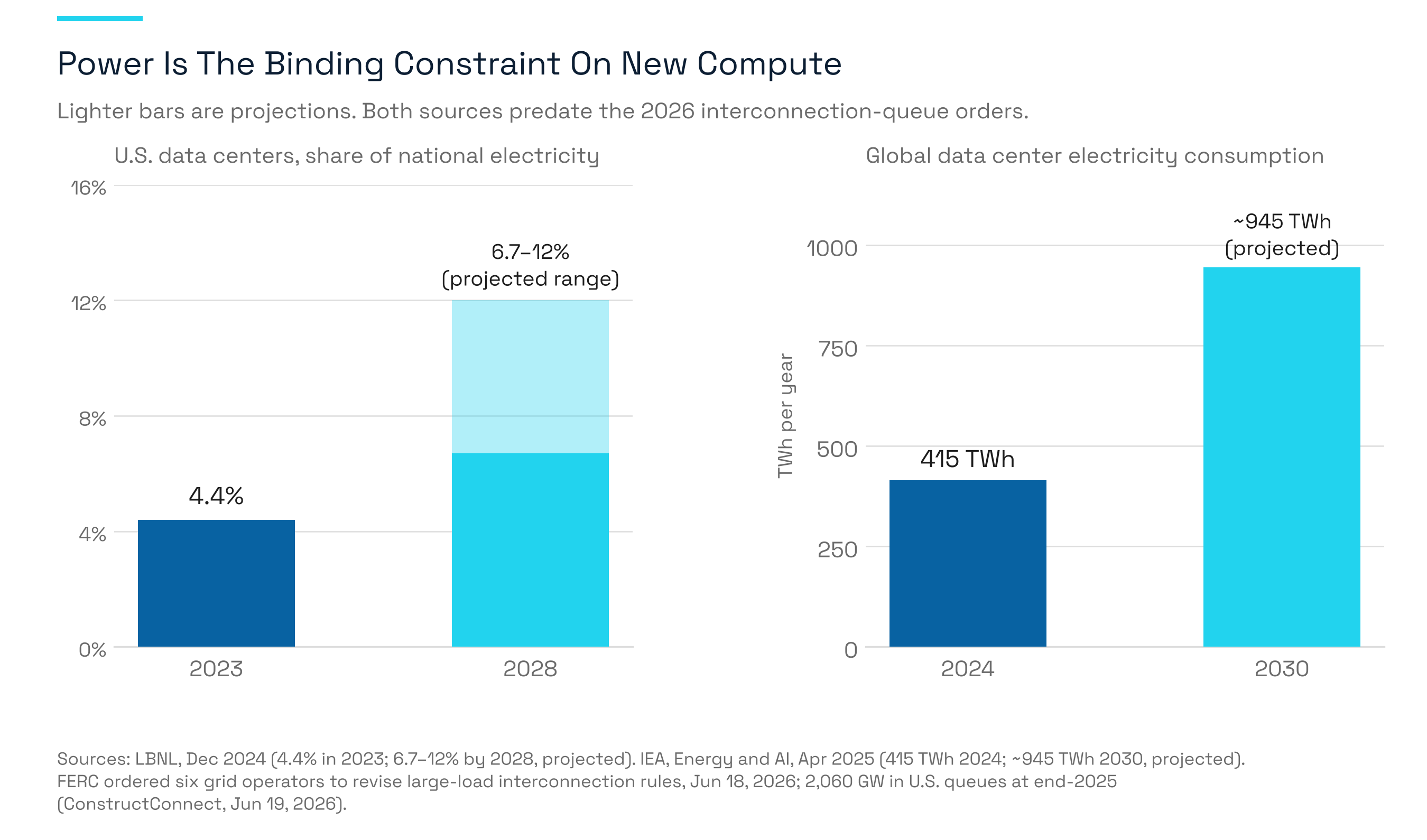
Figure 1. Data center electricity demand. LBNL, December 2024 (U.S. share); IEA, April 2025 (global TWh). Lighter bars are projections.
Those are forecasts and queues, not invoices. The invoice shows up as a colocation provider who cannot add kilowatts to your cage this year, or a lead time measured in quarters for a new power circuit.
Servers second. Dell's Jeff Clarke told analysts on the company's May earnings call that it was "repricing, it feels like, every day" with memory as the primary constraint. TrendForce's September 30 forecast has conventional DRAM contract prices rising another 10 to 15 percent and NAND 15 to 20 percent in the fourth quarter. The server you budgeted in January costs more today and arrives later.
Put the two together and the question an engineering leader has to answer changes. It is no longer "how many servers do we need?" It is "how many streams can we run inside the power and the hardware we can actually get?"
Why Spec Sheets Fail Here
A spec sheet gives you a peak figure under conditions the vendor chose. It does not tell you streams per rack unit at your ladder, your codec mix, your quality floor, and your concurrency. It does not tell you watts at that load, which is the number the colocation provider cares about. And it does not tell you what happens at the integration surface, where a driver, a container runtime, or a monitoring agent decides whether the peak figure survives contact with production.
The only cure we know is measurement. A proof of concept exists to replace every number in the business case with a measured one. Streams per rack unit, watts per stream, quality at target bitrate, latency under load, and failure behavior are all measured on your content, on hardware you can procure, before anyone signs a purchase order.
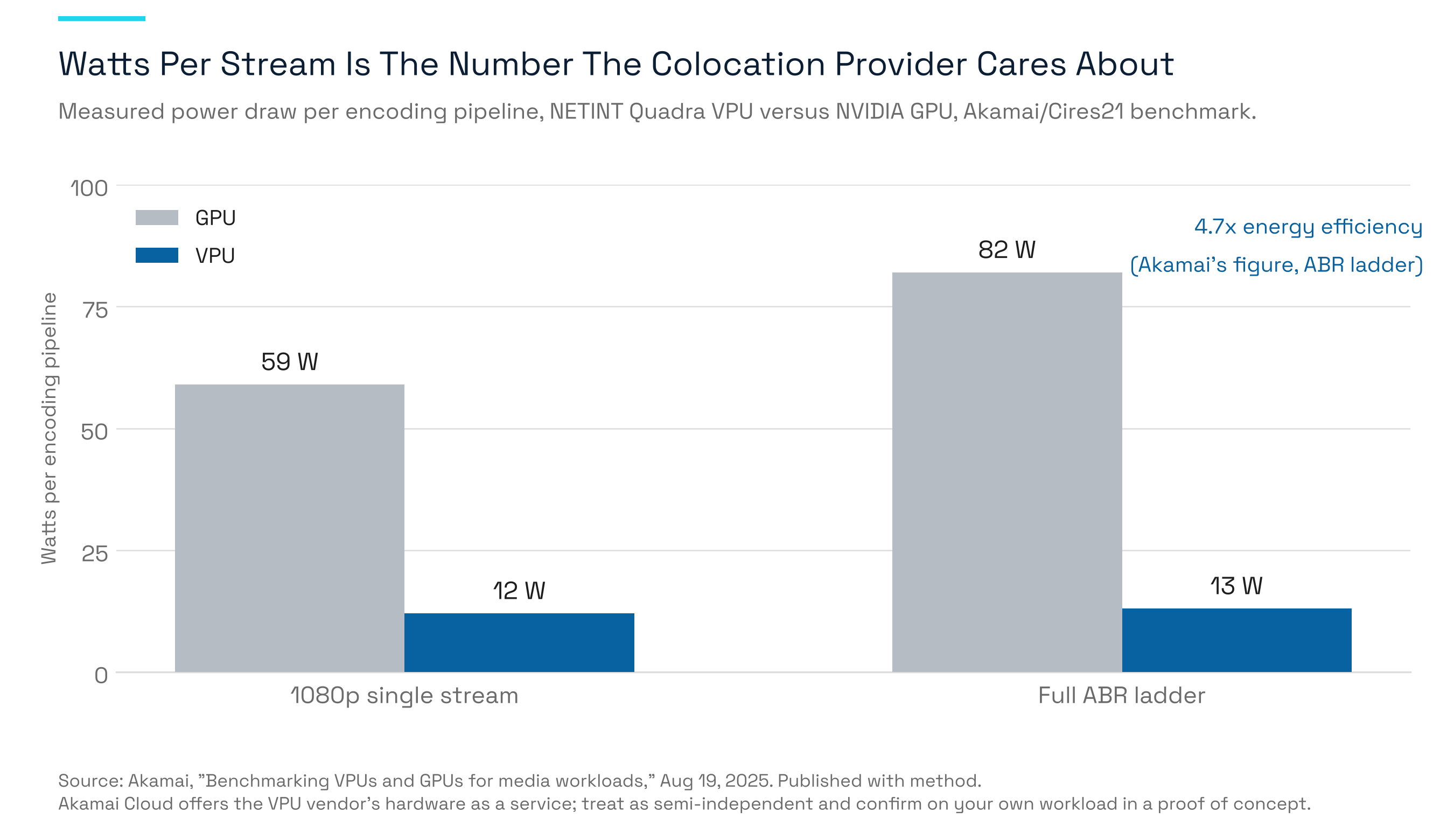
Figure 2. Measured watts per encoding pipeline, VPU versus GPU. Akamai/Cires21 benchmark, 19 August 2025.
The chart above shows why the measurement matters. In a benchmark Akamai published in August 2025 with Cires21, a hardware video processing unit drew about 13 watts running a full adaptive bitrate ladder against about 82 watts for a GPU doing the same work, and 12 against 59 watts at 1080p. Akamai calls that 4.7 times the energy efficiency. We cite the figure because it is independent of us and published with its method. We also note that Akamai Cloud offers that vendor's VPUs as a service, which is why we never let a published benchmark substitute for a proof of concept on your workload. The published figure tells you where to look. Your measurement tells you what you will get.
The Ten Steps, Compressed
Our full methodology runs ten steps from problem recognition to lifecycle management. Four of them carry most of the weight in a constrained market.
Workload Profiling. Before any hardware is discussed, we document the channel lineup, the ladder per channel, codec requirements by output, latency budgets, and peak concurrency. We see five deployment triggers: rack space, power, codec efficiency, cloud cost, and control over latency or data location. In 2026 the first two dominate. Naming the trigger decides what the proof of concept has to prove.
Proof of Concept and Benchmarking. We run your content through candidate hardware and report streams per rack unit, watts per stream, VMAF and PSNR against your quality floor, and encoder latency under production concurrency. Every number in the eventual business case traces to a row in that report.
Deployment Model Selection. Our methodology covers on-premises, colocation, hybrid, and phased models. NETINT frames the choice as three ways to add hardware-accelerated capacity: retrofit cards into servers you already own, build dedicated systems, or consume capacity from a hosted provider that has already procured the hardware. In a market where the server itself is scarce, the first and third options are worth more than they were. Retrofitting an existing server with an accelerator card adds streams without adding a chassis, a power supply, or a memory kit at this year's prices. Hosted capacity moves procurement to a provider buying at volume.
Pilot, Staging, and Rollout. Staging is where the design meets production-shaped reality. In rollout, we never big-bang a channel lineup. A pilot carries real channels on the new path alongside the old one, and the first production stream behaves exactly like the last test stream, or the migration pauses.
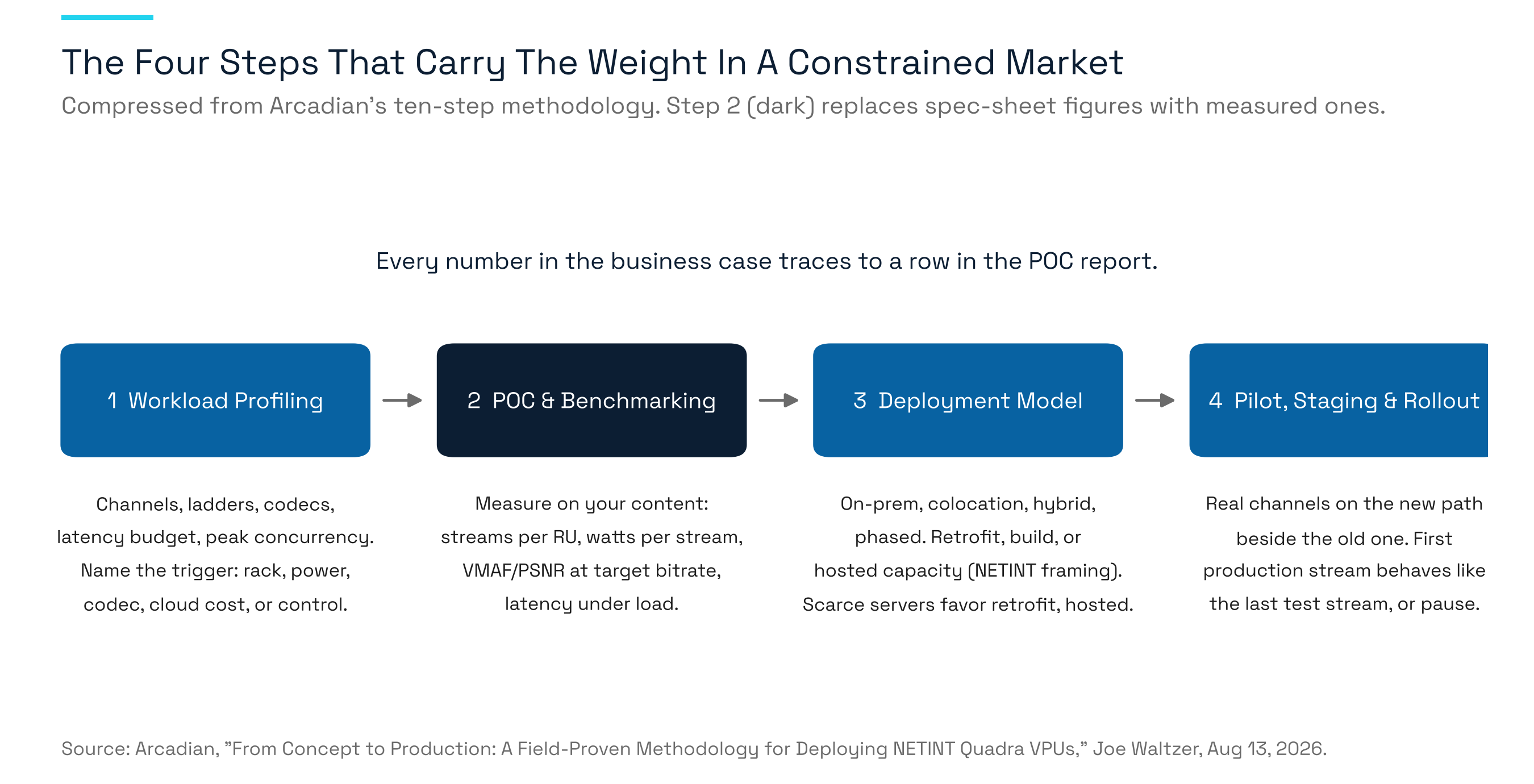
Figure 3. The four weight-bearing steps, compressed from Arcadian's ten-step methodology, 13 August 2026.
The Arithmetic That Changes the Decision
Here is the calculation we walk every client through. Take your channel count and your ladder. Divide by measured streams per rack unit on each candidate platform. That gives you rack units. Multiply by measured watts per rack unit at your load. That gives you kilowatts. Now compare the kilowatts to what your colocation provider can give you this year, and compare the rack units to the servers you can procure this year.
Hardware selection becomes arithmetic rather than persuasion. In 2026 the arithmetic usually points at density, because density is the one variable that reduces both constraints at once. Fewer rack units means fewer servers to buy in a memory-constrained market. Fewer watts means fitting inside the power you have instead of waiting for power you cannot get.
Density can come from several places: a newer CPU generation, a GPU, or a purpose-built VPU. We integrate VPUs because, in our own measurements, their watts per stream have been the lowest we have recorded, but the method is the same regardless of silicon. Measure, then decide.
What To Do This Quarter
Write a one-page problem statement that names your trigger. Get your current measured watts per stream from the fleet you run today, not from the spec sheet it was bought against. Ask your colocation provider, in writing, how many additional kilowatts you can have in the next twelve months. Then run a proof of concept on any candidate platform with those three numbers as the pass criteria.
The market will loosen eventually. Samsung's memory executive Jaejune Kim said on the company's July earnings call that the supply shortage will persist through 2028. The infrastructure you specify now will be in service through that window. Specify it from measurements.

