Streaming now accounts for about half of all television time in the United States, and the average broadband household moves more than 700 gigabytes a month. The cost of video has migrated from the studio to the bitstream and to the access network it crosses. Against that backdrop, a result from MPEG's verification tests of scalable VVC, which Nokia's video research team summarized in September, carries more weight than its technical phrasing suggests: dual-layer VVC delivered subjective quality equal to, or only slightly below, single-layer VVC at the same bitrate.
If a scalable bitstream costs little or nothing in quality, then one encode can serve many screens, and several of the duplicated costs in today's delivery chain become optional.
The demand side, in two numbers
Nielsen's The Gauge put streaming at 49.0 percent of U.S. television usage in July 2026, up from 47.5 percent in December 2025. YouTube alone reached a record 14.2 percent. Broadcast was 19.5 percent and cable 18.7 percent.
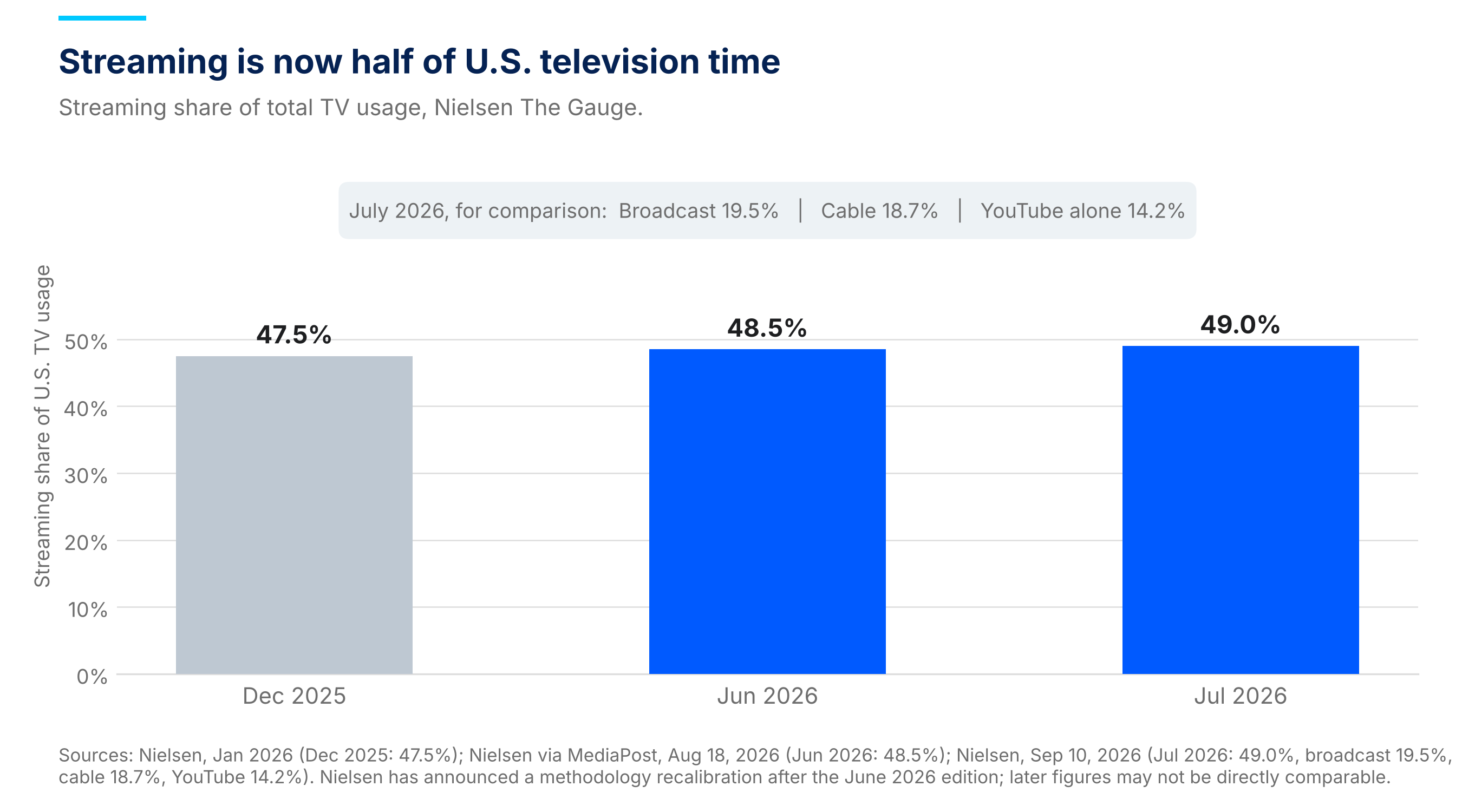
Figure 1. Streaming share of U.S. television usage, Nielsen The Gauge, December 2025 to July 2026.
OpenVault's second-quarter 2026 report put average fixed-broadband consumption at 711 gigabytes per subscriber per month, up 7.1 percent year on year, with the median at 482 gigabytes. Upstream traffic grew 19.2 percent against 6.1 percent for downstream, and the ratio of downstream to upstream has fallen from 16.6:1 in 2019 to 11.2:1. The Fiber Broadband Association reported in April that U.S. fiber passings had reached nearly 100 million, with household consumption that was over 200 gigabytes a month in 2018 now approaching 700.
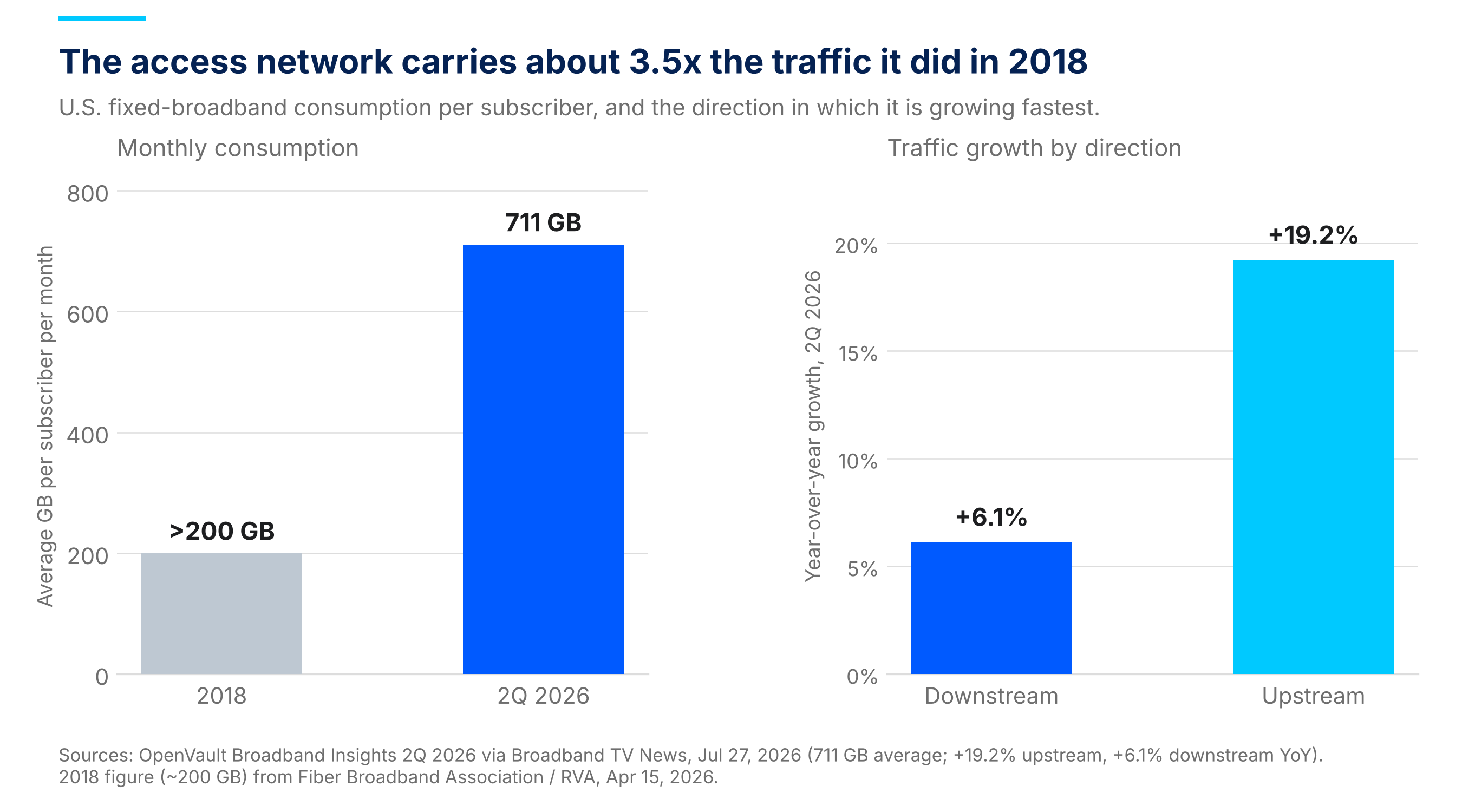
Figure 2. U.S. fixed-broadband consumption per subscriber and growth by direction. OpenVault 2Q 2026 via Broadband TV News, 27 July 2026; 2018 baseline from the Fiber Broadband Association, 15 April 2026.
Two consequences follow. First, every percentage point of compression efficiency is now applied to a large and growing base, so codec gains have a bigger absolute effect than they did a decade ago. Second, the network that carries the traffic is being rebuilt at the same time, and the economics of the two investments are linked. A codec that cuts bitrate reduces the pressure on the access network; a fiber upgrade raises the ceiling the codec is working under.
Why one encode is better than several
Today a typical streaming service encodes each title several times: a ladder of resolutions and bitrates for adaptive streaming, often duplicated for SDR and HDR, and sometimes duplicated again for different codecs to match the device base. Every rung is a separate file stored at the origin, replicated across CDN caches, and managed through its lifecycle. The duplication is the price of serving many screens from a system designed around one bitstream per screen.
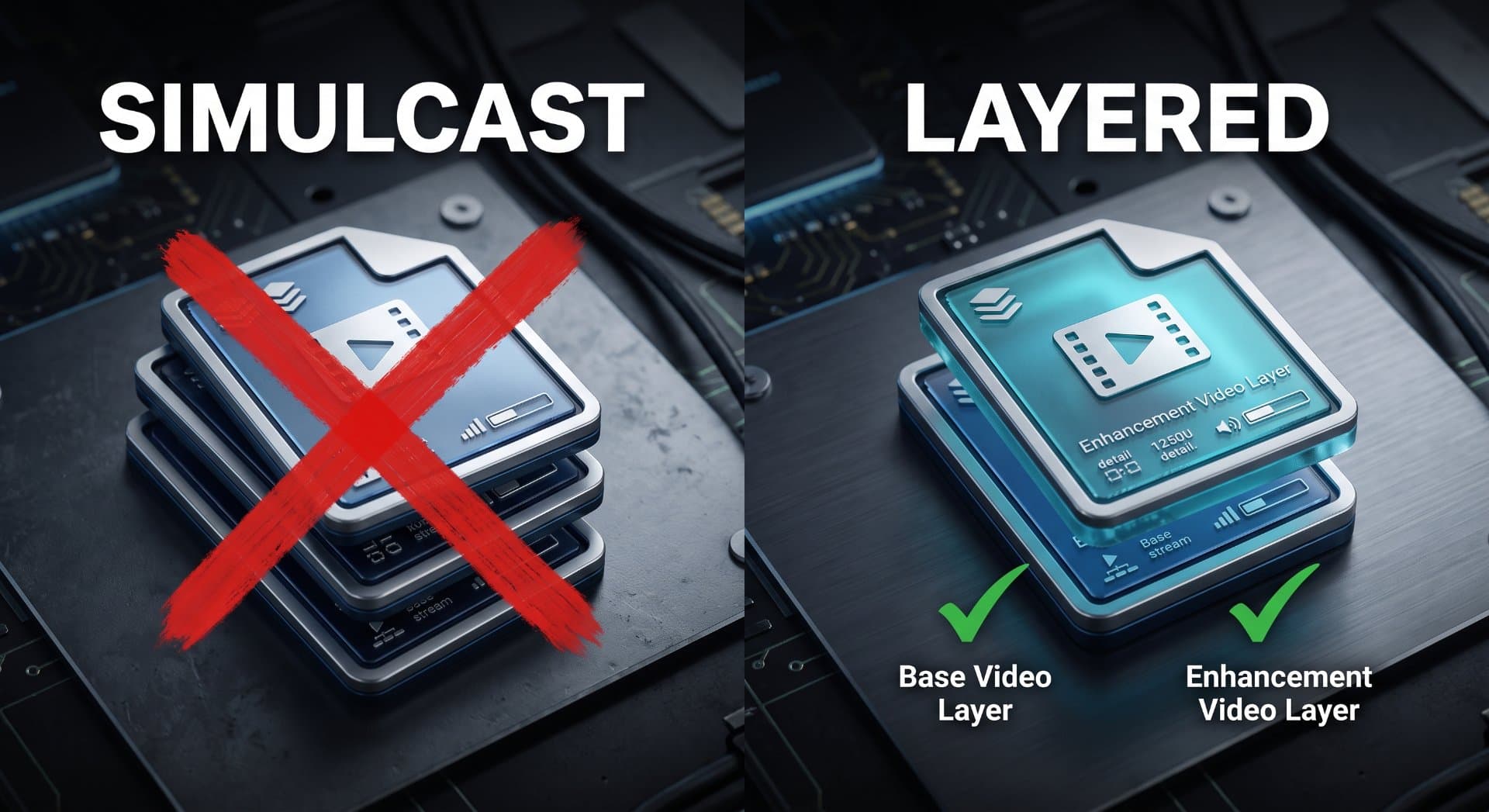
Scalable coding changes the unit of delivery. A scalable bitstream contains a base layer, say HD, and one or more enhancement layers that refine it to UHD. A device that can only display HD receives the base layer. A device that can display UHD receives both. The UHD picture is reconstructed from the base plus the enhancement, so the UHD bits do not repeat what the HD bits already carry.
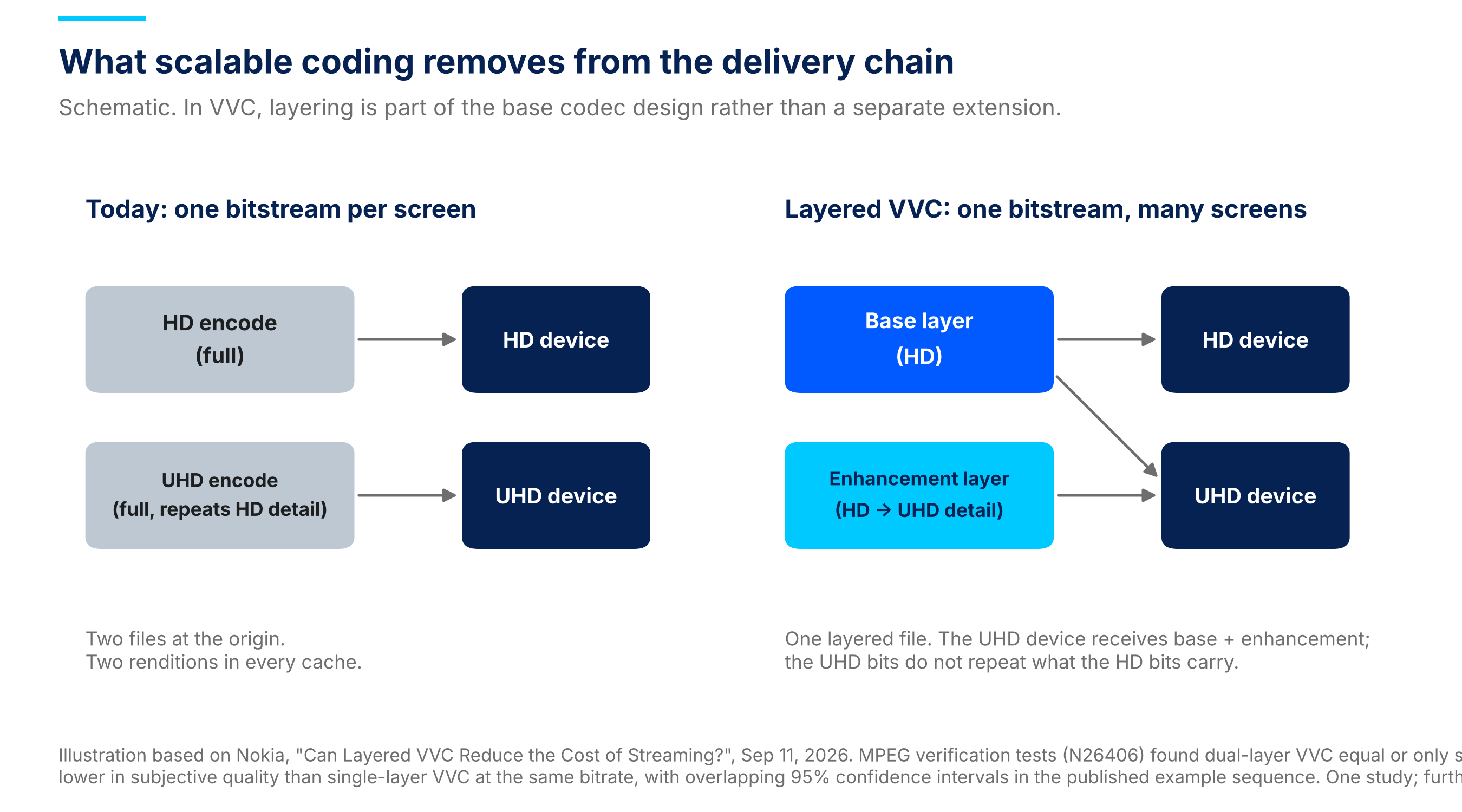
Figure 3. Schematic of simulcast versus layered delivery, based on Nokia, "Can Layered VVC Reduce the Cost of Streaming?", 11 September 2026.
The storage and caching consequence is direct. Instead of a separate HD file and a separate UHD file, the origin holds one layered file, and the CDN caches the base once and the enhancement once. Where a service today stores and distributes HD and UHD renditions of the same content, the layered approach removes the overlap between them.
The same mechanism supports uses beyond resolution. A personalized overlay such as sign-language video can ride as an enhancement layer over a shared base. In machine-vision monitoring, a camera can send the base layer continuously and the enhancement layer only when a human is watching. Nokia's own studies indicate this saves bandwidth when human observation is required less than about 80 percent of the time.
Why scalability failed before, and what is different in VVC
Scalable video coding is not new. H.264 had SVC and HEVC had SHVC. In both cases scalability arrived as a separate extension to the base standard, with its own coding tools, and neither extension reached wide deployment in consumer devices.
VVC took a different path. Scalability is part of the base codec design, implemented through high-level syntax rather than a separate extension. A VVC decoder that conforms to the relevant profile can decode a layered stream without additional tools. That design choice is what the verification tests examined: whether layering built this way costs quality at equal bitrate.
The verification tests, documented in MPEG document N26406, covered HD and UHD content in both SDR and HDR. In the example sequence Nokia published, the 95 percent confidence intervals of the mean opinion scores for dual-layer and single-layer VVC overlapped; across the test set the conclusion was "equal or only slightly lower." It is a strong result, and it is one study. Further verification on additional content classes and at additional operating points is still needed, and the conclusion that scalable VVC can make streaming infrastructure leaner remains conditional on that work.
From a bitrate number to a saving on the books
Here is the point that is easy to miss. "VVC uses about half the bitrate of HEVC" is a statement about an encoder. "Our delivery cost fell by half" is a statement about a business, and the distance between them is where most codec transitions stall.
Three things have to move together before a compression gain reaches a profit-and-loss statement. The codec design has to be finished and verified, which for VVC and its scalable mode it now is. The device base has to be able to decode it; a rule of thumb from an InterDigital-sponsored study, cited by Streaming Learning Center, is that a new codec starts to pay off once roughly 30 percent of a service's installed devices support it, and the first phones with mobile systems-on-chip offering hardware VVC decode, among them MediaTek's Dimensity 9600 Pro, reached the market only in late September 2026. And the access network has to be in a state where bitrate reductions translate into either lower cost or higher capacity, which depends on how the operator is charged for transit, peering and CDN.
The MPEG verification result moves the first of those. Brazil's DTV+ broadcast, running VVC in its first three cities since June, and the arrival of VVC in Android's media framework and in mobile silicon, are moving the second. The fiber build-out is moving the third. None of them moves on its own schedule.
What a streaming operator can do with this now
The first step is to count the duplication in the current ladder: how many stored and cached renditions differ only in resolution or dynamic range from another rendition of the same content. That number is the ceiling on what layered coding can remove.
The second is to measure the device base by decoder capability and track it quarterly. The 30 percent threshold is a heuristic, not a law, but it cannot be applied without the measurement.
The third is to ask encoder and player vendors where scalable VVC sits on their roadmaps, and to request test results at the operator's own operating points rather than at the ones in the standard's test set.
For two decades the industry has treated one bitstream per screen as a fixed cost of serving many devices. The verification result suggests it was a limitation of earlier designs rather than of layered coding itself. Removing it will take several years of device turnover. Understanding it takes considerably less.

