
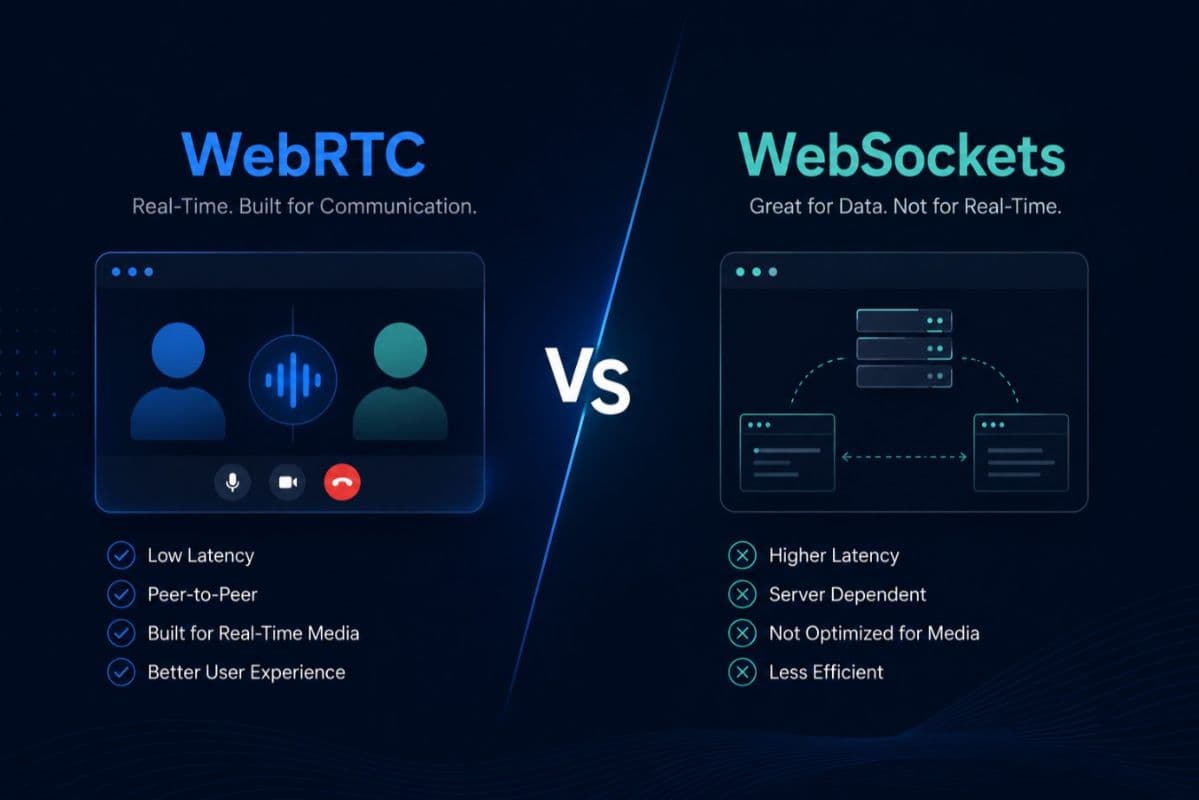
RTC League provides a technical comparison between WebRTC and WebSockets for real-time voice AI applications. The report outlines why WebRTC's built-in features for packet loss, latency, and audio signal processing make it superior for interactive AI voice systems compared to the general-purpose WebSocket protocol.
The choice between WebRTC and WebSockets defines the floor for conversational latency in voice AI. As the industry moves toward multimodal agents, WebRTC provides the structural advantages—such as packet loss concealment and native audio processing—necessary for natural interactions. While WebSockets remain useful for data-only tracks like live transcription, relying on them for media often forces developers to rebuild complex synchronization primitives. For streaming incumbents, moving to WebRTC-centric stacks is becoming the prerequisite for enabling low-latency ‘barge-in’ capabilities where AI agents accurately detect and respond to human interruptions. Watch for whether major LLM providers shift their primary client-side SDKs exclusively toward WebRTC to reduce glass-to-glass latency.
The debate over transport protocols has intensified as the 'Time-to-First-Audio' (TTFA) benchmark becomes the definitive metric for voice AI. According to internal benchmarks from Inworld.ai in March 2026, natural conversation requires a TTFA under 250ms, a threshold that remains difficult to reach using TCP-based WebSockets due to retransmission delays. Consequently, major model providers are diversifying their transport options; OpenAI’s Realtime API now officially supports WebRTC specifically for browser and mobile clients to minimize these overheads, while recommending WebSockets only for server-to-server integrations (per Webscraft, May 2026).
Despite the theoretical superiority of WebRTC, real-world deployment reveals significant infrastructure hurdles. A June 2026 report from RTC League noted that while WebRTC is ideal for browser-native applications, connecting these agents to the public switched telephone network (PSTN) usually requires a SIP bridge. This hybrid architecture—using WebRTC for web and SIP for telephony—is becoming the enterprise standard. However, some developers have found that the transition is not a universal fix; a Dev.to technical case study from March 2026 cautioned that for high-volume PSTN calls, the choice of protocol can contribute less than 5% of total conversational latency compared to the 500ms to 2-second processing time of the underlying large language model.
Market competition is currently revolving around 'Agent Frameworks' that orchestrate these connections. Platforms like LiveKit and Daily.co have moved to the center of the ecosystem by offering managed WebRTC Selective Forwarding Units (SFUs) that handle global scaling and regional routing. According to Voice Agent Index (June 2026), developers are increasingly choosing between LiveKit’s open-source WebRTC agents and Daily's Pipecat ecosystem to avoid the 'maintenance debt' of building custom audio-handling logic on top of raw WebSocket streams.
Add StreamingMeme as a preferred source on Google to see more of our streaming news at the top of your Search results.
Add as preferred source