

Adobe launches agentic AI assistant in Premiere to automate video editing
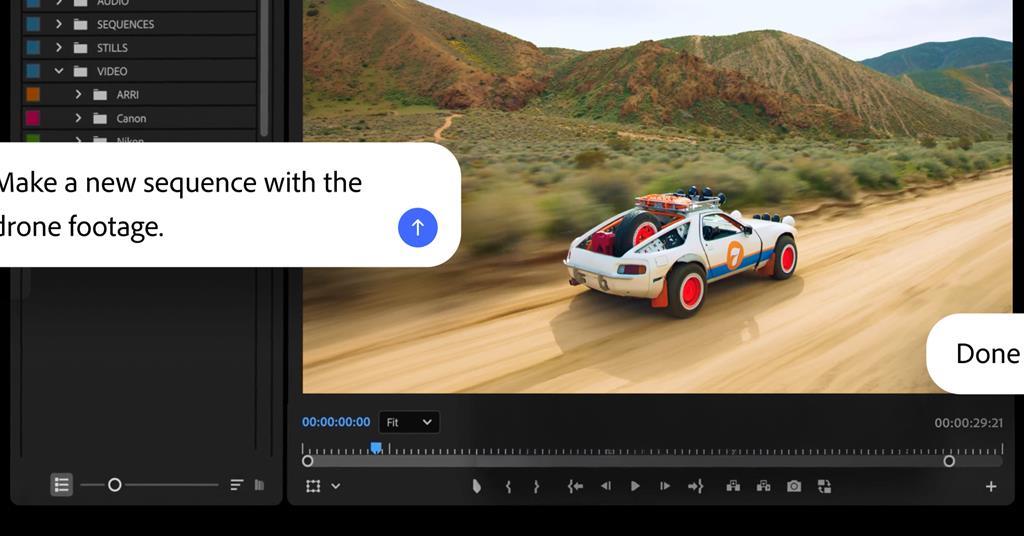
Adobe is rolling out an agentic AI assistant in public beta across its Creative Cloud products, including Premiere, Photoshop, and Illustrator. Within Premiere, this assistant can automate standard timeline tasks such as creating first cuts, generating storyboards, sorting assets into bins, and batch renaming clips. The goal is to allow video editors to automate tedious production setup tasks using natural language prompts.
Key Takeaways
- AI Assistant in Premiere Pro can automatically identify interview questions and add markers to the timeline.
- Integrated tools are now available across third-party platforms including OpenAI’s ChatGPT, Anthropic’s Claude, and Microsoft 365 Copilot.
- The updated Firefly creative studio introduces 'Elements,' allowing creators to save and reuse characters and objects for visual continuity.
- The assistant is currently in public beta for Premiere, Photoshop, and Illustrator, while After Effects remains in private beta.
Why It Matters
Adobe is shifting from simple generative asset creation to 'agentic' workflow orchestration, positioning itself as the connective tissue in fragmented production environments. By offloading mechanical setup tasks like asset binning and rough cuts, the company aims to defend its enterprise market share against nimble AI-native competitors. For the streaming industry, this suggests a future where high-volume short-form content and localized versions are assembled by assistants rather than junior editors. Watch for adoption rates among major post-production houses to see if these tools genuinely reduce billable hours or simply increase output capacity.
Additional Context
The rollout of these agentic tools follows Adobe's strong financial performance tied to its AI pivot. In September 2025, per Bloomberg, Adobe reported that annual recurring revenue from AI-influenced products exceeded $5 billion, with nearly 90% of its top 50 enterprise accounts adopting AI-powered tools. This growth underscores an aggressive strategy to embed AI directly into professional software rather than relying on standalone generators, a move meant to counter competition from startups like Runway and Pika. Technologically, the expansion is supported by the Firefly Video Model. Released in public beta in early 2025, per Adobe and TechCrunch, the model is marketed as the first 'commercially safe' video generator, trained exclusively on licensed Adobe Stock and public domain content. This focus on IP safety is a critical differentiator for B2B streaming and advertising clients who must avoid copyright infringement risks inherent in open-source or scraped models. Looking ahead, Adobe is further integrating its ecosystem into broader enterprise stacks. Per VentureBeat (June 2026), the company plans to extend its 'Creative Cloud connector' to Google Gemini and Slack. This cross-platform availability, combined with the new 'Elements' feature for character and location continuity, addresses a long-standing weakness in generative AI: the difficulty of maintaining visual consistency across an entire series or marketing campaign.
Read full article at broadcastnow.co.uk