

Paris-Troyes cycling race adopts Starlink and Blackmagic for live remote production
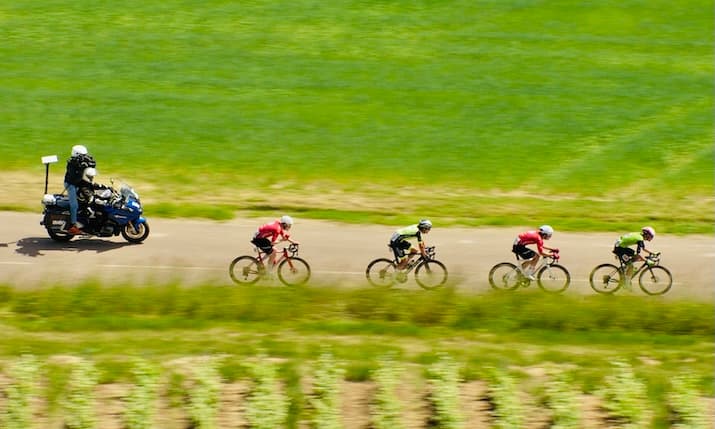
AVEO successfully deployed a remote production workflow for the Paris-Troyes cycling race using Blackmagic Design hardware in a custom-equipped van and motorcycle fleet. The solution utilizes cellular bonding and Starlink for reliable contribution over 180km, enabling live broadcast from a regional budget for the first time.
Key Takeaways
- AVEO utilized Blackmagic URSA Broadcast G2 cameras on custom-equipped BMW motorcycles for mobile race coverage.
- Starlink was integrated alongside Aviwest 4G modems to provide signal redundancy across remote sections of the 180km parcours.
- The production replaced a vMix setup with Blackmagic Replay and DaVinci Resolve for near-live highlights and slow-motion playback.
- A Mercedes Sprinter OB van managed nine sources, including drone-mounted PTZ cameras and a gyro-stabilized helicopter feed.
- France Télévisions' digital platform, France.tv, broadcast the race for the first time and has renewed the partnership for 2027.
Why It Matters
This deployment demonstrates a viable economic model for tier-2 sporting events that previously could not afford traditional airborne HF relay and satellite infrastructure. By commoditizing contribution via Starlink and cellular bonding, regional producers can now deliver broadcast-standard live feeds to national platforms at a fraction of Tour de France-level costs. This shift empowers niche rights-holders to monetize content via digital platforms, bypassing the gatekeeping effect of high technical overhead. For the broader ecosystem, it signals the maturation of IP-native remote workflows as a reliable alternative to legacy SNG systems. Watch for more UCI-ranked regional classics to migrate to this 'lean OB' model as 5G and LEO satellite coverage expands across Rural Europe.
Additional Context
The integration of Starlink into professional broadcast workflows reflects a broader industry trend toward Low Earth Orbit (LEO) satellite adoption. Per Creative Broadcast UAE (March 2026), the region's recent commercial Starlink launch has allowed production teams to treat LEO as a 'first-class member' of a bonded uplink rather than just a failover. This architectural shift enables 4K HDR contribution from remote heritage sites like AlUla where fiber or 5G infrastructure is absent. Similarly, IMG collaborated with Starlink and LiveU in early 2026 to deliver infrastructure-free coverage of the R&A Women’s Amateur Championship in remote Scotland, eliminating the need for traditional OB trucks.
Technologically, the shift toward software-defined and IP-connected production reached a new milestone at NAB 2026. Per RedShark News (April 2026), Blackmagic Design introduced an end-to-end 100G SMPTE-2110 IP ecosystem, including the URSA Cine 12K LF 100G camera and live encoders. These tools are designed to streamline remote production by compressing high-frame-rate streams over standard Ethernet, significantly lower than the cost of proprietary broadcast hardware. This aligns with Jachetta’s NAB 2026 Technology Trends Report, which noted that AI-assisted monitoring and cloud-based resources are now standard planning elements for modern broadcasters seeking operational flexibility.
Read full article at svgeurope.org
Enjoy our coverage?
Add StreamingMeme as a preferred source on Google to see more of our streaming news at the top of your Search results.
Add as preferred source