

Bayerischer Rundfunk launches first software-defined SMPTE ST 2110 radio mobile unit
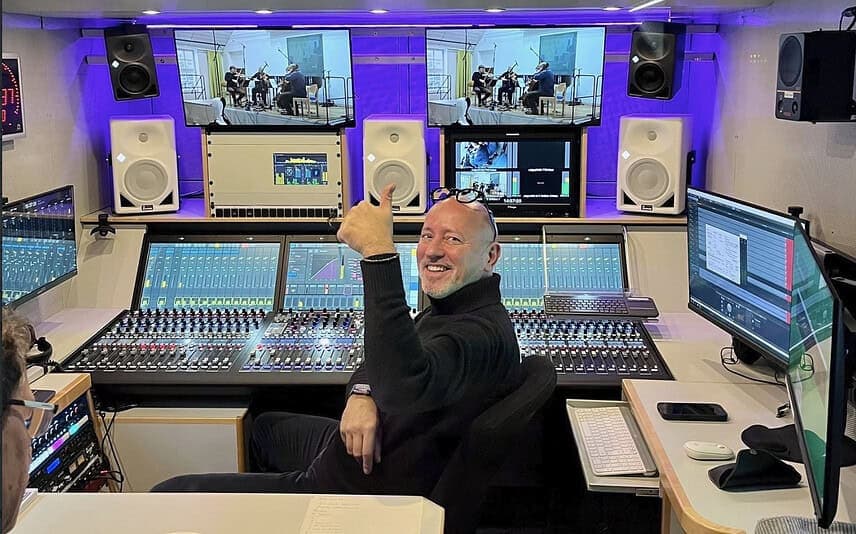
Bayerischer Rundfunk has modernized its Ü5 radio outside broadcast vehicle into a fully software-defined mobile unit utilizing SMPTE ST 2110 and Lawo's IP-native production ecosystem. The upgrade features a 48-fader mc²56 console and is designed to handle high-capacity IP audio processing and signal transport for live events.
Key Takeaways
- Technical infrastructure centers on a 48-fader Lawo mc²56 MkIII console paired with the HOME mc² DSP App
- Onboard software-based audio processing runs on standard CPU servers rather than proprietary hardware cores
- System capacity supports 384 processing channels, 1,280 I/O points, and up to 192 recording channels
- IP-based stageboxes incorporate 48 microphone inputs and 16 line outputs with integrated Dante and MADI connectivity
- Modernization project, conceptualized in 2022, retained the vehicle's original 2007 chassis while fully redesigning the internal signal chain
Why It Matters
The transition to a software-defined architecture in a mobile environment signals a shift away from specialized hardware reliance toward commodity server-based processing. By decoupling DSP from the physical console, Bayerischer Rundfunk can scale processing capacity via licensing rather than hardware installs. This move aligns with broader industry efforts to standardize on SMPTE ST 2110 for interoperable audio and video transport over shared IP networks. For the market, this represents a benchmark for high-stakes live audio production, including opera and sports, where reliability has traditionally favored fixed-hardware designs. Watch for whether this software-centric model reduces maintenance overhead and if peer broadcasters adopt similar 'headless' or server-based mixing engines for Tier-1 event coverage.
Additional Context
The deployment of the Ü5 vehicle follows a broader industry trend toward software-defined media processing. Per Lawo, April 2024, the HOME mc² DSP app was specifically re-engineered as a microservice-based equivalent to the company’s A__UHD Core to provide ultra-low latency on standard COTS servers. This flexibility allows broadcasters to utilize the same processing algorithms for both physical OB trucks and remote, virtualized mixing environments. Such transitions are critical as the industry migrates away from uncompressed SDI toward more complex, interoperable ST 2110 workflows, which the SMPTE ST 2110 Practical Lab—launched in January 2026—aims to standardize through professional training.
Contextually, European broadcasters are increasingly prioritizing modular architectures to combat rising operational costs. Per Medium, November 2025, the traditional OB truck market is evolving from massive 'supertrucks' to modular units that support hybrid remote integration models (REMI). For instance, Broadcast Solutions delivered two software-defined OB units to DMC in July 2026, which utilize Grass Valley's AMPP software for entire signal delivery workflows. By retaining the 2007 chassis but rebuilding the interior, Bayerischer Rundfunk demonstrates a strategy of technical longevity, extending the life of physical assets through software-based upgrades rather than costly total vehicle replacements.
Read full article at sportsvideo.org
Enjoy our coverage?
Add StreamingMeme as a preferred source on Google to see more of our streaming news at the top of your Search results.
Add as preferred source