

Apple Mac Studio M5 supports 33 simultaneous 8K ProRes streams
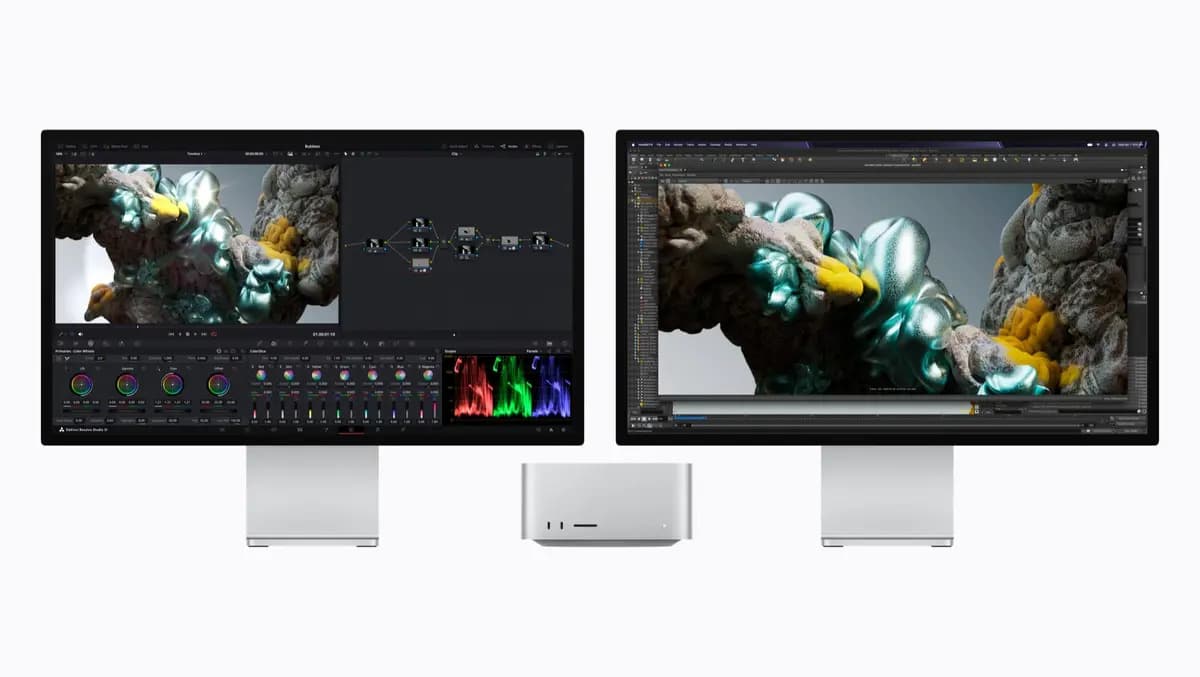
Apple has introduced new Mac Studio models equipped with M5 Max and M5 Ultra chips, featuring hardware-accelerated AV1 decoding and support for 33 simultaneous 8K ProRes streams. The systems are designed for local AI inference and professional video production, incorporating Thunderbolt 5 connectivity and enhanced neural accelerators.
Key Takeaways
- M5 Ultra configuration supports up to 512GB of unified memory and 1.2TB/s memory bandwidth.
- New Media Engine enables simultaneous playback of 33 streams of 8K ProRes 422 video at 30fps.
- Thunderbolt 5 integration allows linking four units to triple AI inference performance via RDMA.
- Foundry Nuke CopyCat ML training runs up to 15.4 times faster than on M1 Ultra models.
- Hardware updates include Wi-Fi 7, Bluetooth 6, and genlock support over USB-C for iPhone 17 Pro sync.
Why It Matters
The introduction of M5 Ultra chips signals a shift toward localized, high-compute environments for video professionals who require real-time 8K color grading and AI-driven visual effects. By integrating Neural Accelerators directly into the GPU and offering 512GB of unified memory, Apple is reducing the industry's dependence on expensive cloud rendering for complex ML training tasks like those found in Foundry Nuke. This hardware refresh forces a competitive response from workstation manufacturers to match the 120Gb/s throughput of Thunderbolt 5 and integrated AV1 hardware decoding. Watch for how third-party developers adopt the new Core AI framework to optimize rendering pipelines for macOS 27.
Additional Context
Apple's M5 Ultra chip enters a workstation market where Nvidia has long dominated GPU-accelerated creative workloads. The Mac Studio's claim of 33 simultaneous 8K ProRes streams positions it against Nvidia RTX-equipped workstations that rely on discrete GPUs and separate memory pools. Cerebras filed for an IPO in mid-2026 with a reported $10 billion contract from OpenAI, signaling that alternative AI compute architectures are gaining commercial traction even as Nvidia maintains its near-monopoly on GPU-based inference. For video production houses evaluating the Mac Studio, the competitive question is whether Apple's unified memory architecture can match the throughput of discrete GPU rigs for sustained 8K timelines and ML-assisted effects in tools like Foundry Nuke.
The broader AI infrastructure spending environment adds financial context to Apple's hardware push. Nvidia is working on AI deals worth more than $750 billion, including a partnership with SK Group exceeding $500 billion, and the chipmaker is in talks to backstop as much as $250 billion to help OpenAI lease computing power from a US data center project. These figures illustrate the scale of cloud-side AI investment that Apple's local-inference strategy implicitly challenges. If the Mac Studio can handle meaningful AI inference workloads on-device, production studios may reduce their dependence on cloud GPU instances, shifting capital expenditure from operational cloud billing to one-time hardware purchases.
On the security and governance side, running AI workloads locally introduces its own operational considerations. NIST launched an AI Agent Standards Initiative in February 2026 focused on interoperability, security, and identity for agentic systems, and its draft concept paper addresses authentication, authorization, delegation, and prompt-injection controls for architectures that take autonomous action. For studios deploying AI-assisted editing or effects pipelines on Mac Studio hardware, these emerging standards will shape how local inference integrates with broader production workflows that may still call cloud services for training or collaboration. The OWASP agentic Top 10 taxonomy, which identifies risks including tool misuse and insecure inter-agent communication, provides a framework that applies whether inference runs on a local M5 Ultra or a remote GPU cluster.
Read full article at itbrief.com.au
Enjoy our coverage?
Add StreamingMeme as a preferred source on Google to see more of our streaming news at the top of your Search results.
Add as preferred source