

Black Forest Labs launches FLUX 3 with 20-second multimodal video
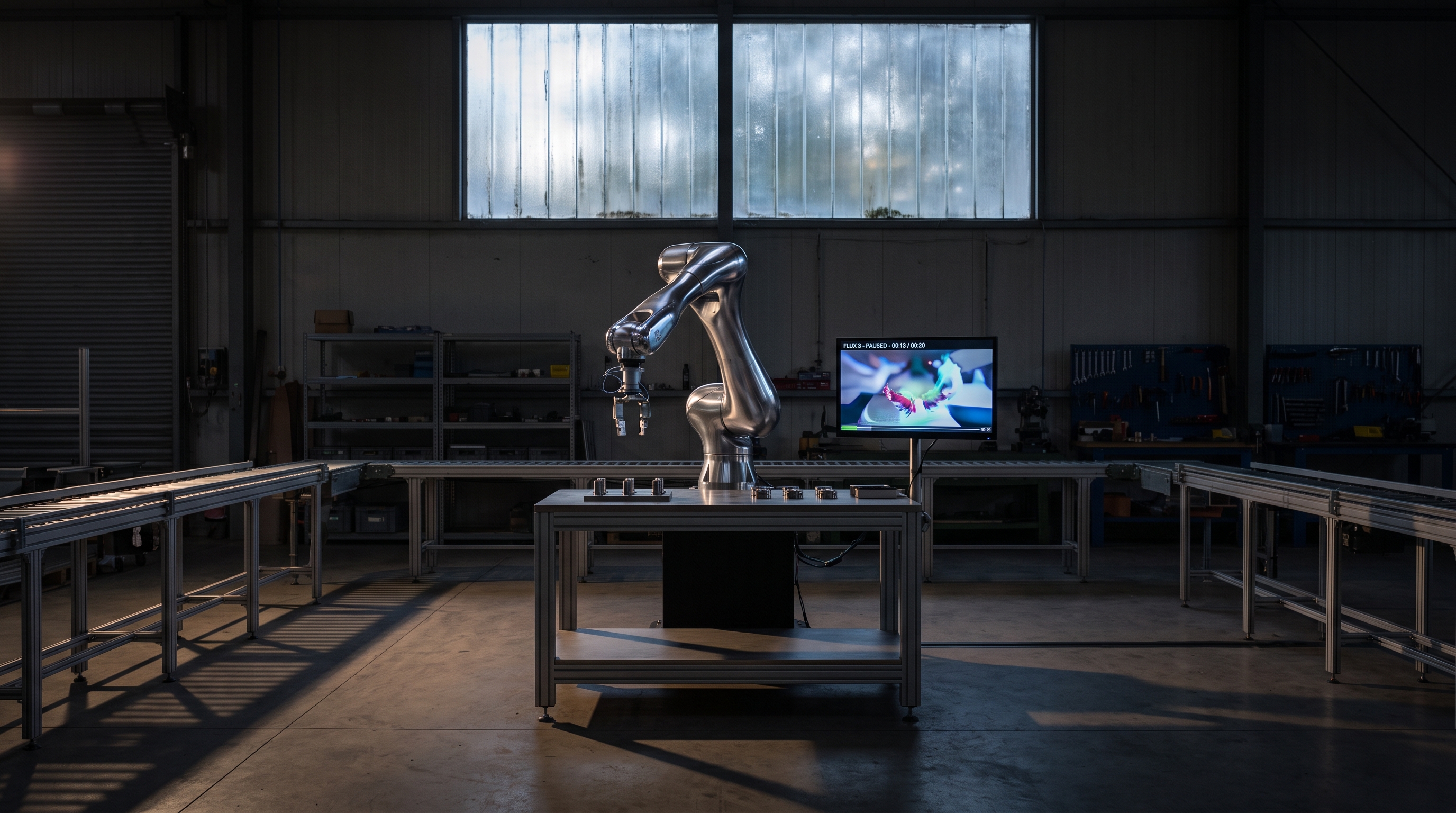
Black Forest Labs has announced the launch of FLUX 3, a multimodal foundation model capable of generating up to 20-second video clips with native audio and predicting robotic actions. The model is currently available through a gated early access program, with future plans for open-weight versions and general availability.
Key Takeaways
- FLUX 3 generates 20-second video clips with synchronized audio, matching the duration seen in OpenAI's discontinued Sora.
- Internal preference testing showed a 93% win rate against Luma Ray 3.2 and a 77% win rate against Runway Gen-4.5.
- The model architecture extends to physical AI via FLUX-mimic, currently being tested by Audi for industrial robotic assembly.
- Phased rollout includes FLUX 3 Video and Action today, with FLUX 3 Image and open-weight Dev versions arriving later in 2026.
Why It Matters
FLUX 3 shifts the generative video paradigm from silent pixel prediction to native audio-visual coherence. By training on a unified architecture, BFL targets the 'continuity gap' that has historically prevented generative tools from entering professional pipelines, specifically through agentic clip chaining for multi-minute sequences. Its edge — and its leverage for upcoming licensing deals with enterprise partners like Canva and Picsart — is the claim of 'world knowledge' where physical laws (gravity and momentum) are encoded directly into the model's visual intelligence backbone. Watch for the late 2026 open-weight Dev release, which will likely trigger a surge in local deployment for high-security industrial and creative environments.
Additional Context
Black Forest Labs has rapidly expanded its commercial footprint since its 2024 launch, moving from a research-led startup to a key infrastructure provider for global creative platforms. Per Sacra (June 2026), the company signed a $140 million multi-year licensing deal with Meta in late 2025, which, combined with contracts for Adobe Photoshop and Canva, brought its total partner contract value to approximately $300 million. This commercial momentum was supported by a December 2025 Series B round that raised $300 million at a $3.25 billion valuation, co-led by Salesforce Ventures and AMP, with participation from Nvidia and Andreessen Horowitz. The launch of the FLUX-mimic derivative also positions the firm at the center of the 'Physical AI' trend. According to reports from GlobeNewswire (July 2026), the model is already deployed in the Audi Production Lab to handle soft-body manipulation tasks that were previously impossible for conventional robotics. Audi representatives noted that the system’s reaction times average roughly 101 milliseconds, suggesting that the video prediction backbone is efficient enough for real-world industrial environments. This crossover from creative media to factory-floor automation represents a strategic move to diversify revenue beyond the volatile generative art market. While BFL holds a strong position in Western markets, it faces unique competitive hurdles. Alibaba’s Z-Image Turbo and ByteDance’s Seedance 2.0 remain formidable local-market rivals, though the latter’s international expansion was suspended following copyright concerns from major U.S. studios (VentureBeat, July 2026). Furthermore, Google’s Gemini Omni Flash remains a dominant price competitor; per Google’s June 2026 pricing updates, Omni generates 10-second clips for as little as $1.00, placing immediate pressure on Black Forest Labs to release a competitive pricing structure once it exits early access.
Read full article at venturebeat.com
Get this in your inbox → Subscribe
Enjoy our coverage?
Add StreamingMeme as a preferred source on Google to see more of our streaming news at the top of your Search results.
Add as preferred source