

Reactor releases 1.6B parameter open-source Dreamer 4 world-model implementation
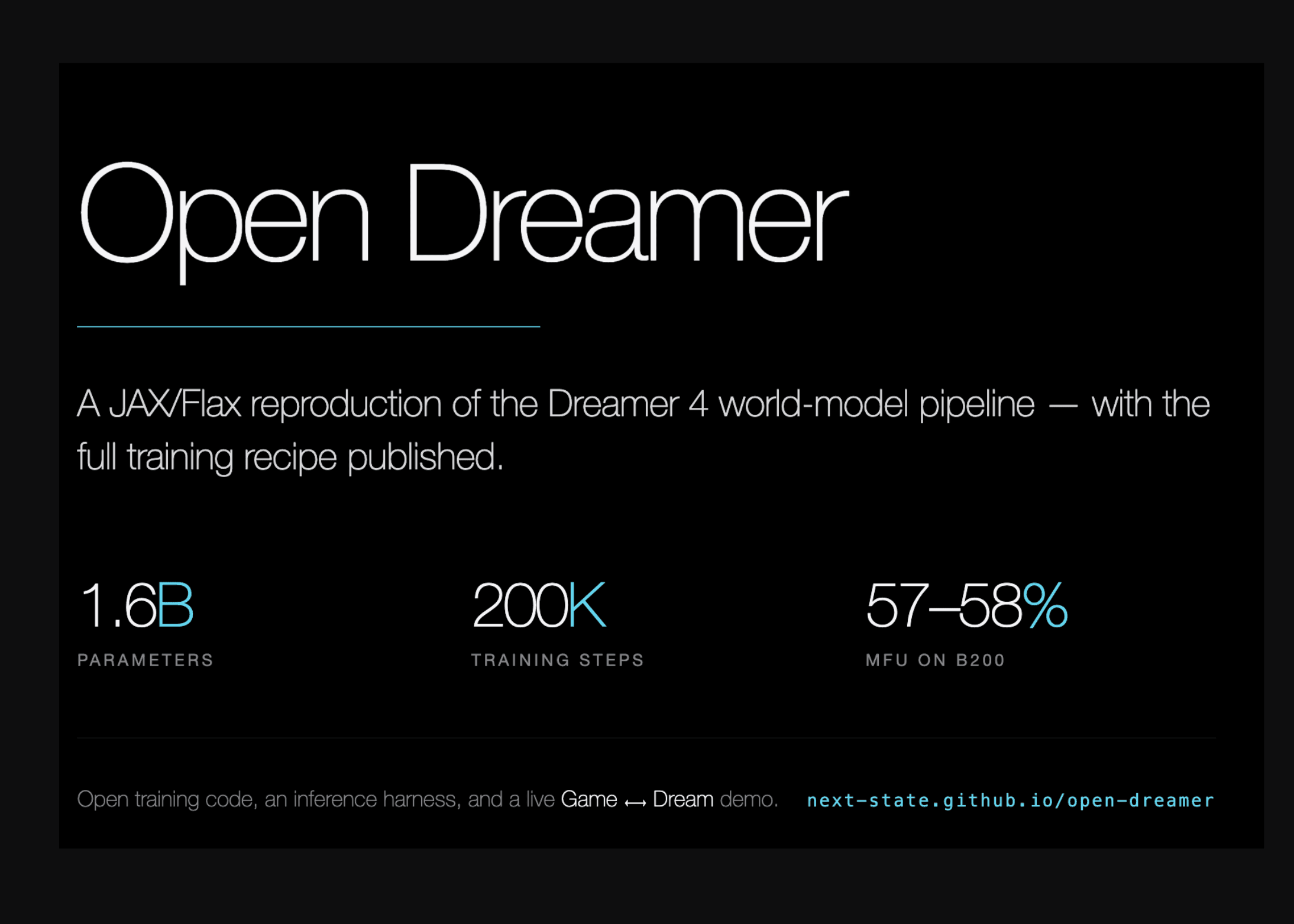
An AI research group named Reactor has released Open Dreamer, an open-source JAX/Flax reproduction of the Dreamer 4 world-model pipeline. The release features a 1.6B parameter dynamics model, a causal video tokenizer achieving 100x compression, and a Minecraft-focused real-time generation demo.
Key Takeaways
- Dynamics model features 1.6B parameters and 30 block-causal layers trained for 200,000 steps using the Muon optimizer.
- Causal video tokenizer achieves 100x compression using a transformer-based Masked Autoencoder architecture without adversarial loss.
- Model training reached 57–58% FLOPs utilization on Nvidia B200 GPUs, successfully navigating the memory wall via activation checkpointing.
- Browser-based demo includes a Game-to-Dream toggle that hands off real-time video streams from a game engine to the generative world model.
- Current license reserves all rights, with the team planning to replace this provisional notice with a formal open-source license.
Why It Matters
The release move sophisticated world-model research into an accessible, reproducible framework for B2B developers. By proving that 1.6B parameter models can simulate complex interactions in real time on a single GPU, Reactor demonstrates a path toward generative environments that replace pre-rendered video in gaming and training simulations. This shift suggests a move away from static video content toward interactive, action-conditioned streams. Strategists should monitor if this repo's upcoming formal license encourages downstream application in robotics or virtual production, and whether the planned reinforcement learning loops improve the agent's long-horizon planning capabilities.
Additional Context
The Dreamer 4 architecture, originally detailed in research by Danijar Hafner and others in September 2025, represented a significant milestone as the first agent to obtain diamonds in Minecraft using only offline video data. Per arXiv (Sept 2025), the model’s ability to learn from diverse, unlabeled video datasets addresses the high cost and safety risks associated with online environment interaction. This research demonstrated that agents can develop a deep understanding of physics and object dynamics through "imagination training," outperforming prior benchmarks like OpenAI’s VPT while using approximately 100x less data.
Reactor, the startup behind the Open Dreamer implementation, emerged from stealth in May 2026 with $59 million in Series A funding led by Lightspeed Venture Partners. According to AWS (May 2026), Reactor is positioning itself as the infrastructure layer for real-time generative video, building APIs and SDKs that sit between complex world-model research and commercial application. The company was co-founded by former Apple Vision Pro technical leads and has gained significant industry attention, including a board observer seat for WndrCo founder Jeffrey Katzenberg.
This release aligns with an industry-wide push toward agentic autonomy and interactive world models. In March 2026, Meta aggressively moved into this space by licensing technology and hiring the founding team of the startup /dev/agents, according to recent tech reporting. While companies like Meta focus on consumer-facing personal agent operating systems, Reactor’s open-source release target engineers building for media, entertainment, and robotics. This fragmentation mirrors the early days of LLM development, where high-performance open implementations frequently catalyzed rapid downstream commercialization.
Read full article at marktechpost.com
Enjoy our coverage?
Add StreamingMeme as a preferred source on Google to see more of our streaming news at the top of your Search results.
Add as preferred source