

Merging Technologies debuts Anubis Premium SPS for mission-critical broadcast audio
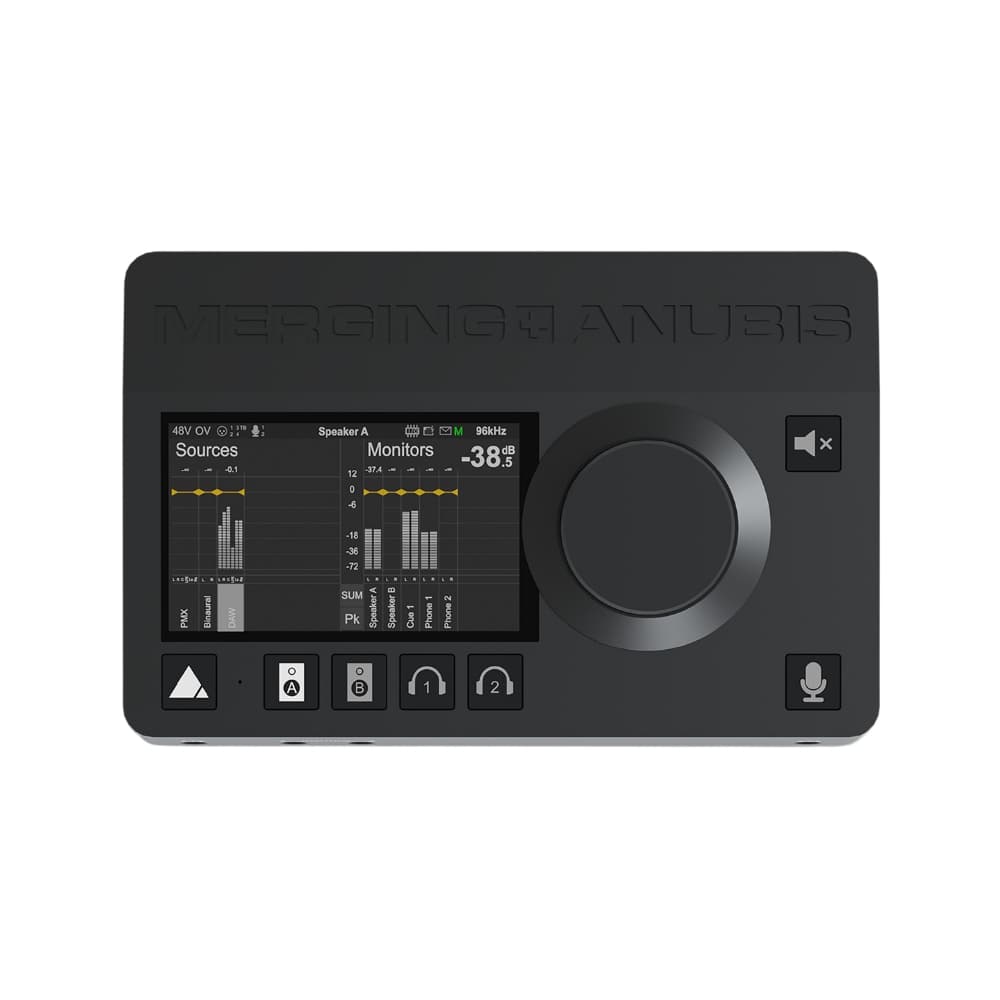
Merging Technologies has launched the Anubis Premium SPS, a networked audio interface that integrates ST 2022-7 Seamless Protection Switching for redundant broadcast workflows. The device supports high-resolution audio formats and is fully compliant with ST 2110 and NMOS standards for IP-based production environments.
Key Takeaways
- Integrated dual Gigabit Ethernet ports support ST 2022-7 Seamless Protection Switching for redundant network operation.
- Hardware supports high-resolution formats including 32-bit PCM up to 384kHz, DXD, and native DSD64 through DSD256.
- Compliant with ST 2110 Class C and NMOS IS-04/IS-05 standards for discovery and connection management in IP infrastructures.
- Onboard FPGA-based DSP enables low-latency monitoring, bass management, and immersive audio control directly on the device.
Why It Matters
The introduction of ST 2022-7 redundancy to a compact desktop interface signals a maturing of IP-based audio-over-video workflows, moving professional-grade protection into modular studio hardware. By integrating NMOS and ST 2110 standards, Merging Technologies provides the interoperability necessary for hybrid facilities transitioning away from legacy SDI. This enables smaller production units and remote broadcast teams to maintain mission-critical reliability without large-scale rack hardware. For the wider market, it reinforces the shift toward "software-defined" monitoring where hardware roles are determined by networking protocols. Watch for the adoption rate of such redundant desktop units in live sports contribution where link reliability remains a primary engineering bottleneck.
Additional Context
The launch of the Anubis Premium SPS follows the 2022 acquisition of Merging Technologies by the Sennheiser Group, which moved the Swiss audio specialist into a strategic partnership with Georg Neumann GmbH. According to MusicTech in June 2025, the Sennheiser Group reported annual revenues of €492.3 million for the 2024 financial year, during which it invested roughly 10% of total sales into research and development for its professional brands, including Merging and Neumann. This integration has prioritized standardizing IP protocols across the group's product lines to capture the growing broadcast demand for IP-native equipment.
At the NAB 2026 Show, industry leaders highlighted that while Audio-over-IP (AoIP) has become a de facto standard, the "second wave of IP" is now focused on operationalizing these systems via software-driven infrastructure. Per TV Technology in April 2026, despite the momentum of SMPTE ST 2110, approximately 82% of broadcast operations still utilize SDI backbones, cited in a Haivision survey. The persistent complexity of managing the Precision Time Protocol (PTP) for synchronization remains a cited hurdle for facility-wide migrations.
Simultaneously, the broadcast market is facing shifts in professional audio ownership. In March 2026, Sonova Holding AG, which acquired Sennheiser's consumer division in 2022, announced plans to divest that consumer unit to focus on medical hearing aids. This move physically separates the Sennheiser brand's professional and consumer identities, leaving the Sennheiser Group—and its subsidiaries like Merging—to concentrate exclusively on high-end professional audio and streaming technology for the broadcast and studio sectors.
Read full article at audiochocolate.com.au
Enjoy our coverage?
Add StreamingMeme as a preferred source on Google to see more of our streaming news at the top of your Search results.
Add as preferred source