

Google morphs Flow Music Spaces into end-to-end AI production studio
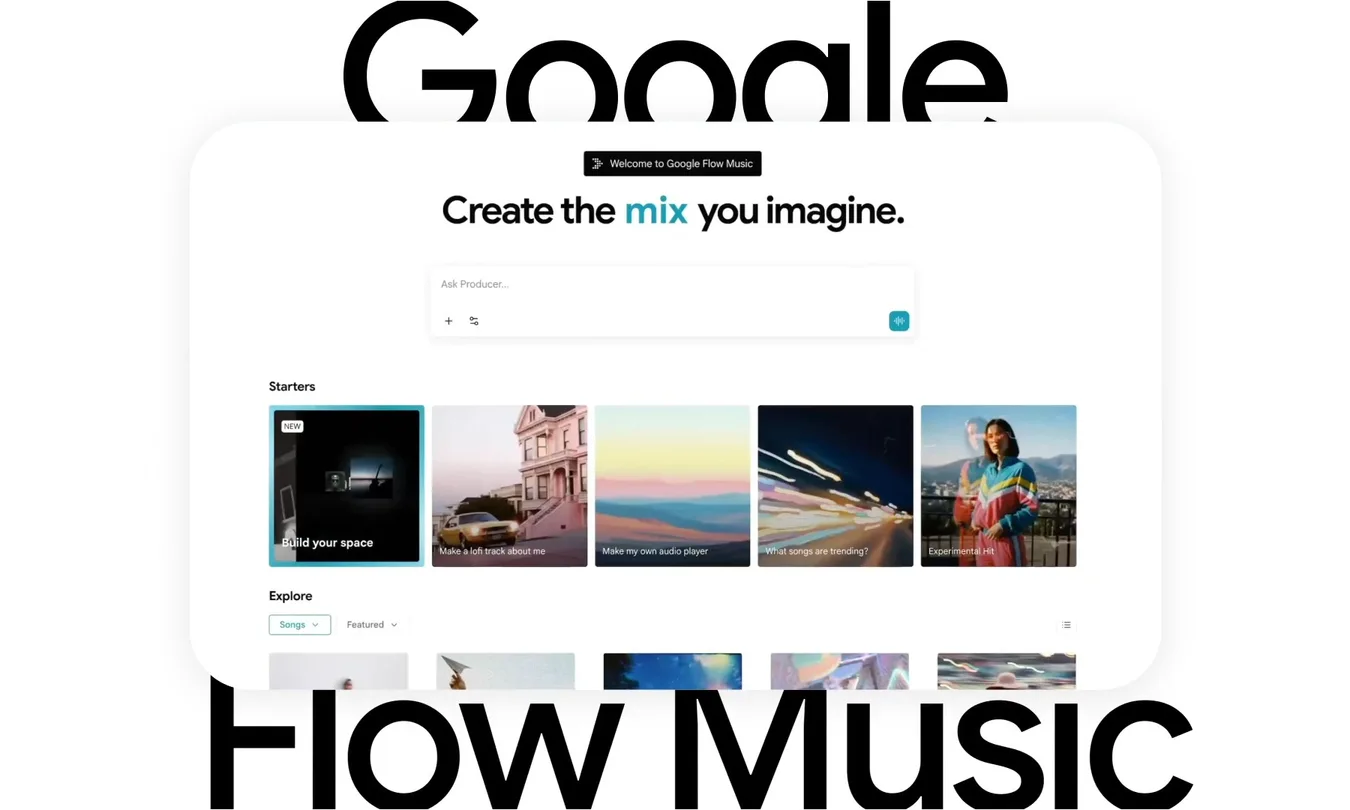
Google has expanded its Flow Music Spaces platform with enhanced AI-powered creative tools including stem splitting, internal song editing, and direct video, image, and lyrics generation. The update aims to integrate the fragmented music and video production workflow into a single collaborative environment.
Key Takeaways
- New 'Spaces' tools include stem splitting to isolate vocals and instrumentals for precise remixing and editing.
- Integrated creative suite now generates non-audio assets including lyrics, images, and full-length videos.
- Song editing features 'Cover', 'Replace', and 'Extend' allow direct manipulation of specific track segments.
- The platform shifts from a 'prompt-and-output' model to an 'all-in-one' studio focused on the production lifecycle.
Why It Matters
This move signals a strategic shift from standalone AI generators to integrated vertical suites. By owning the 'messy middle' of production — editing, packaging, and visual pairing — Google aim to lock creators into its ecosystem before the final asset is published. For the streaming industry, this lowers the barrier for high-volume, synchronized content creation, potentially flooding social and streaming platforms with highly polished, AI-assisted multi-asset campaigns. Watch for whether professional digital audio workstations (DAWs) respond with similar integrated visual tools to prevent user churn.
Additional Context
The expansion of Flow Music Spaces follows a series of laboratory consolidations at Google. Per SiliconAngle (May 2026), the platform was significantly bolstered at Google I/O 2026 through the integration of Gemini Omni Flash and Lyria 3 Pro. These models introduced 'vibe coding,' a system allowing users to build custom virtual instruments and modular workflows via natural language. Earlier that year, according to fonearena.com (February 2026), Google had already unified its visual tools by merging Whisk AI and ImageFX into the broader Flow interface, creating a singular workspace for image and video generation.
Historically, the tool originated from Google's April 2026 acquisition of Producer.ai, a startup that rebranded from Riffusion, according to Zinstrel (April 2026). This acquisition provided the foundational 'Replace and Extend' logic now powering the new Spaces editing features. While Google is pushing toward mainstream adoption with dedicated Flow mobile apps on Android and iOS, it faces significant industry friction. Per LA Times (February 2026), the company is currently navigating class-action litigation from independent musicians alleging copyright infringement and unauthorized training on creative data.
Competition is intensifying as the AI music market is projected to reach $5.55 billion by the end of 2026, according to Medium (June 2026). While Google focuses on a unified studio approach, competitors like Apple and Suno are targeting different segments. Apple introduced 'Playlist Playground' in February 2026 to bring AI curation to mainstream Apple Music listeners, while Suno Studio launched in June 2026 to blend generative features with professional multi-track editing. Additionally, Google recently signed a distribution partnership with TuneCore (May 2026) to ensure outputs meet legal standards for commercial streaming, directly competing with specialized tools like Muzaic that focus on rights-cleared soundtracks for serial video creators.
Read full article at wersm.com
Enjoy our coverage?
Add StreamingMeme as a preferred source on Google to see more of our streaming news at the top of your Search results.
Add as preferred source