

Verizon secures $1B+ Google deal for AI data center dark fiber
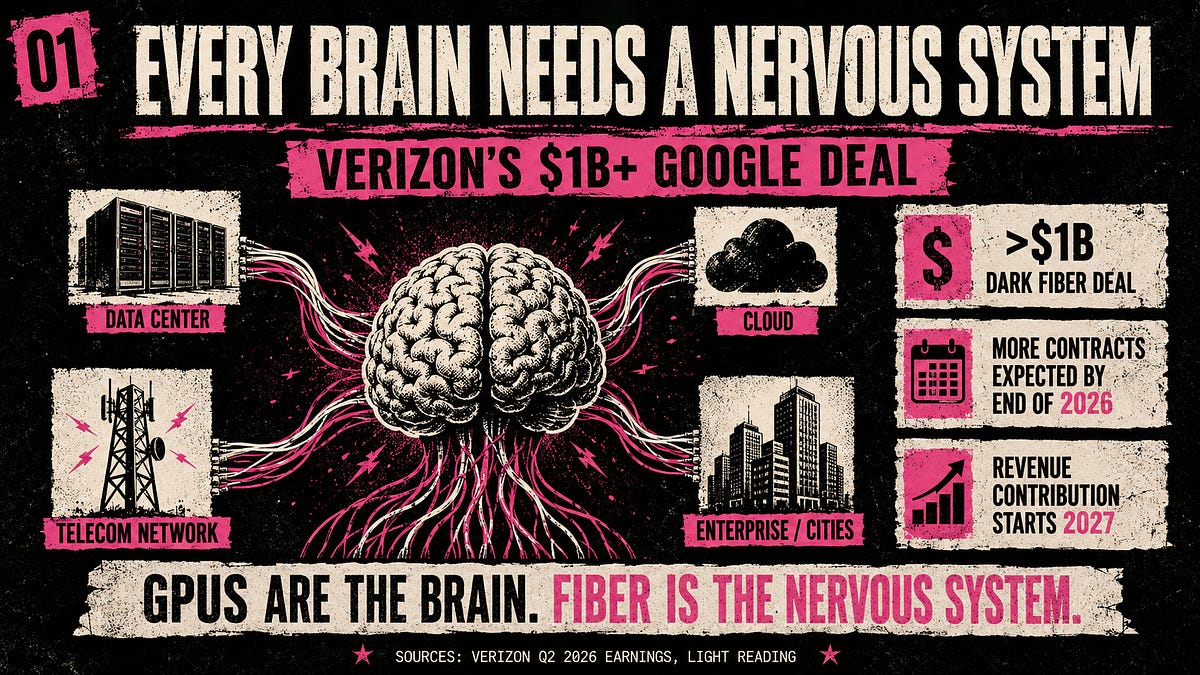
Verizon has entered into a multi-year deal valued at over $1 billion to provide Google with dark fiber and managed capacity to support AI data center connectivity. The agreement reflects the growing need for high-capacity networking infrastructure to transport large AI training datasets and inference results between computing clusters and edge locations.
Key Takeaways
- Verizon will supply Google with multiple dark fiber routes and managed lit capacity for AI infrastructure.
- Financial contributions from the contract are scheduled to begin in 2027.
- CEO Dan Schulman expects to announce additional hyperscaler contracts totaling several billion dollars by year-end 2026.
- Verizon intends to use existing fiber assets while constructing new routes where required for Google’s network.
Why It Matters
The migration of AI workloads from localized training to distributed inference is turning terrestrial fiber into a critical bottleneck. While hyperscalers like Google own massive private networks, the speed of AI expansion is forcing a reliance on carrier-owned 'nervous systems' to bridge the gap between regional clusters. For the streaming ecosystem, this shift signals that future delivery costs and latency will be heavily dictated by how telcos monetize their legacy long-haul assets. Watch for whether rival carriers like AT&T move to aggressively reprice their unlit fiber to capture similar multi-billion dollar back-end commitments.
Additional Context
The Verizon-Google agreement is part of a broader industry-wide surge in high-capacity infrastructure spending driven by artificial intelligence. Per Fierce Network (February 2025), Lumen Technologies and Zayo have already secured major hyperscale networking deals worth $8 billion and $1 billion respectively, with Amazon Web Services, Microsoft, and Meta identified as lead customers. Zayo reported that demand for long-haul dark fiber doubled between 2024 and 2025 as AI workloads forced more distributed network architectures. To meet this demand, Zayo announced plans to build over 5,000 new route miles of fiber over the next five years. This terrestrial expansion coincides with a massive capital cycle in subsea connectivity. Per TeleGeography (March 2026), total investment in new subsea cable projects is projected to reach $13 billion between 2025 and 2027, nearly double the previous three-year window. Alphabet (Google) alone has raised its 2026 capital expenditure guidance to between $195 billion and $205 billion, up from $180 billion, specifically to fund the servers, data centers, and networking gear required for AI mining. Analysts at Omdia (June 2026) noted that hyperscalers now participate in over two-thirds of all planned submarine deployments, dominating 75% of global international bandwidth. For traditional telcos, the AI boom offers a strategic pivot toward 'AI Connect' services. Per Nvidia's State of AI in Telecom 2026 report, 90% of operators are now using AI to grow revenue, frequently by retrofitting old central offices into power-ready edge data centers for local inference. This infrastructure layer is critical because AI data center designs currently require approximately 36 times more fiber-optic cabling than traditional facilities to handle the intensity of internal and external data flows, according to industry reporting from July 2026.
Read full article at sebastianbarros.substack.com
Get this in your inbox → Subscribe
Enjoy our coverage?
Add StreamingMeme as a preferred source on Google to see more of our streaming news at the top of your Search results.
Add as preferred source