

TDF activates 5G Broadcast across four French cities, targets nationwide by 2028
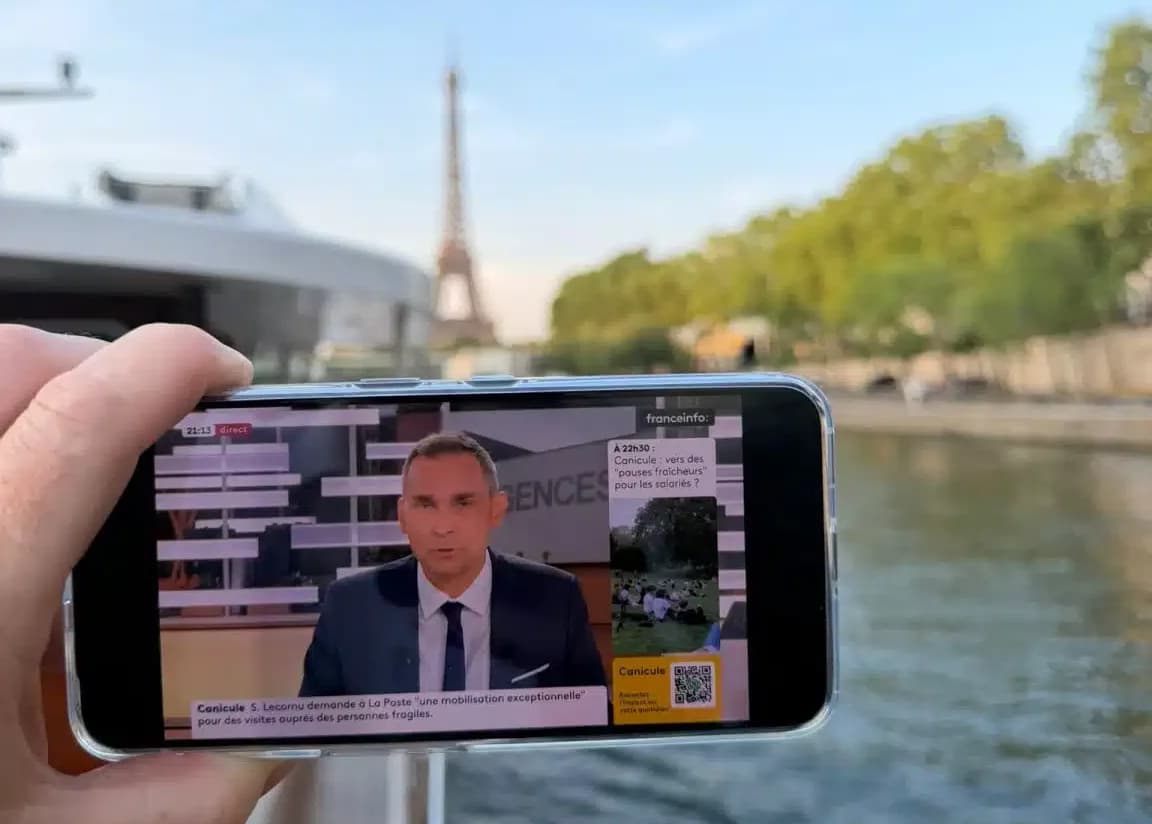
French broadcast infrastructure provider TDF is expanding its 5G Broadcast trial across multiple cities, aiming to extend free-to-air DTT to smartphones without SIM cards or data consumption. The technology uses a single signal for simultaneous reception, offering broadcasters a mobile distribution complement to streaming. Nationwide expansion is planned through 2028.
Key Takeaways
- Initial broadcast zones are operational across Paris, Reims, Bourges, and Le Havre, using transmitter sites including the Eiffel Tower and Meudon
- Technology delivers live TV to smartphones without a SIM card, Wi-Fi, or data consumption via a single point-to-multipoint signal received simultaneously by all devices
- Further expansions are scheduled for 2026 in Brittany, Eastern France, the Lyon area, and the South-West, with nationwide rollout continuing through 2027 and 2028
- Trial was announced June 25 at a Paris event featuring TDF CEO Karim El Naggar, T18 President Christopher Baldelli, and France Télévisions Director of Distribution Jacques Donat-Bouillud
Why It Matters
TDF's trial gives broadcasters a mobile distribution path that bypasses cellular networks entirely — no SIM card, no data consumption, no streaming infrastructure required for live TV on smartphones. For streaming and OTT operators, TDF positions 5G Broadcast as complementary rather than competitive, but it targets the mass-audience live viewing scenarios where unicast streaming can hit capacity limits. Watch whether TDF's scheduled 2026 expansion to Brittany, Lyon, and the South-West brings additional commercial broadcasters into the trial beyond France Télévisions and T18.
Additional Context
TDF's deployment fits into a broader European push. Italy's public broadcaster Rai, together with network operator Rai Way, has been running a pre-commercial 5G Broadcast service since November 2024 in Rome and Turin, broadcasting three TV channels 24/7, with plans to expand to Milan, Naples, and Palermo (per Rai Way). During the Milano Cortina 2026 Winter Olympics in February, Rai and the European Broadcasting Union conducted additional trials to evaluate reception and service performance in metropolitan areas (per SVG Europe, February 2026).
Germany is also advancing. The media authority MSA extended its 5G Broadcast pilot project in Halle — originally launched in June 2024 — through May 31, 2028. The trial uses UHF channel 40 and recently added local commercial channel MDF 1, the first time a local commercial broadcaster has participated in a German 5G Broadcast trial (per Broadband TV News, May 2026).
Device availability remains the key bottleneck. Qualcomm chipsets already support 5G Broadcast in hardware, but mainstream handset manufacturers have not yet enabled the feature in commercial products. XGN Global and X1 Mobile announced the world's first commercial 5G Broadcast-capable smartphone at Mobile World Congress in March 2026 — a rugged device targeting first responders, available from May 2026 (per TM Broadcast International, March 2026). Industry analysis from TM Broadcast suggests the first 5G Broadcast-enabled Android smartphones for general consumers could arrive in the first half of 2028, with a forecast of 275 million citizens covered across 21 EU countries by end of 2030.
TDF's ambitions are substantial. According to Telecompaper (March 2026), the operator plans to deploy across approximately 20 locations initially — representing over 12 million people — scaling to 320 broadcasting sites covering 40 million people by 2028. The 3GPP standardization of 5G Broadcast was completed in December 2025 with Release 19 (per Rai CRIT).
Read full article at advanced-television.com
Enjoy our coverage?
Add StreamingMeme as a preferred source on Google to see more of our streaming news at the top of your Search results.
Add as preferred source