

Resolve guide urges custom bitrates over standard YouTube presets
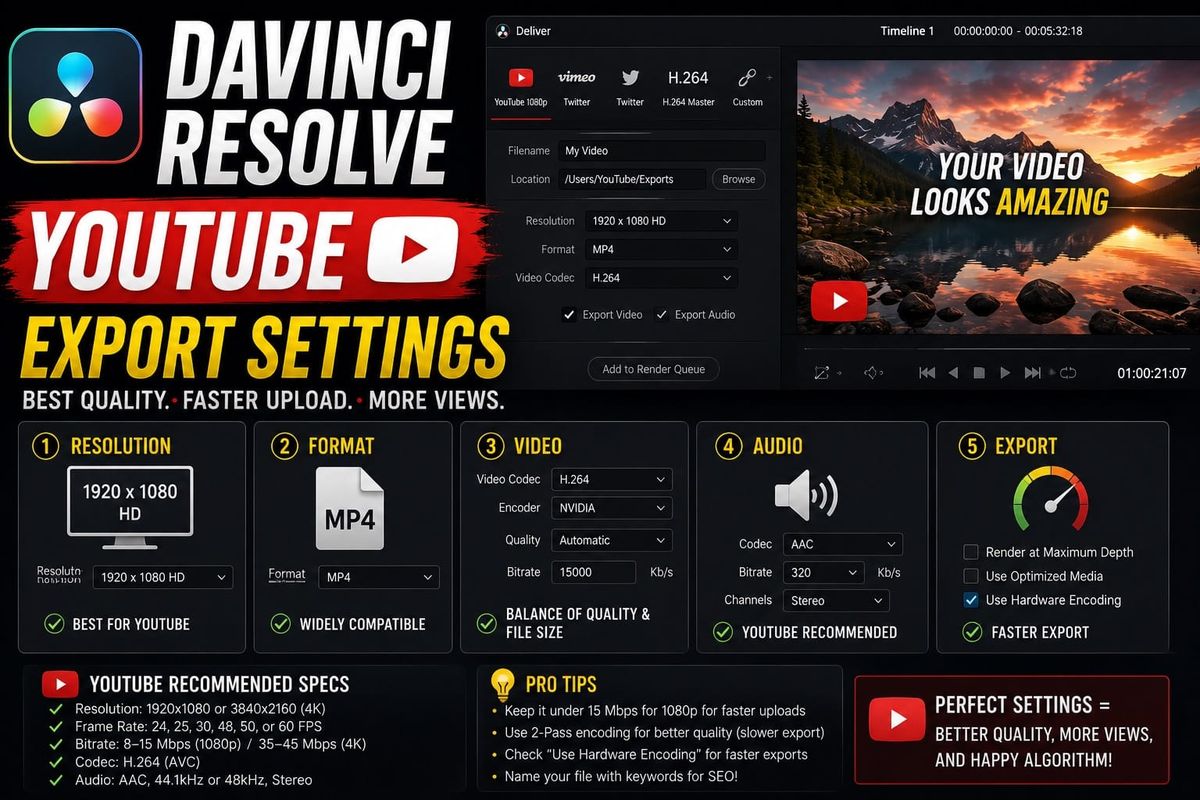
This technical guide details the recommended export settings for DaVinci Resolve when delivering content to YouTube, emphasizing custom bitrate targets over standard presets. It also analyzes hardware acceleration differences within the software across macOS, Windows, and Linux platforms.
Key Takeaways
- Recommended 4K bitrate targets in Resolve range from 45-60 Mbps for 30fps and 65-85 Mbps for high-frame-rate content.
- Hardware-accelerated H.264/H.265 encoding is available in the Free version on macOS, unlike Windows and Linux where it requires a Studio license.
- Network Optimization should be checked to move the 'moov atom' to the front of the MP4 container for faster platform processing.
- Free version users are capped at Ultra HD (3840x2160) resolutions at up to 60fps regardless of hardware or OS.
- Audio export should be set to 384 Kbps AAC-LC for stereo to match YouTube's exact high-tier recommendation.
Why It Matters
The shift toward 4K and HDR content on YouTube has made Resolve’s legacy presets increasingly insufficient for high-fidelity delivery. By exceeding the standard encoding 'floor,' creators can mitigate the quality loss inherent in YouTube's aggressive server-side re-encoding, specifically combating color banding and motion artifacts. This technical calibration reflects a broader industry trend where software capabilities vary sharply by operating system, forcing engineering and production teams to choose hardware based on specific encoding efficiencies. Watch for similar cross-platform performance audits as DaVinci Resolve continues to expand its AI-driven 'Neural Engine' features.
Additional Context
The release of DaVinci Resolve 21 in April 2026 further expanded the software's capabilities, introducing specialized AI tools like 'IntelliSearch' for media analysis and 'CineFocus' for post-production focal point adjustment. Per TVB Europe (April 2026), these updates include advanced AI-generated speech and face aging transformations, marking a strategic pivot toward generative tools within the NLE ecosystem. This follows the 2025 release of version 20, which Blackmagic Design positioned as a major upgrade featuring over 100 new tools, including AI-driven automated multicam switching and animated subtitling. Hardware partnerships have become a critical differentiator in this landscape. For example, per NVIDIA (April 2024), AI effects in Resolve are now heavily optimized for TensorRT, reportedly running up to three times faster on GeForce RTX 4090 GPUs compared to equivalent Apple silicon. Simultaneously, Blackmagic has optimized performance for Windows ARM systems. Per Blackmagic (June 2024), the software saw a 4.7x speed increase for neural engine tasks on Snapdragon X Elite processors. This fragmentation in hardware optimization underscores why the 2026 guide warns editors that rendering speeds and encoding access are no longer uniform across different desktop environments. YouTube’s own standards have evolved alongside these software shifts. While H.264 remains the compatibility standard, current platform behavior prioritizes the newer AV1 and VP9 codecs for 4K and high-traffic videos. Per ZebGardner.com (January 2026), uploading in 1440p or 4K often triggers a 'VP9 threshold' that preserves significantly more detail than standard 1080p uploads. Consequently, industry experts now treat YouTube's published bitrate ranges as mere minimums, as the platform’s subsequent re-encoding passes often degrade footage that was originally delivered near the technical floor.
Read full article at davinciresolveclub.com
Get this in your inbox → Subscribe
Enjoy our coverage?
Add StreamingMeme as a preferred source on Google to see more of our streaming news at the top of your Search results.
Add as preferred source