

Radio France deploys Lawo IP audio infrastructure for massive Bastille Day broadcast
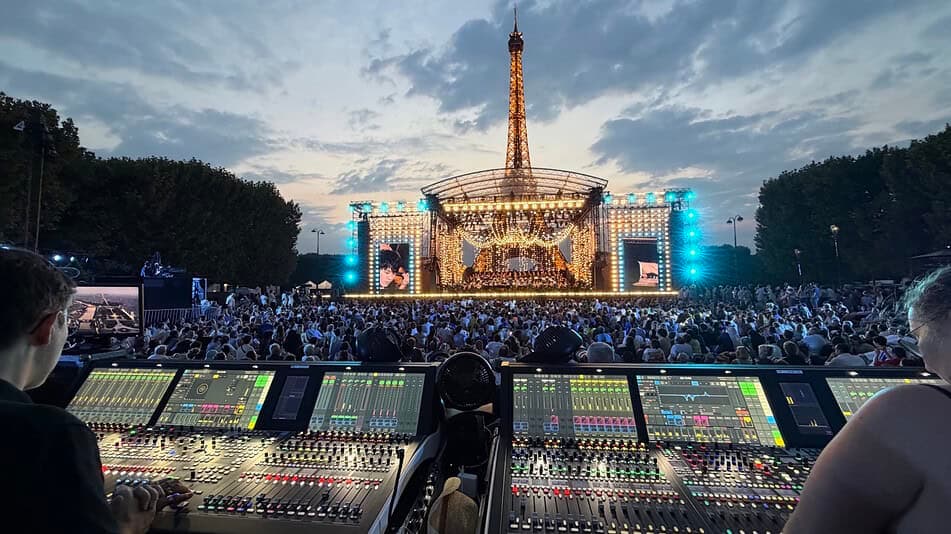
Radio France deployed an IP-based audio production infrastructure from Lawo for the 2026 Concert de Paris, utilizing mc² consoles, A__UHD Core audio engines, and RAVENNA networking. The setup enabled live sound reinforcement, stage monitoring, and broadcast distribution across 70 countries, incorporating new Dynamic EQ functionality.
Key Takeaways
- Deployment of three Lawo mc²56 production consoles linked to a redundant pair of A__UHD Core audio engines via a RAVENNA network.
- First-time utilization of Lawo’s Dynamic EQ functionality at the event to enhance tonal precision for live and broadcast mixes.
- Integrated management via the Lawo HOME platform for system-wide device discovery, security, and operational monitoring.
- Dual-operator mc²56 configuration used for stage monitoring to provide low-latency mixes for the Orchestre National de France.
- Broadcast audio facilitated by a Lawo mc²66 MkII console within Radio France’s OB facilities for Eurovision and Euroradio distribution.
Why It Matters
The transition to fully redundant, software-defined IP audio allows broadcasters to handle the massive scale of 70-country distribution without the physical footprint of traditional hardware. By centralizing management through the HOME platform, Radio France minimizes latency and maximizes routing flexibility, which is critical for live outdoor productions involving thousands of performers and drones. This deployment demonstrates that AoIP (Audio over IP) has matured enough to support the industry's most high-profile, mission-critical cultural broadcasts. Watch for further adoption of virtualized DSP engines as broadcasters shift away from dedicated FPGA-based hardware to more flexible, software-defined microservices on COTS servers.
Additional Context
The 2026 Concert de Paris continues a broader industry trend toward software-defined production. At InfoComm in May 2026, Lawo debuted its HOME mc² DSP app, which virtualizes the A__UHD Core engine used in Paris. Per Lawo and TV Technology (May 2026), this shift allows engineers to instantiate virtual mixing engines on standard servers, potentially eliminating the need for dedicated hardware in future large-scale events. This movement toward virtualization is mirrored by other major players; for instance, Grass Valley launched its AMPP Edge Live platform in June 2026 to bring enterprise-grade live production to the edge of the network.
Simultaneously, the European Broadcasting Union (EBU) reported significant shifts in how these massive live events are consumed. While traditional linear television remains a core component, digital engagement for EBU-distributed events like the Eurovision Song Contest reached record heights in 2026. Per ESCXTRA (June 2026), official Eurovision content generated 2.75 billion views across social platforms in early 2026, while host broadcaster ORF in Austria saw a 76% increase in digital viewership. This expanding digital footprint places immense pressure on audio delivery systems to maintain high-fidelity standards across fragmented mobile and web platforms.
Beyond technical delivery, classical music broadcasters are increasingly integrating immersive technologies to reach younger demographics. In November 2025, the Philharmonie de Paris launched a mixed-reality concert experience featuring 360-degree video and spatial audio, as reported by ClassicalNext. As public radio stations in the U.S. and Europe face shifting funding models—highlighted by U.S. public radio's 2025 budgetary uncertainties per WGTE—leveraging high-efficiency software-defined live video like those seen at Bastille Day has become a strategic priority for maintaining high-quality cultural programming with lower long-term operational costs.
Read full article at sportsvideo.org
Enjoy our coverage?
Add StreamingMeme as a preferred source on Google to see more of our streaming news at the top of your Search results.
Add as preferred source