

Pliant Technologies launches frameless matrix IP intercom for production workflows
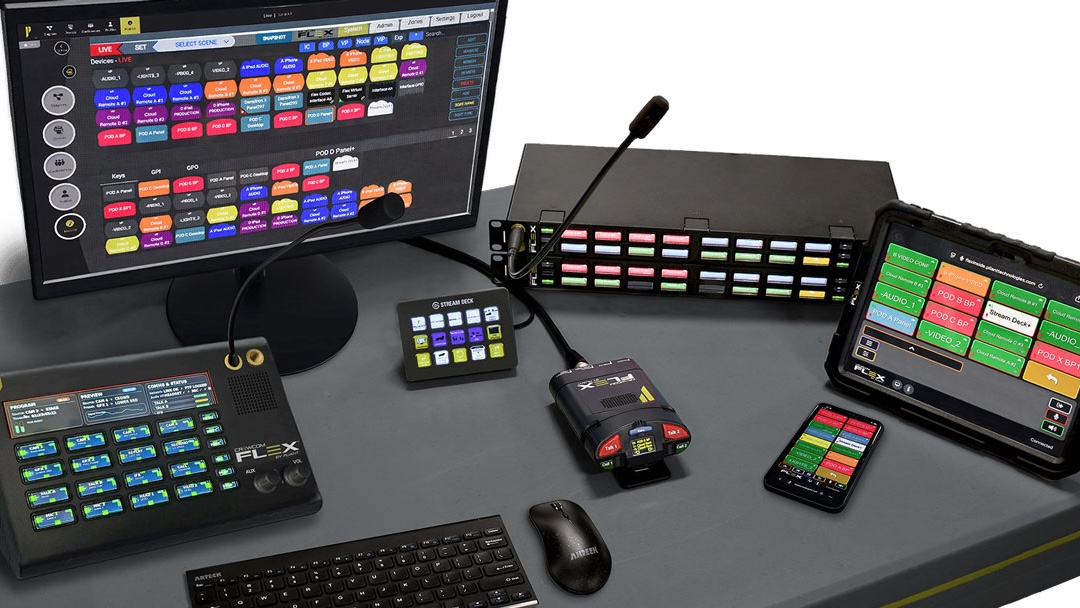
Pliant Technologies has launched CrewCom Flex, a frameless matrix IP intercom system designed to support AES67 and SMPTE ST 2110 standards. The platform enables scalable, distributed voice communications across wired, wireless, and virtual infrastructures for production environments.
Key Takeaways
- Eliminates centralized hardware frames, using each CKP-16 Main Panel as an intelligent distributed matrix node.
- Supports SMPTE ST 2110 and AES67 standards with ST 2022-7 redundancy for mission-critical reliability.
- Features a browser-based virtual intercom solution with configurations ranging from 4 to 36 keys.
- Enables legacy CrewCom integration via the CXD-32CF 32x32 Dante/AES67 digital network interface.
- Introduces CBP-22 and CBP-24 beltpacks with integrated speakers for communication without headsets.
Why It Matters
The transition to frameless matrix systems addresses the scaling bottlenecks and single points of failure inherent in traditional centralized hardware. By adopting ST 2110-30 and AES67, Pliant aligns its communication stack with the broader industry move toward vendor-agnostic, all-IP broadcast facilities. This allows engineers to manage voice, video, and data over a unified managed network rather than maintaining discrete infrastructure for intercom. The inclusion of native virtual panels also accommodates the rise in remote and hybrid production, enabling off-site staff to join local loops via standard web browsers. Watch for whether this decentralized model forces legacy matrix providers like Clear-Com or RTS to accelerate their hardware-to-software pivot.
Additional Context
The launch of CrewCom Flex at InfoComm 2026 follows a period of expansion for Pliant. In early 2026, the company appointed Adam Grede as Regional Sales Manager to drive growth in the Pro AV sector, per Pliant's January 2026 corporate reporting. This was accompanied by a new distribution partnership with Audio Tecnologias in Spain in March 2026, signaling a concerted push to capture a larger share of the international broadcast and live events market. These moves highlight Pliant's strategy to move beyond its established wireless niche into full-scale production infrastructure. Technically, the integration of SMPTE ST 2110-30 is a critical development for the intercom sector. Per SMPTE and AIMS documentation (as referenced in 2025/2026 engineering briefings), the ST 2110 suite allows for the separate carriage and synchronization of audio, video, and data streams. By adopting this, Pliant ensures its hardware can interoperate with other Tier 1 broadcast equipment without needing dedicated analog or proprietary digital bridges. This alignment with 'essence-based' workflows is increasingly becoming a requirement for major outside broadcast (OB) fleets and fixed studio installations. Competitively, the market for IP-based intercoms has seen significant activity throughout 2026. Per TV Technology, other major players like Clear-Com and Lawo have similarly focused on IP interoperability at major trade shows like NAB and InfoComm. Specifically, Lawo showcased its Edge One platform in mid-2026, targeting efficient IP workflows that compete with the same decentralized, scalable model proposed by Pliant's CrewCom Flex. This competition underscores a shift where product differentiators are defined by software flexibility and network redundancy rather than the physical capacity of a centralized rack-mounted frame.
Read full article at mixonline.com
Get this in your inbox → Subscribe
Enjoy our coverage?
Add StreamingMeme as a preferred source on Google to see more of our streaming news at the top of your Search results.
Add as preferred source