

Hardware-level NPU integration drives localized AI video processing at 15 Watts
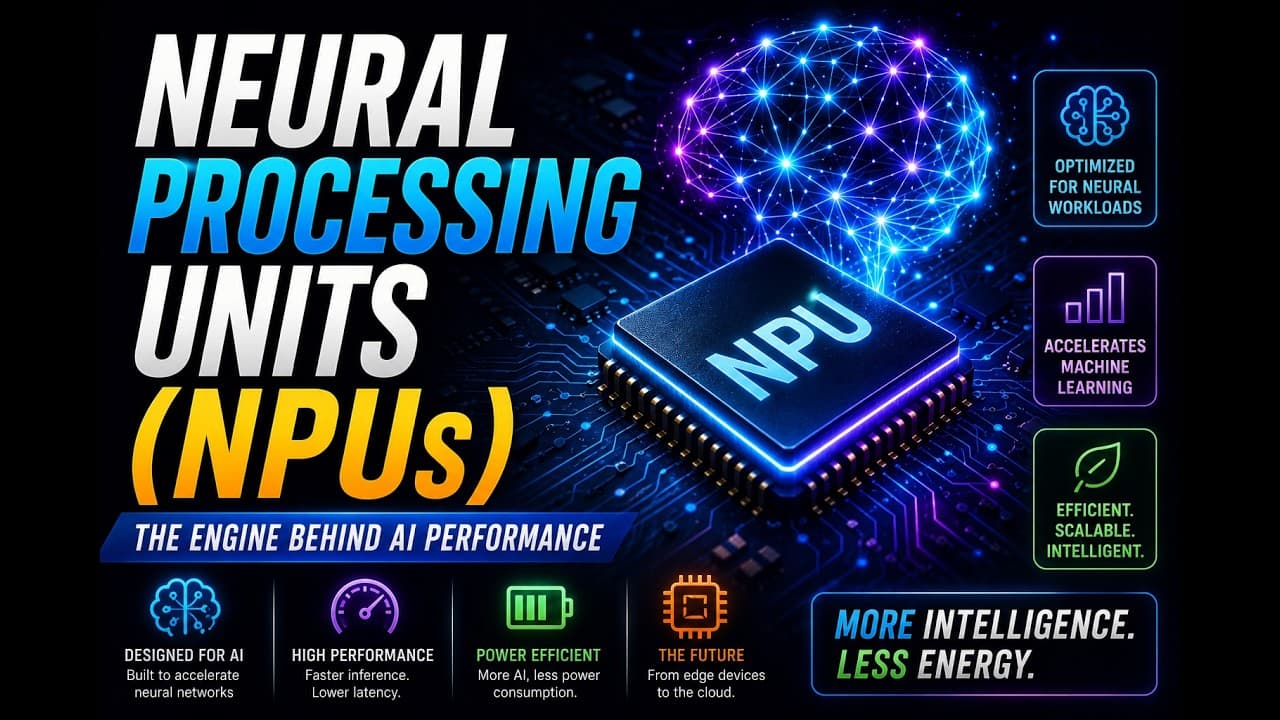
This technical analysis explores the evolution of Neural Processing Units (NPUs) and their role in handling localized AI inference for media and computing tasks within a low thermal envelope. It highlights how NPUs differ from CPUs and GPUs in data-flow execution and memory hierarchy, emphasizing their growing importance in offloading background video processing tasks.
Key Takeaways
- Snapdragon X2 Elite leads current NPU raw performance with 80-85 TOPS on a 3nm process.
- Data-flow execution models allow NPUs to dedicate 80-90% of clock cycles to AI math by eliminating cache misses and branching.
- Memory bandwidth, rather than raw TOPS, is identified as the primary bottleneck for large language model (LLM) performance on-device.
- Integrated NPUs maintain continuous background inference tasks within a 1W to 15W thermal envelope.
Why It Matters
The shift toward on-device NPU inference fundamentally alters the streaming device ecosystem by enabling low-latency, privacy-first video enhancements without cloud reliance. For stream operators, this transition shifts the cost of real-time AI processing—such as noise reduction and upscaling—from server-side infrastructure to consumer hardware. The architectural split between NPUs for efficiency and GPUs for heavy lifting defines a new system design philosophy for media playback devices. Success for third-party video apps now hinges on optimizing for heterogeneous compute across varied NPU targets. Watch for whether memory bandwidth parity emerges as the key benchmark over marketing-focused TOPS ratings in the 2027 chipset cycle.
Additional Context
At CES 2026, Intel launched the Core Ultra Series 3 'Panther Lake' processors, built on the Intel 18A process, which feature standalone NPUs rated at 50 TOPS. Per Intel (January 2026), these chips are designed to power over 200 mobile designs and offer up to 2.3x better performance per watt on end-to-end video analytics compared to previous generation hybrid architectures. They are the first compute platforms from the company to focus explicitly on localizing edge AI workloads to reduce total cost of ownership by eliminating discrete GPU requirements for creative tasks.
AMD expanded its mobile presence in January 2026 with the Ryzen AI 400 'Gorgon Point' lineup. Per HotHardware (January 2026), the flagship Ryzen AI 9 HX 475 utilizes an XDNA 2 NPU achieving 60 TOPS and supports LPDDR5X-8533 memory to address bandwidth limitations in token generation. While NPUs currently excel at background inference, benchmark data suggests a performance paradox: in tasks like image generation via Stable Diffusion, integrated GPUs still outperform NPUs in raw speed, though they consume significantly more power.
Beyond PCs, NPU integration is reaching the broadband core. Per The Futurum Group (June 2026), Broadcom has introduced the BCM68850 home gateway SoC, which integrates an NPU alongside 50G PON and Wi-Fi 8 connectivity. This hardware allows service providers to run network monitoring and distributed AI applications natively on the router. For the streaming industry, this suggests a future where video processing tasks—like local 8K AI upscaling—can be pooled across local gateways, laptops, and set-top boxes before hitting the network.
Read full article at youtube.com
Enjoy our coverage?
Add StreamingMeme as a preferred source on Google to see more of our streaming news at the top of your Search results.
Add as preferred source