

Efinix Titanium Edge FPGAs target 50% lower power for streaming vision
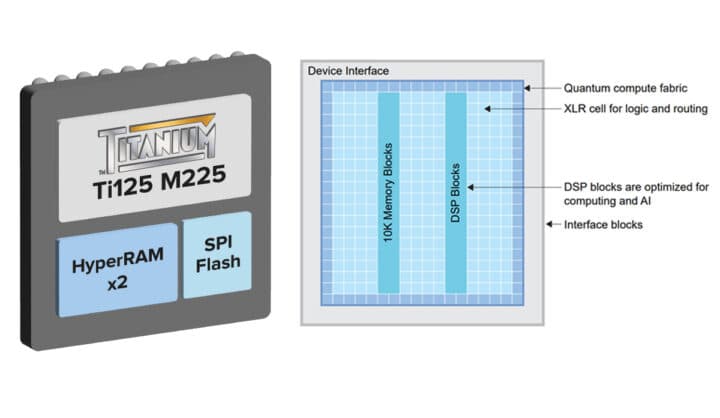
Efinix has announced its new Titanium Edge FPGA family, featuring 16nm process technology and integrated HyperRAM to support low-power AI and computer vision at the edge. The new devices, including the Ti125, offer programmable I/O and hardware-level SEU correction, designed to decrease PCB footprint and power consumption in specialized streaming and vision hardware.
Key Takeaways
- Ti125 SiP variant integrates 512 Mbit HyperRAM and SPI flash into one package, reducing PCB footprint by up to 60%.
- Hardware-level Single-Event Upset (SEU) correction engine protects configuration memory from radiation-induced bit errors in harsh environments.
- Integrated MIPI CSI/DSI interfaces support data rates up to 2.5 Gbps for multi-sensor vision pipelines.
- Ti125 and Ti95 models are currently sampling, with smaller Ti70 and Ti40 variants scheduled for Q4 2026.
Why It Matters
The shift toward localized processing in streaming hardware requires a delicate balance of throughput and thermal management. By halving static power and integrating memory into the package, Efinix directly addresses the mechanical and electrical constraints of smart cameras and robotics. This move counters the dominance of specialized vision SoCs by offering the field-programmability needed for evolving AI models without the traditional energy penalties of FPGAs. Strategists should view this as a maturing of the "edge vision" tier where reliability (SEU correction) and footprint are now as critical as raw compute. Monitor the Q4 2026 rollout of the lower-density Ti40 and Ti70 models as indicators of Efinix's penetration into high-volume, cost-sensitive consumer vision markets.
Additional Context
The launch of the Titanium Edge family arrives as the edge AI semiconductor market undergoes significant diversification. While heavyweights like AMD (Xilinx) and Intel (Altera) continue to dominate the high-end data center and infrastructure sectors, smaller players are aggressively carving out niches. Per semiconductor.tools in May 2026, Lattice Semiconductor remains the primary independent competitor in the ultra-low-power FPGA category, specifically targeting IoT and instant-on control logic with its iCE40 and MachXO3 families. Efinix’s and Lattice's focus on power efficiency highlights a broader industry pivot toward sustainability and thermal stability in 'always-on' devices.
Competition is also intensifying from beyond the FPGA sector. Per EE Times in July 2026, many vision system designers are weighing FPGAs against off-the-shelf SoCs that include integrated NPUs and image signal processors. FPGAs maintain an edge in flexibility, particularly when handling proprietary or new sensor interfaces that standard SoCs cannot native support. To further this flexibility, Efinix has also prioritized its Efinity IDE, which according to recent developer reports, was updated in June 2026 to include a Partition Planner and faster compile times, aiming to reduce the 'toolchain friction' that often prevents faster adoption of programmable logic over fixed ASICs.
Market forecasts underscore the massive opportunity at stake. Per Grand View Research in early 2026, the global edge AI accelerator market—encompassing GPUs, FPGAs, and ASICs—is projected to grow at a CAGR of 31.5% through 2033. This growth is largely fueled by the transition to 5G and the increasing sophistication of autonomous systems and medical imaging. As localized AI workloads become more practical due to the emergence of small language models and improved on-device performance, hardware like the Titanium Edge series will be critical for providing the necessary secure, real-time compute without relying on costly cloud backhauls.
Read full article at cnx-software.com
Enjoy our coverage?
Add StreamingMeme as a preferred source on Google to see more of our streaming news at the top of your Search results.
Add as preferred source