

Alibaba Cloud cracks production bottlenecks with new video AI agents
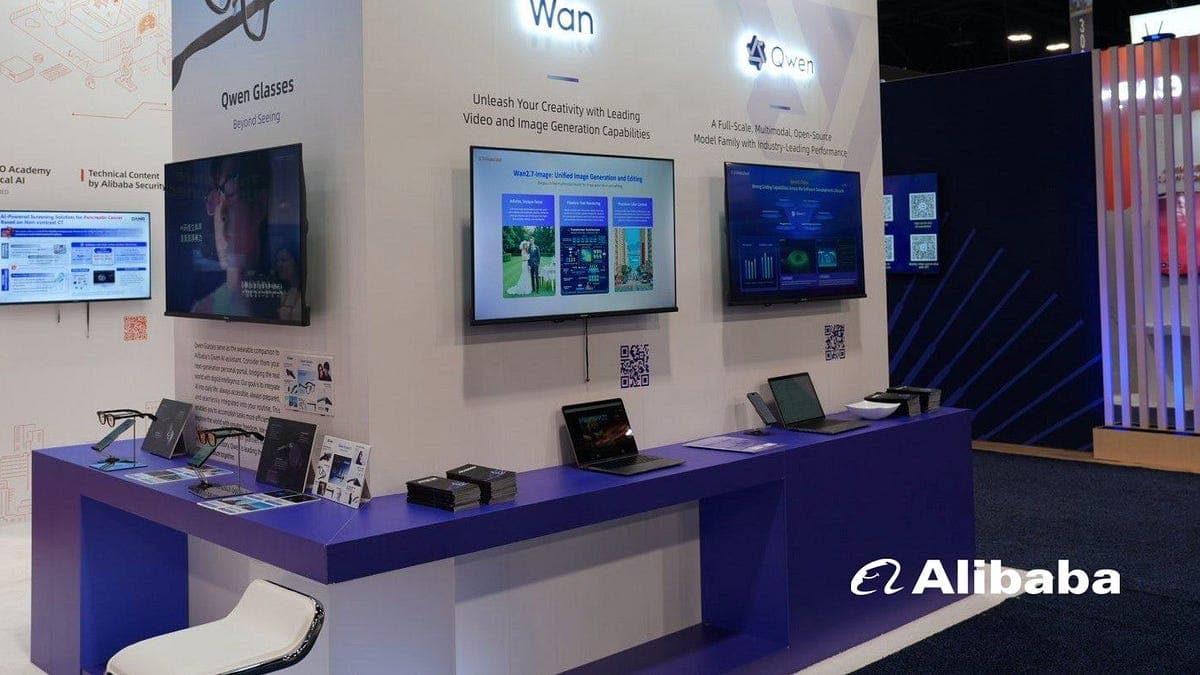
Alibaba Cloud presented several research papers at CVPR aimed at solving critical bottlenecks in production video AI workflows. The papers detailed methods for reducing the computational costs of video diffusion and comprehension through token compression, as well as delivering editable, workflow-ready outputs.
Key Takeaways
- EarlyTom framework reduces time-to-first-token (TTFT) by up to 2.65x and cuts FLOPs by 61% via early-stage video token compression.
- RAPID generation method achieves a 2.01x speedup in video diffusion tasks by dynamically reusing attention sparsity between steps.
- Qwen-Image-Layered decomposes flat RGB images into independently editable RGBA layers, enabling Photoshop-style manipulation without full regeneration.
- Evo-Retriever improved document retrieval accuracy by 14.1% over text-only baselines on AstraZeneca's multimodal knowledge base benchmark.
- Wan-Weaver decouples text planning from visual consistency to generate coherent, interleaved narrative content, as featured in the Wan 2.6 and 2.7 releases.
Why It Matters
The shift from generative demos to autonomous agents requires solving the 'last mile' of production: cost and editability. By prioritizing token compression and layer-based outputs, Alibaba is moving the industry away from 'flat' AI files toward modular assets that fit existing technical stacks. This development specifically challenges competitors like OpenAI and Runway by tackling the prohibitive compute costs of video comprehension while offering the surgical control needed for commercial broadcasting and design. The integration of these tools into the OpenTrek platform signals a transition toward full-stack agentic infrastructure where AI doesn't just see, but actively manages complex, multimodal business data. Watch for the public weight release of Wan 2.7 to benchmark its performance against Sora 2.
Additional Context
The research surge at CVPR 2026 comes as Alibaba Cloud aggressively expands its 'agentic' infrastructure. In May 2026, the company launched its Qwen3.7-Max model in Singapore, positioning it as a foundational backbone for autonomous agents capable of managing cloud resources through a new 'Skills' portal, per Alibaba Cloud filings. This strategy aligns with a broader market shift where enterprise interest has pivoted from simple chatbots to 'fleets' of specialized agents. Market forecasts from June 2026 project the agentic AI sector will reach $10.8 billion by year-end, with roughly 40% of new enterprise applications incorporating task-specific agents.
Simultaneous to the CVPR technical announcements, Alibaba's Tongyi Lab released Wan 2.7 in April 2026. This 27-billion-parameter Mixture-of-Experts (MoE) video generation model introduced a 'Thinking Mode' designed to plan shot composition before pixel generation, according to MarketScreener. By offering these models under Apache 2.0 licenses, Alibaba is competing directly with proprietary systems like Runway Gen-4.5 and Sora. Industry analysts at EqualOcean noted in June 2026 that Alibaba’s dual focus on open weights and high-fidelity editing tools—such as the RGBA layer decomposition featured in Qwen-Image-Layered—is specifically targeted at reducing vendor lock-in for professional creative studios.
Read full article at genaiassembling.substack.com
Enjoy our coverage?
Add StreamingMeme as a preferred source on Google to see more of our streaming news at the top of your Search results.
Add as preferred source