
StreamingMemeStreamingMemeBuyers Guide
AboutLeaderboardsEventsSubmit News
Subscribe

Daily Brief

The streaming industry in your inbox every morning.

Daily Brief

The streaming industry in your inbox every morning.

StreamingMemeStreamingMeme

The independent buyers guide and news aggregator for the streaming technology industry.

Explore

Buyers GuideLeaderboardsEventsSubmit News

Stay updated

Weekly digest of new companies and streaming news.

Categories

Encoding & SoftwareVideo Delivery & CDNStreaming PlatformsAI for VideoProduction HardwareBusiness NewsMonetization & Ad TechRegulatory & Policy

© 2026 StreamingMeme. All rights reserved.

AboutPrivacy PolicyTermsContact
EncodingCDNPlatformsAI & VideoHardwareBusinessAd TechPolicy
← Streaming Platforms
PlatformsTechnical DevelopmentJuly 5, 2026

WebRTC architecture deep dive: Decoding the protocols behind real-time video calls

WebRTC architecture deep dive: Decoding the protocols behind real-time video calls
Medium

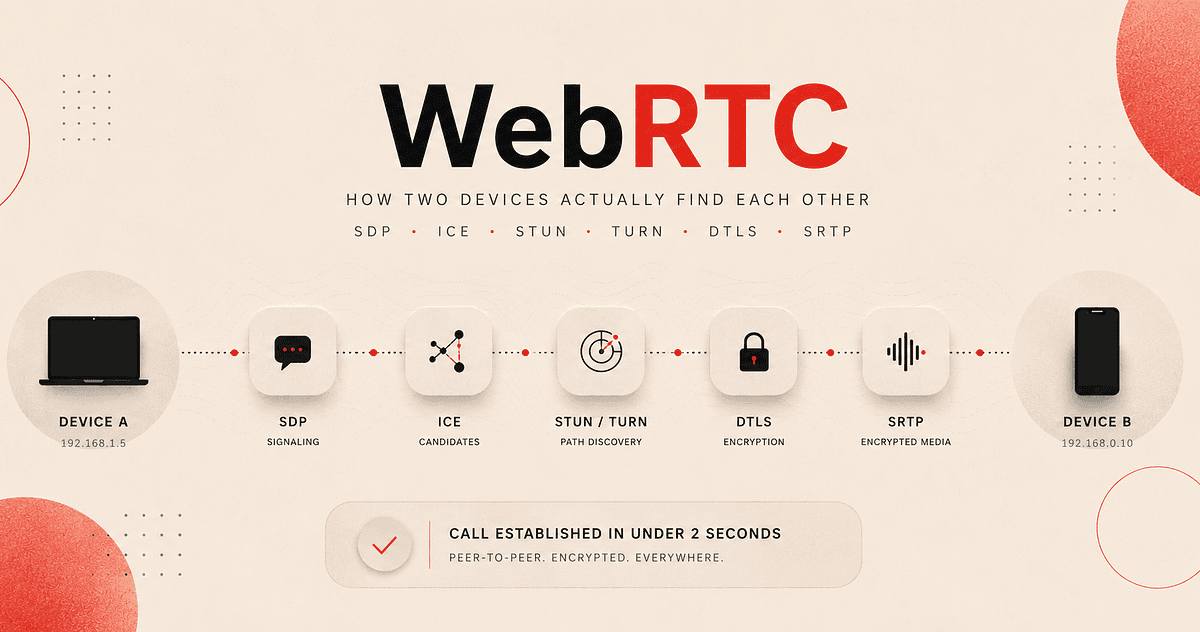
This technical deep dive explores the underlying protocols of WebRTC, including SDP, ICE, STUN, and TURN, and how they navigate network address translation for real-time video communications. The article provides engineers with practical insights into connection state management, signaling implementation, and scaling strategies such as Mesh, SFU, and MCU.

Key Takeaways

  • Symmetric NAT remains the primary cause of connection failure on corporate and mobile networks, requiring TURN relays to bridge communication.
  • Session Description Protocol (SDP) acts as the negotiation metadata, defining supported codecs like Opus for audio and VP8/H.264 for video.
  • Trickle ICE improves join times by allowing devices to test network candidates incrementally rather than waiting for a full list.
  • Selective Forwarding Units (SFUs) are the industry standard for scaling to 3–50 participants, reducing peer upload bandwidth compared to mesh topologies.
  • ICE restart is recommended for recovering from 'disconnected' states to preserve existing encryption and codec settings without ending the call.

Why It Matters

For streaming B2B architects, understanding these underlying protocols is no longer optional as real-time interactive video migrates into enterprise stacks. The reliance on SFU and hybrid models highlights a shift toward server-side coordination to bypass the inherent scaling ceilings of pure peer-to-peer mesh. Failure to properly implement TURN relays or ICE restarts directly impacts churn in mobile and corporate environments, where up to 20% of sessions may fail without robust NAT traversal. As platforms move toward sub-second latency targets, mastering the 'glue' of signaling and SDP negotiation determines a product's technical viability. Watch for the adoption of Media over QUIC (MoQ) as a potential successor to bridge the gap between WebRTC interactivity and broadcast-scale audience reach.

Additional Context

The global WebRTC market is undergoing a significant expansion, with recent estimates valuing the sector at approximately $31.87 billion in 2026. Per Straits Research (June 2026), the market is projected to reach $554.11 billion by 2034, driven by a compound annual growth rate of 42.9%. This surge is largely attributed to the normalization of remote work and the integration of AI-driven features like real-time translation and background noise suppression. North America currently maintains a lead with roughly 37% of the market share, though the Asia-Pacific region is cited as the fastest-growing territory due to rapid 5G infrastructure deployment. From an architectural standpoint, the industry has consolidated around the Selective Forwarding Unit (SFU) for mid-size group sessions. Per Fora Soft (November 2025), SFUs are now the default for rooms with 3 to 50 participants, as they balance computational costs with predictable scaling. However, for ultra-large events, developers are increasingly turning to hybrid models. According to reporting from Red5 (June 2026), the WebRTC HTTP Ingest Protocol (WHIP) and WebRTC HTTP Egress Protocol (WHEP) have emerged as essential standards for simplifying connection handshakes. These protocols allow broadcasters to use WebRTC for sub-second ingest while leveraging traditional CDNs for massive fan-out. Technological pressure is also mounting from the emergence of Media over QUIC (MoQ). As noted by Technavio in early 2026, MoQ is expected to compete with WebRTC by providing similar low-latency performance but with improved ease of scaling across existing content delivery networks. While WebRTC remains the dominant choice for truly bidirectional interactivity, many streaming platforms are now evaluating whether to migrate custom browser ingest stacks to WebTransport and WebCodecs to avoid the complexity of SDP and ICE negotiation.


Read full article at medium.com

Get this in your inbox → Subscribe

Enjoy our coverage?

Add StreamingMeme as a preferred source on Google to see more of our streaming news at the top of your Search results.

Add as preferred source

Related Articles

Tech Insider: Spree Casino implements WebRTC and WebSockets for sub-500ms social gaming
FaroPop: TV Globo launches native 4K DTV+ interactivity for Antena Paulista
SiliconANGLE: AWS updates EC2 compute for agentic AI and physical workloads

Newest

about 23 hours ago
Barchart: Cerebras and AMD partner on low-latency AI inference architecture
about 24 hours ago
Light Reading: Charter sidesteps Starlink partnership rumors as Q2 broadband losses widen
1 day ago
GuruFocus: Fastly joins Experian to secure autonomous commerce at the edge
1 day ago
Investing.com: TF1 Digital Revenues Jump 17% as Netflix Partnership Exceeds Growth Targets
1 day ago
The BIG Newsletter: Nexstar and TEGNA Accused of Violating Judicial Order in $6.2 Billion Merger
1 day ago
Vocal: TeqBlaze challenges Epom with modular full-stack white-label ad tech suite
1 day ago
Audio Chocolate: Merging Technologies debuts Anubis Premium SPS for mission-critical broadcast audio
1 day ago
daily.dev: AVIF achieves universal browser support as Edge and Safari close gaps
2 days ago
Ealing Times: YouTube debuts UK Shopping Affiliate Programme with M&S and Currys
2 days ago
Investing.com: AMD and Cerebras debut disaggregated architecture to slash AI inference latency
2 days ago
MediaPost: Sports leagues explore non-exclusive local rights as RSN model collapses
2 days ago
YouTube: Blackmagic Design details GPU optimization protocols for DaVinci Resolve workflows
2 days ago
Startup Fortune: AI data centers threaten US grid stability and freeze cloud pipelines
2 days ago
TechRadar: OpenAI joins coalition lobbying against strict open-weight AI model regulations
2 days ago
Startup Fortune: SPAN and Nvidia board residential homes with 16-GPU Blackwell compute nodes
2 days ago
Digital Applied: Google faces €890M EU fine as Digital Markets Act enforcement accelerates
2 days ago
iZOOlogic: Ultra Clean Android App Masquerades as Utility to Host Malware-Grade Adware
2 days ago
SiliconANGLE: HPE and AMD converge supercomputing and AI via liquid-cooled GX5000
2 days ago
MarketBeat: AMD data center revenue surges 38% to $10.25B on AI demand
2 days ago
PPC Land: Acast revenue per listen jumps 26% despite flat audience growth

Upcoming Events

Jul
29–30
Buffer-Free VideoSeattle
Aug
17–20
SET EXPOSao Paulo
Sep
11–14
IBCAmsterdam
Sep
13
SportsPro Streamtime Sports LiveAmsterdam
Sep
16–18
RTC.ONKrakow
View all events →

Top Sources

  1. 1.Sports Video Group104
  2. 2.SiliconANGLE91
  3. 3.Tech Times60
  4. 4.YouTube59
  5. 5.AdExchanger57
  6. 6.TechCrunch54
  7. 7.arXiv50
  8. 8.PPC Land48
Full leaderboards →

Newest

about 23 hours ago
Barchart: Cerebras and AMD partner on low-latency AI inference architecture
about 24 hours ago
Light Reading: Charter sidesteps Starlink partnership rumors as Q2 broadband losses widen
1 day ago
GuruFocus: Fastly joins Experian to secure autonomous commerce at the edge
1 day ago
Investing.com: TF1 Digital Revenues Jump 17% as Netflix Partnership Exceeds Growth Targets
1 day ago
The BIG Newsletter: Nexstar and TEGNA Accused of Violating Judicial Order in $6.2 Billion Merger
1 day ago
Vocal: TeqBlaze challenges Epom with modular full-stack white-label ad tech suite
1 day ago
Audio Chocolate: Merging Technologies debuts Anubis Premium SPS for mission-critical broadcast audio
1 day ago
daily.dev: AVIF achieves universal browser support as Edge and Safari close gaps
2 days ago
Ealing Times: YouTube debuts UK Shopping Affiliate Programme with M&S and Currys
2 days ago
Investing.com: AMD and Cerebras debut disaggregated architecture to slash AI inference latency
2 days ago
MediaPost: Sports leagues explore non-exclusive local rights as RSN model collapses
2 days ago
YouTube: Blackmagic Design details GPU optimization protocols for DaVinci Resolve workflows
2 days ago
Startup Fortune: AI data centers threaten US grid stability and freeze cloud pipelines
2 days ago
TechRadar: OpenAI joins coalition lobbying against strict open-weight AI model regulations
2 days ago
Startup Fortune: SPAN and Nvidia board residential homes with 16-GPU Blackwell compute nodes
2 days ago
Digital Applied: Google faces €890M EU fine as Digital Markets Act enforcement accelerates
2 days ago
iZOOlogic: Ultra Clean Android App Masquerades as Utility to Host Malware-Grade Adware
2 days ago
SiliconANGLE: HPE and AMD converge supercomputing and AI via liquid-cooled GX5000
2 days ago
MarketBeat: AMD data center revenue surges 38% to $10.25B on AI demand
2 days ago
PPC Land: Acast revenue per listen jumps 26% despite flat audience growth

Upcoming Events

Jul
29–30
Buffer-Free VideoSeattle
Aug
17–20
SET EXPOSao Paulo
Sep
11–14
IBCAmsterdam
Sep
13
SportsPro Streamtime Sports LiveAmsterdam
Sep
16–18
RTC.ONKrakow
View all events →

Top Sources

  1. 1.Sports Video Group104
  2. 2.SiliconANGLE91
  3. 3.Tech Times60
  4. 4.YouTube59
  5. 5.AdExchanger57
  6. 6.TechCrunch54
  7. 7.arXiv50
  8. 8.PPC Land48
Full leaderboards →