

Vbrick launches automated video retention service to streamline cloud compliance
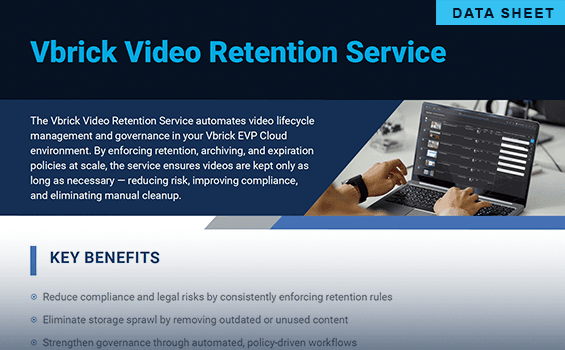
Vbrick has introduced a new Video Retention Service for its EVP Cloud environment. This service automates video lifecycle management and governance by enforcing retention, archiving, and expiration policies at scale. The goal is to ensure compliance, reduce risk, and eliminate manual cleanup of video content.
Key Takeaways
- Automates video lifecycle governance within the Vbrick EVP Cloud environment to maintain regulatory compliance.
- Eliminates manual content deletion by enforcing scalable archiving and expiration policies across video libraries.
- Reduces enterprise risk and storage bloat by ensuring video assets are retained only for required durations.
- Integrates with existing Vbrick EVP Cloud features to manage unstructured video data as a governed corporate asset.
Why It Matters
As enterprises increasingly treat video as a primary data source for AI agents and internal knowledge bases, unmanaged storage poses both a cost and liability risk. Vbrick’s move into automated governance reflects a shift in the Enterprise Video Platform (EVP) market toward infrastructure that treats video with the same rigorous lifecycle standards as document and email storage. For customers in regulated sectors like finance and healthcare, this automation is a baseline requirement for scaling internal video libraries that frequently exceed 500 terabytes. Watch for rival EVP providers like Kaltura and Panopto to accelerate similar governance features as corporate video volume continues to outpace manual management capabilities.
Additional Context
The demand for automated video governance follows a period of rapid content growth within the enterprise. Per Vbrick’s own historical benchmarks, some corporate libraries now surpass 500 terabytes in size, a volume that makes manual auditing for compliance or storage optimization impossible. External analysts at Mordor Intelligence, in their 2026 reporting, value the enterprise video market at roughly $29 billion, noting that growth is increasingly driven by the transition of video from siloed recordings to integrated, searchable data layers. This paradigm requires strict adherence to retention schedules to mitigate legal discovery risks.
Regulatory pressure is also intensifying across key industries. According to data from DLA Piper in late 2025, cumulative GDPR-related fines have exceeded $6.5 billion, with auditors increasingly scrutinizing data retention practices as a core component of privacy compliance. Furthermore, sector-specific mandates such as SEC Rule 17a-4 and FINRA Rule 4511 require financial institutions to maintain certain records for three to seven years, as cited by industry guides in early 2026. By automating these schedules, Vbrick is positioning its cloud environment as a defensible repository for high-stakes corporate communication.
This release also complements Vbrick’s broader strategy of turning video into "enterprise intelligence." In March 2026, Vbrick expanded its Model Context Protocol (MCP) server to allow AI agents to securely query video content for knowledge retrieval. Integrating retention logic ensures that these AI systems only draw from authorized, current material, preventing the hallucination of facts from outdated or expired assets. This convergence of AI-driven search and automated lifecycle governance highlights a maturation in the B2B streaming space where security and data integrity are as prioritized as delivery performance.
Read full article at vbrick.com
Enjoy our coverage?
Add StreamingMeme as a preferred source on Google to see more of our streaming news at the top of your Search results.
Add as preferred source