

UK court issues 26-month AI deepfake prison sentence for Telegram distribution
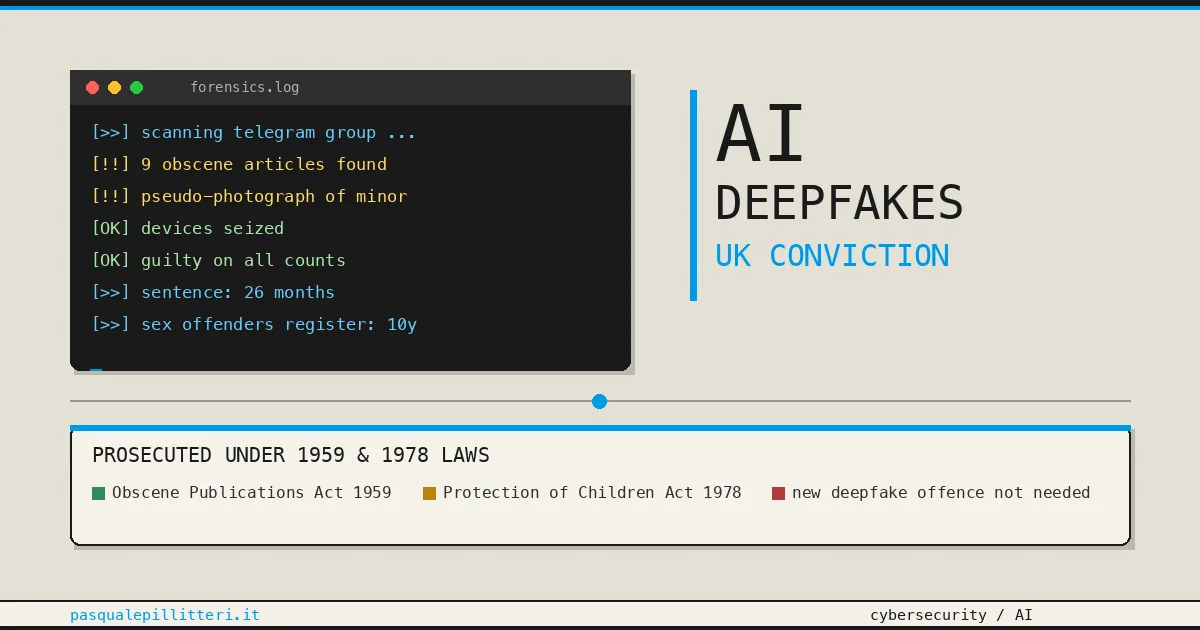
A UK court sentenced Lewis Davison to 26 months in prison for creating and distributing AI-generated sexual deepfakes of women and a minor. The conviction, secured under existing laws like the Obscene Publications Act 1959, underscores the ongoing legal and investigative challenges in addressing synthetic media abuse.
Key Takeaways
- Lewis Davison received a 26-month custodial sentence and 10 years on the sex offenders register for nine charges.
- Prosecutors secured the conviction using the 1959 Obscene Publications Act and 1978 Protection of Children Act rather than newer 2026 statutes.
- The case involved AI-generated 'pseudo-photographs' distributed in private Telegram groups that incited sexual violence.
- UK law now includes the Data (Use and Access) Act 2025, which criminalizes the creation of deepfakes without requiring proof of intent to harm.
Why It Matters
This ruling demonstrates that existing legal frameworks regarding obscenity and child protection are sufficient to prosecute synthetic media abuse, even without specialized AI legislation. For the streaming and social ecosystem, it highlights a shift from targeting celebrity deepfakes to addressing 'weaponized' AI used against private individuals. While platforms like YouTube are deploying likeness-detection tools, the Davison case underscores that enforcement remains reactive, relying on device seizures and reports from closed, encrypted channels like Telegram. Industry observers should monitor whether other jurisdictions adopt the UK's strict 2026 standard, which removes the 'intent to harm' requirement for criminalizing synthetic content creation.
Additional Context
The Davison conviction arrives amid a broader push by UK regulators and lawmakers to close gaps in synthetic media governance. In April 2026, the UK government introduced amendments to the Online Safety Act that remove the requirement to prove intent to harm when prosecuting creators of non-consensual deepfake intimate images, making mere creation and distribution a criminal offense regardless of the perpetrator's stated purpose. This legislative shift directly enabled prosecutors to pursue cases like Davison's without needing to establish subjective malicious intent, lowering the evidentiary bar significantly. The move followed sustained pressure from victim advocacy groups and a January 2026 report from the UK's Internet Watch Foundation documenting a 380% year-over-year increase in AI-generated child sexual abuse material detected on platforms.
Telegram, the platform Davison used to distribute his images, has faced mounting scrutiny from regulators across multiple jurisdictions. The messaging service's encrypted channels and minimal content moderation have made it a preferred distribution vector for synthetic abuse content. Nokia's Autonomous Network Fabric, announced at DTW Ignite in June 2026, includes AI-driven content classification agents designed to flag synthetic media at the network edge, representing one approach telcos are exploring to intercept harmful content before it reaches end users. However, encrypted platforms like Telegram present a distinct challenge because network-level inspection cannot decrypt payload content, leaving enforcement dependent on device-level forensics and user reports rather than automated detection.
The technical detection landscape for AI-generated imagery is advancing rapidly, though deployment remains uneven across platforms. Ericsson launched its AI in RAN commercial software subscription on June 11, 2026, claiming up to 20% higher downlink throughput across more than 15 live deployments, demonstrating how AI models trained on synthetic content patterns can be repurposed for detection tasks at scale. In the streaming and social media context, YouTube and Meta have deployed likeness-detection systems that flag AI-generated faces against known individuals, but these tools struggle with non-celebrity victims who lack reference imagery in training datasets. The Davison case highlights this gap: his victims were private individuals whose likenesses had no prior digital footprint in detection databases, meaning the content circulated undetected until a human report triggered investigation.
Read full article at pasqualepillitteri.it
Enjoy our coverage?
Add StreamingMeme as a preferred source on Google to see more of our streaming news at the top of your Search results.
Add as preferred source