

USTC and Huawei debut ZeroGVC for zero-shot streaming video compression
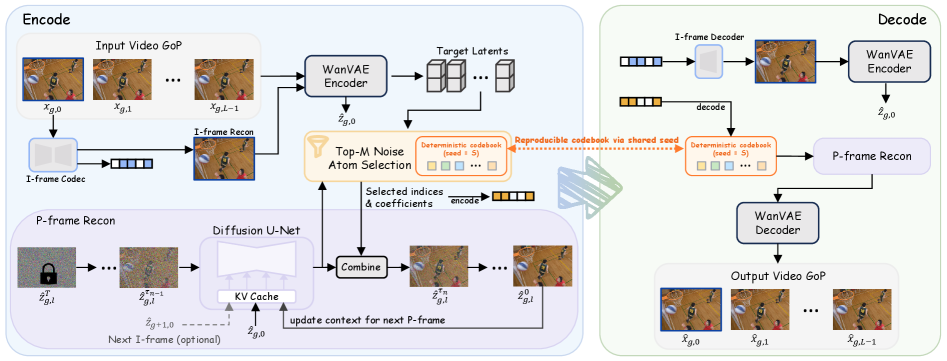
Researchers from USTC and Huawei have presented ZeroGVC, a zero-shot generative video compression framework that utilizes pretrained autoregressive diffusion models to reconstruct P-frames without additional training. The method operates by transmitting compact index sequences to steer the latent denoising trajectory, offering a low-latency alternative for video streaming applications.
Key Takeaways
- ZeroGVC utilizes pretrained autoregressive diffusion models to reconstruct P-frames sequentially from decoded history.
- The framework employs Codebook-Guided Autoregressive Latent Compression, transmitting sparse atom-combination indices and quantized coefficients.
- Experimental results on standard benchmarks like JVET and UVG show superior LPIPS, DISTS, and FID scores over HEVC and VVC.
- An optional bidirectional reference mode improves quality by using the next I-frame as context without adding bitrate overhead.
Why It Matters
ZeroGVC addresses the latency and high training costs of generative video compression by eliminating the need for model fine-tuning. For streaming providers, this means deploying high-fidelity perceptual reconstruction using off-the-shelf generative models while maintaining low-delay performance suitable for live delivery. It shifts the industry focus toward reusing massive pretrained priors rather than building specialized compression networks from scratch. Watch for the integration of this framework into real-time streaming pipelines as hardware dedicated to diffusion acceleration becomes more prevalent in consumer devices.
Additional Context
The introduction of ZeroGVC aligns with a broader industry shift toward training-free generative codecs that leverage existing AI foundation models. Per recent findings in the field, including Denoising Diffusion Codebook Models (DDCM) published at ICML 2025, researchers have successfully demonstrated that replacing continuous Gaussian noise with discrete index selections can enable lossy compression without degrading generative sample quality. This technique allows for the creation of standardized 'noise menus' known to both encoders and decoders, reducing the data required to recreate complex textures. Huawei's involvement reflects its strategic push into AI-native infrastructure. At MWC Shanghai 2026, Huawei's leadership emphasized the transition from traffic-centric networking to real-time interaction for AI models, launching platforms designed to accelerate KV cache inference and reduce 'time to first token' in multimodal applications. The adoption of the WanVAE architecture—a spatio-temporal variational autoencoder open-sourced by Alibaba's Wan team in early 2026—further underscores the collaborative evolution of latent space representation in Asia's tech ecosystem. Related developments in the sector, such as the PA-VDM framework spotlighted at CVPR 2025, have explored multi-step denoising for long-form video generation, but ZeroGVC focuses specifically on the 'low-delay' requirements of the streaming industry. As mobile manufacturers increasingly integrate dedicated npus for 6G-era applications, these diffusion-based codecs are transitioning from research benchmarks to viable alternatives for commercial ultra-low bitrate delivery, potentially replacing GAN-based methods that often struggle with temporal consistency over extended sequences.
Read full article at arxiv.org
Get this in your inbox → Subscribe
Enjoy our coverage?
Add StreamingMeme as a preferred source on Google to see more of our streaming news at the top of your Search results.
Add as preferred source