
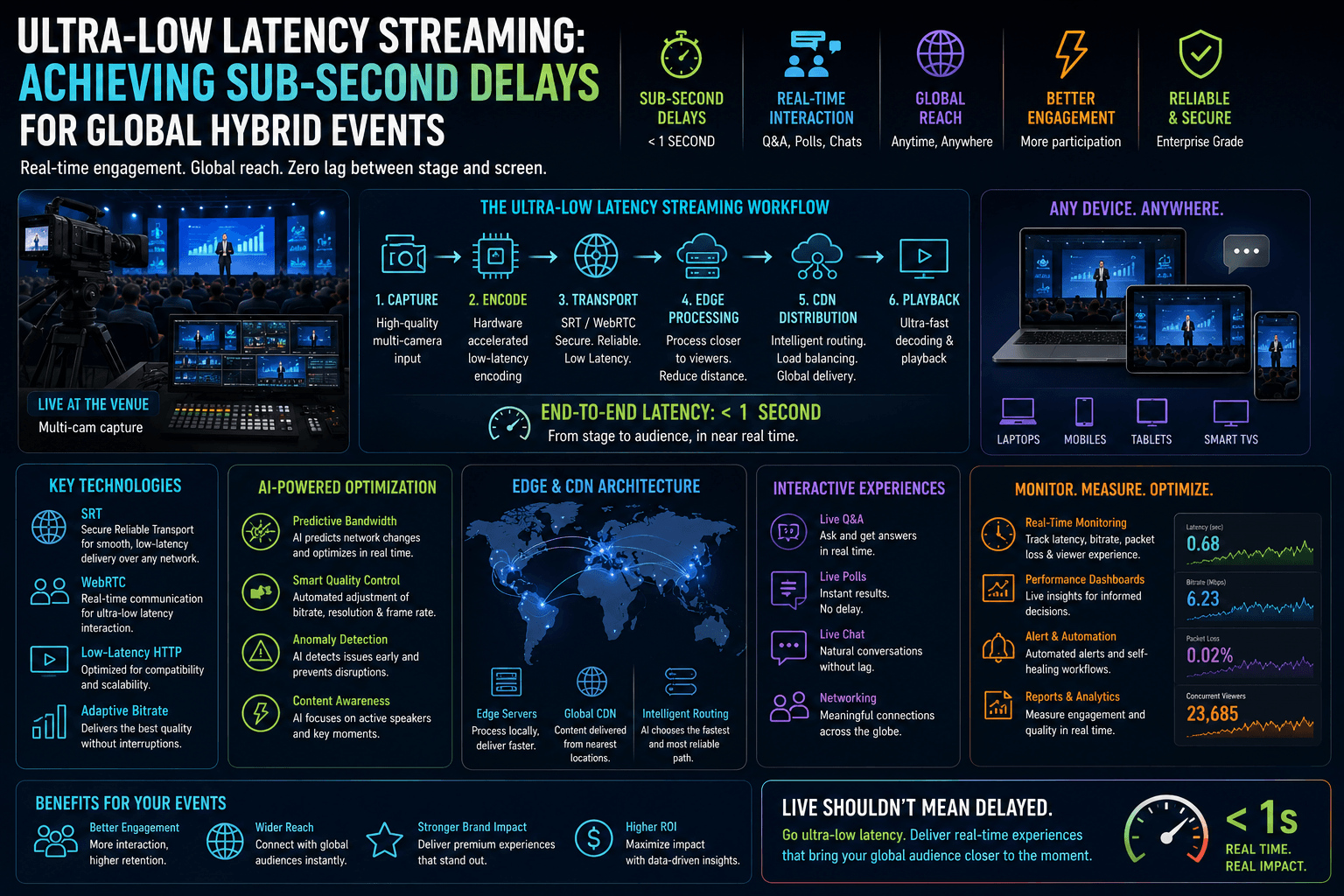
This article outlines the technical architectural requirements for achieving sub-second latency in global hybrid event streaming. It details the necessity of combining protocols like WebRTC and SRT with edge computing, AI-driven congestion management, and private 5G infrastructure to overcome traditional streaming bottlenecks.
The shift to sub-second latency transitions virtual attendance from passive viewing to active participation, a critical requirement for high-stakes corporate broadcasts and interactive workshops. By moving processing to the edge and automating network recovery through AI, streaming stacks are overcoming the inherent instability of the public internet. This development forces a commoditization of basic delivery, pushing service providers to differentiate via complex real-time features like multi-site synchronization and interactive overlays. Watch for the 2026 adoption rates of Media over QUIC (MoQ), which aims to merge WebRTC’s speed with traditional HTTP scalability.
The push for ultra-low latency is accelerating as industry standards and hardware finalize. Per SVG Europe (February 2025), Haivision reported that SRT usage among broadcasters grew to 77%, up from 68% the previous year, securing its spot as the dominant transport protocol. This shift is supported by massive infrastructure upgrades; for instance, Akamai launched its Inference Cloud (April 2026), deploying Nvidia RTX GPUs across 4,400 edge locations to handle real-time AI workloads and video transcoding closer to end-users. This proximity is vital for glass-to-glass performance goals in 2026.
Simultaneously, the WebRTC market is undergoing a fundamental transformation due to explosive demand for real-time interaction. According to Technavio (February 2026), the WebRTC sector is projected to expand by over $247 billion through 2029, maintaining a 62.6% compound annual growth rate. This growth is increasingly driven by 'split-frame' hardware encoding, such as Nvidia's Blackwell NVENC, which can halve the time required to prepare individual frames for streaming (per XDA Developers, June 2026). These hardware-level efficiencies are effectively moving the remaining streaming bottlenecks from the network back to the ingest stage.
Regional data further underscores this shift in spectator expectations. During the 2026 ICC Champions Trophy in February, peak traffic exceeded 40 Tbps, with viewers on 5G connections reporting latencies under 2.8 seconds—compared to over 11 seconds for those on traditional centralized architectures. This wider performance gap is pressuring event organizers to move away from legacy origin-centric packaging toward the edge-compute models described in current architectural frameworks.
Add StreamingMeme as a preferred source on Google to see more of our streaming news at the top of your Search results.
Add as preferred source