
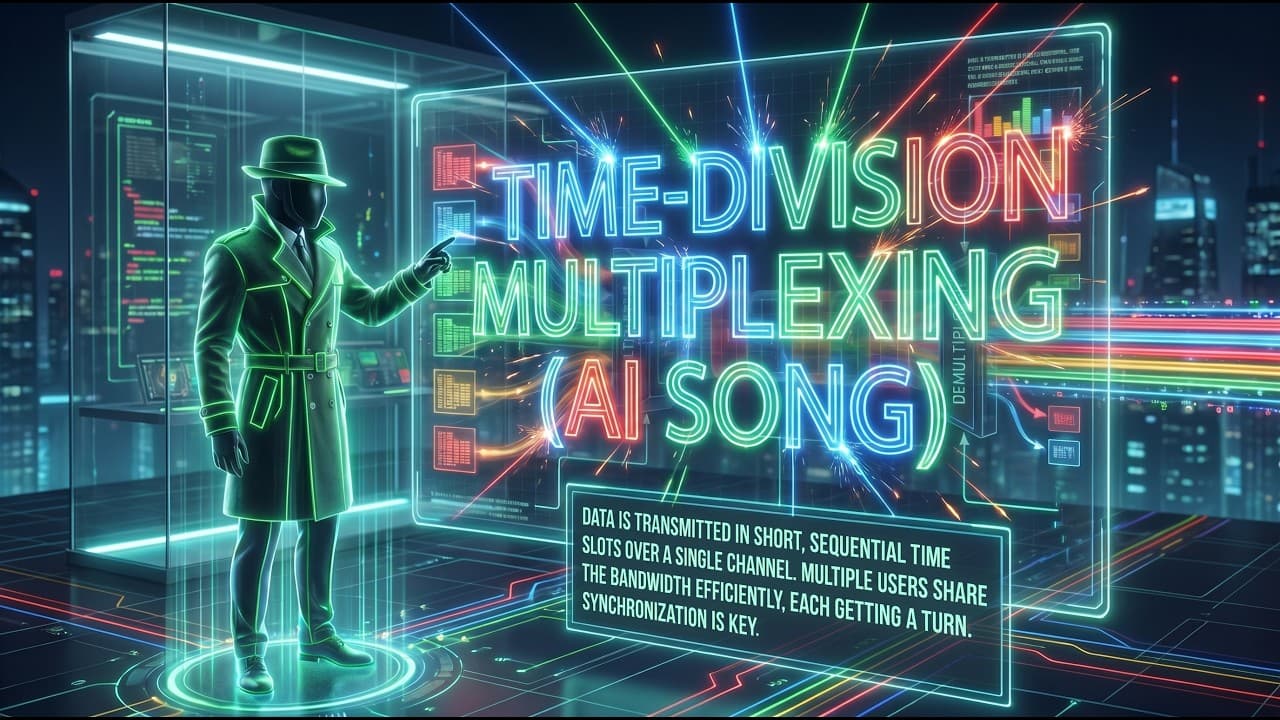
This article, presented as an AI-generated song, explains the technical concepts of Time Division Multiplexing (TDM), detailing synchronous and statistical approaches. It covers standards like T1, E1, T3, SONET, and SDH, outlining how data is divided and transmitted across channels.
Understanding the transition from synchronous to statistical multiplexing is essential for engineers managing the phase-out of legacy circuit-switched infrastructure. While synchronous TDM provides the deterministic timing required for uncompressed voice and high-reliability industrial links, its inherent bandwidth waste in 'bursty' data environments makes it increasingly untenable for modern video delivery. As streaming architectures shift toward all-IP packet transport, these concepts define the layer-1 and layer-2 trade-offs between fixed-latency reliability and dynamic-scale efficiency. Watch for decommissioning schedules of legacy T1/T3 copper and SONET optical rings as carriers migrate mission-critical traffic to packet-optical networks.
The transition away from legacy TDM infrastructure has accelerated as carriers prioritize packet-optical convergence to handle AI and high-resolution video workloads. According to a June 2025 report from industry observers, major global carriers are entering an 'accelerated outphasing' period for SONET and SDH networks, moving toward Ethernet and OTN (Optical Transport Network) systems. While these legacy systems were the workhorses of the 1980s and 90s telecommunications boom, their fixed-bandwidth allocation is poorly suited for the bursty nature of modern internet traffic, often leading to significant underutilization of physical fiber assets.
Despite this push for modernization, legacy TDM remains entrenched in sectors requiring extreme deterministic performance. Per the Utility Broadband Alliance in April 2025, entities in power utilities, transportation, and government agencies often maintain TDM deployments due to the lack of an equivalent deterministic alternative and the high cost of migrating specialized hardware interfaces. To bridge this gap, technology providers like Ribbon Communications and Loop Telecom are offering circuit emulation and pseudowire solutions, which allow legacy TDM services to run over modern packet-switched networks.
Looking toward 2026, the industry is increasingly adopting IP-over-DWDM (IPoDWDM) to simplify the transport stack. According to WWT and Adtran reports from early 2026, the rise of AI-driven traffic is forcing a shift from traditional optical hierarchies to high-capacity 800G and 1.6T lines. This shift effectively replaces the rigid time-slotting of classic TDM with massive wavelength-based capacity, allowing the infrastructure to scale dynamically with real-time demand while preserving the reliability once unique to synchronous circuits.
Add StreamingMeme as a preferred source on Google to see more of our streaming news at the top of your Search results.
Add as preferred source