

Spanish broadcasters pressure Smart TV makers for prominent 'Home' screen access
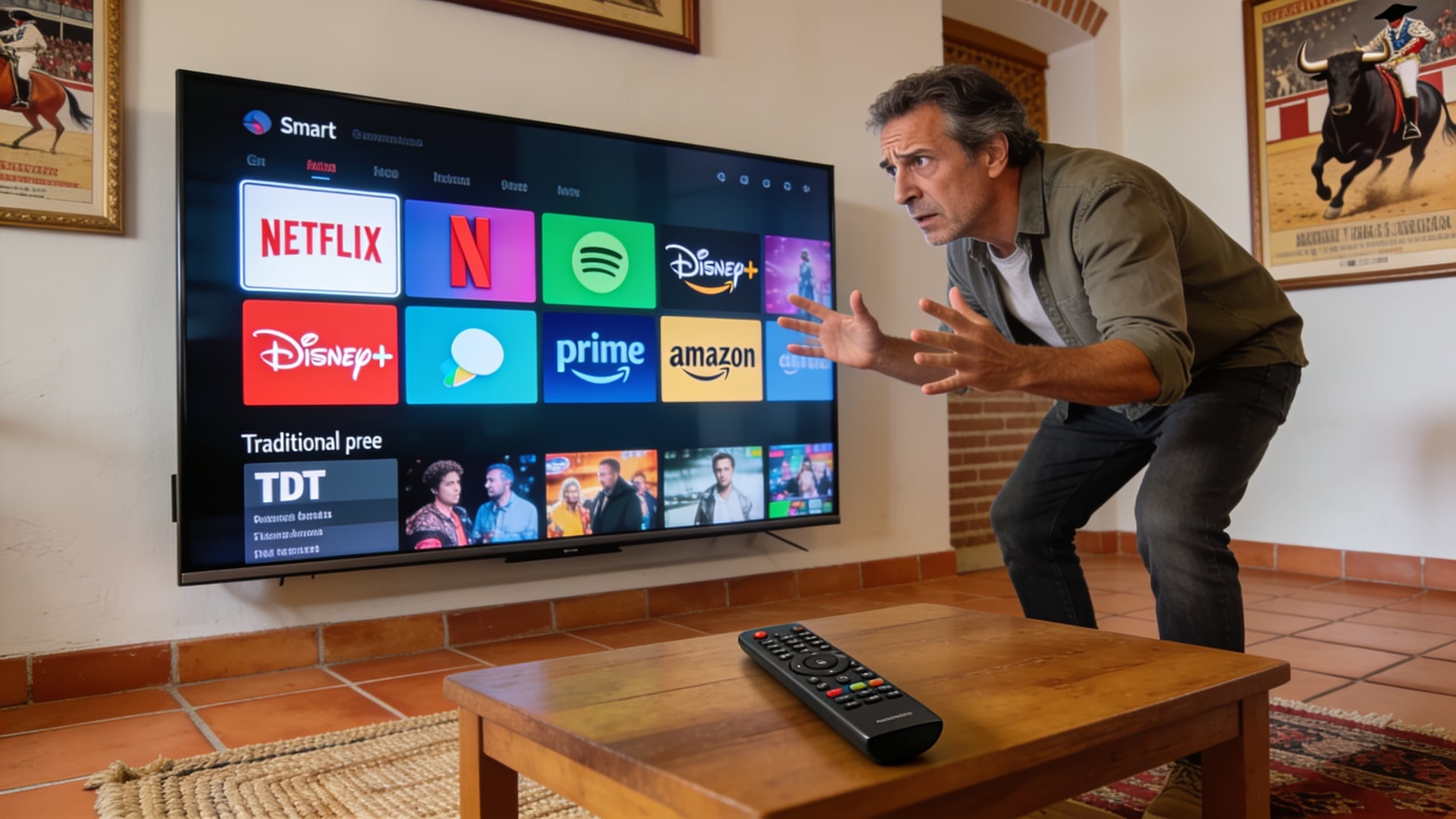
Spanish commercial broadcast association UTECA has launched a campaign pressuring Smart TV manufacturers to improve the visibility of free-to-air digital terrestrial television within their interfaces. The group cites research showing traditional broadcast remains the most-watched content and argues that current UI designs prioritize streaming apps at the expense of public accessibility.
Key Takeaways
- Broadcast TV remains dominant in Spain, with 99% of the population (47.1 million users) tuning in during the 2025/2026 season.
- Traditional television accounts for three out of every four minutes of total screen time, while apps and games represent only 25%.
- Current Smart TV penetration in Spain has reached 86%, yet UTECA claims interfaces frequently bury free-to-air channels under layers of menus.
- A 2025 barometer found that 94.6% of Spanish citizens view free TV as a public good, supporting the call for easier accessibility.
Why It Matters
The tension between local broadcasters and global hardware OEMs like Samsung and LG is reaching a regulatory tipping point. By framing the 'last-click' to broadcast as a public accessibility issue, UTECA is positioning Spanish Digital Terrestrial Television (TDT) as a protected utility rather than just a legacy platform. This push likely precedes formal regulatory intervention to mandate 'Prominence'—a move that would force manufacturers to redesign profitable home screen real estate. For streaming services, this could mean losing prime dashboard positioning to local linear channels. Watch for the Spanish government to potentially incorporate these demands into its upcoming 2026 review of the Audiovisual Media Services Directive implementation.
Additional Context
The campaign by UTECA aligns with a broader European movement toward 'prominence' legislation for local media. The European Media Freedom Act (EMFA), which became largely applicable in August 2025, introduced rights for users to customize media offerings on devices like connected TVs. Per DigitalEurope (July 2025), several EU member states have already begun introducing national rules to ensure 'Services of General Interest' (SGI) appear on the first selection level of user interfaces. France, for instance, requires DTT services and public broadcasters to receive appropriate visibility, a standard Arcom is currently reviewing for 2026 effectiveness.
Technically, Spain is simultaneously upgrading its broadcast backbone to stay competitive with streaming. Per Advanced Television (July 2026), the Ministry for Digital Transformation recently confirmed a nationwide transition to DVB-T2 and Ultra HD (UHD) set for November 5, 2026. This move will migrate national multiplexes to HEVC compression, enabling free 4K broadcasts and introducing a new national commercial channel, SIETE. The government’s National Technical Plan also mandates that new TV sets support HbbTV 2.0.4, facilitating more sophisticated interactive services and addressable advertising.
Hardware manufacturers face increasing pressure as their operating systems, such as Samsung’s Tizen and LG’s webOS, transition into ad-supported revenue engines. According to StreamTV Insider (July 2026), Samsung TV Plus has seen significant advertiser depth with over 8,400 detected ads in the first half of the year. As OEMs rely more on their own FAST (Free Ad-supported Streaming TV) channels for margin, the demand from local broadcasters for 'obstacle-free' access creates a direct conflict over screen real estate and the lucrative first-screen data loop.
Read full article at russpain.com
Enjoy our coverage?
Add StreamingMeme as a preferred source on Google to see more of our streaming news at the top of your Search results.
Add as preferred source