

Solid State Logic expands software-defined production with virtualized engine updates
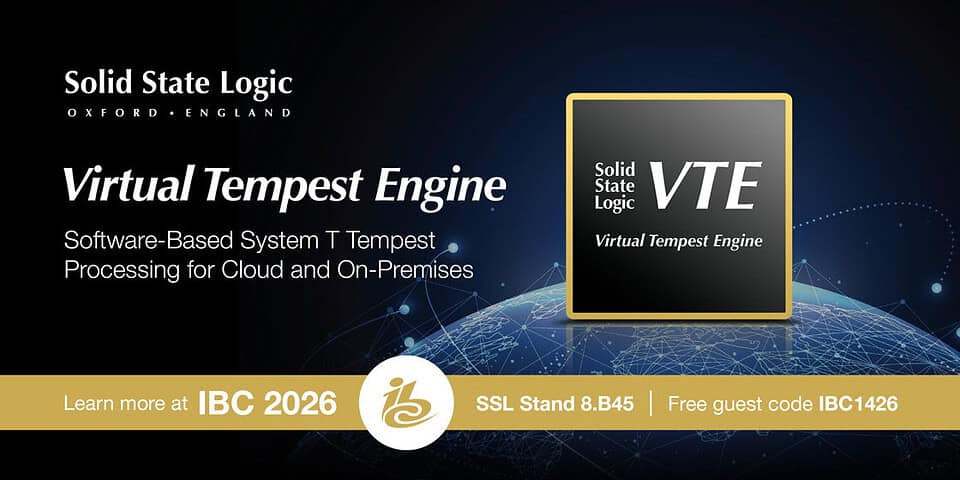
Solid State Logic is demonstrating expanded software-defined production capabilities for its System T platform at IBC 2026, including the Virtual Tempest Engine (VTE) and new ST 2110 conversion hardware. The updates focus on cloud and hybrid broadcast workflows and alignment with the EBU’s Dynamic Media Facility project for containerized media processing.
Key Takeaways
- Virtual Tempest Engine handles up to 256 processing paths on COTS, public cloud, or hybrid infrastructures.
- The new Net I/O ST 2110 Bridge supports up to 512 channels of standalone conversion with NMOS and Dante integration.
- µVTE debuted as a virtualized entry point providing 96 processing paths with event-based licensing options.
- SSL systems now integrate with the Media eXchange Layer (MXL) to allow containerized software to share memory for real-time media transfer.
Why It Matters
The transition to software-defined production marks a technical departure from specialized hardware toward versatile, containerized audio processing. By aligning with the EBU’s Dynamic Media Facility, SSL allows broadcasters to move video, audio, and metadata across shared memory on standard servers, significantly reducing compute overhead compared to traditional IP workflows. This move signals a broader industry shift where interoperability between best-of-breed software functions is prioritized over the purchase of monolithic vendor-locked systems. For the ecosystem, this reduces the cost of entry for immersive and high-scale production. Watch for the commercial adoption rates of MXL-native tools in live sports production as a metric for this model’s viability.
Additional Context
The transition toward software-defined production has accelerated as industry standards bodies formalize the European Broadcasting Union’s (EBU) Dynamic Media Facility (DMF) framework. According to TVBEurope in April 2026, the EBU released an updated DMF reference architecture that provides specific guidance on orchestration, formally positioning it as the management layer across compute nodes and production clusters. This framework is supported by the Media eXchange Layer (MXL) SDK, an open-source project hosted by the Linux Foundation. Per IBC, September 2026, recent accelerators involving the BBC, EBU, and vendors like Techex have demonstrated that MXL allows zero-copy media sharing in memory, effectively acting as 'virtualized cabling' for high-performance live production. Broadcasters are increasingly shifting investments toward these architectures to mitigate the total cost of ownership associated with rigid hardware. Per NewscastStudio, December 2025, economic pressures in the 2026 fiscal year forced many organizations to favor software-defined systems to maximize server utilization and avoid vendor lock-in. This trend matches a reported 18.9% compound annual growth rate in the broadcast automation software market, which is projected to reach $3.07 billion by the end of 2026 according to Research and Markets. In the audio segment, the interoperability between SMPTE ST 2110 and Dante remains a critical bridge for hybrid facilities. Per Solid State Logic’s March 2026 reporting, many facilities operate both formats simultaneously, necessitating hardware like the Net I/O ST 2110 Bridge despite the shift toward virtualization. Competitors are moving in tandem; for example, Audinate highlighted enhanced ST 2110-30 capabilities at NAB 2026 to coincide with Dante’s 20th anniversary, reflecting a broader market push to standardize IP audio transport across software and hardware silos.
Read full article at sportsvideo.org
Get this in your inbox → Subscribe
Enjoy our coverage?
Add StreamingMeme as a preferred source on Google to see more of our streaming news at the top of your Search results.
Add as preferred source