
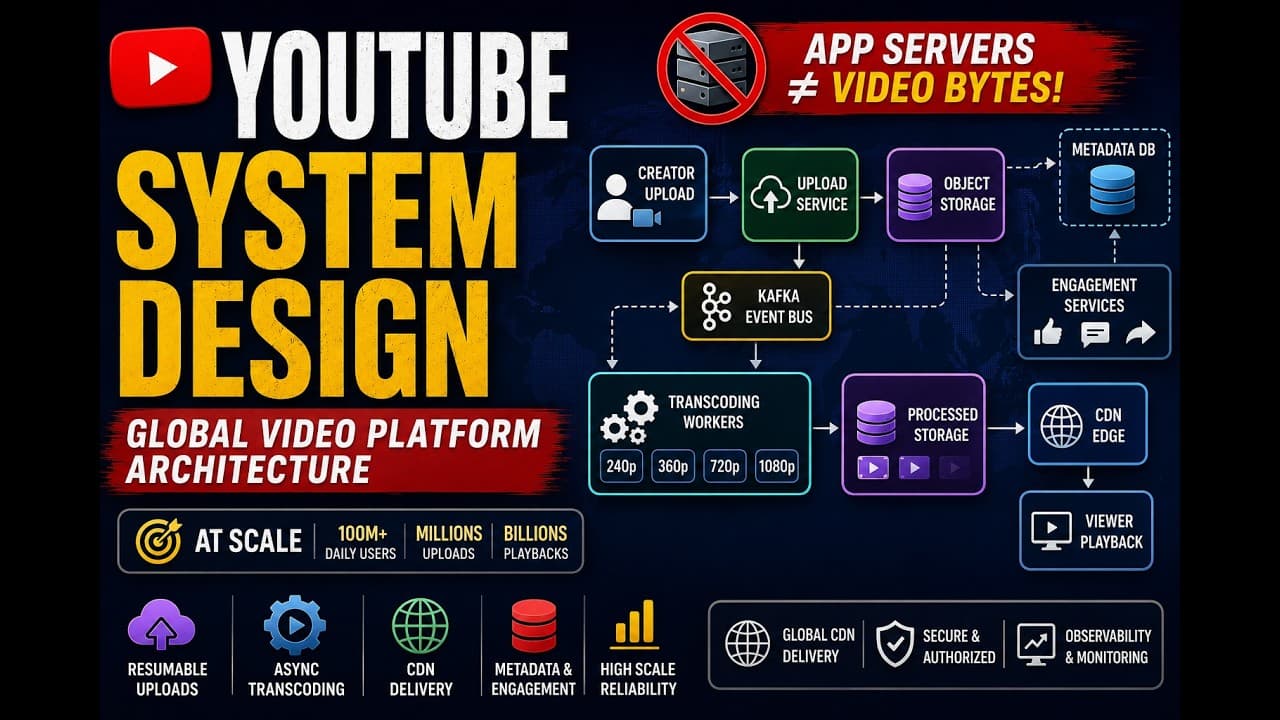
This architectural breakdown details the system design for a scalable, global video platform using decoupled control and data planes. It covers key implementation strategies, including direct-to-storage uploads, Kafka-managed transcoding pipelines, and signed-URL-based CDN delivery.
The architectural separation of control and data planes is no longer optional for platforms scaling beyond millions of users. By offloading heavy media lifting to specialized worker pools and CDNs, engineers can prevent cascading failures in the API layer. This design reflects the industry migration toward event-driven media processing to handle the compute intensity of multi-resolution transcoding. For strategists, mastering these infrastructure fundamentals is critical as cost-of-egress and system reliability become the primary determinants of profitability in high-scale streaming. Watch for a shift toward 'content-aware' encoding ladders that optimize these pipelines further by matching bitrate to specific scene complexity.
The emphasis on sub-second latency and edge delivery in 2026 coincides with a broader industry move toward Low-Latency HLS (LL-HLS) and newer protocols. Per Forasoft (July 2026), scalable video products are increasingly prioritizing bandwidth management over raw compute, as the 'egress bill' remains the largest margin-eater for global platforms. Industry analysis suggests that a single minute of stalled playback during a high-traffic event remains the primary driver of subscriber churn in the B2B and consumer sectors.
Further technical developments in early 2026 highlight the integration of AI-based optimization within the ABRO (Adaptive Bitrate Optimization) cycle. According to reports from Dacast (April 2026), machine learning algorithms are now being used to analyze real-time network conditions and adjust encoding ladders dynamically at the edge. This aligns with the ScalaBrix focus on observability metrics like buffering ratios and Kafka lag, which serve as the data backbone for these automated scaling decisions.
At the infra level, the transition toward hybrid streaming data paths has matured. Per Data Lakehouse Hub (July 2026), the use of Kafka Connect and managed pipelines to feed video telemetry into iceberg-based data lakes has become standard for real-time engagement tracking. This allows platforms to reconcile watch-time data with billing and recommendation engines in sub-second intervals, moving away from traditional daily batch processing for metadata updates.
Add StreamingMeme as a preferred source on Google to see more of our streaming news at the top of your Search results.
Add as preferred source