

Samsung launches 16TB PCIe 6.0 SSD reaching 28.4GBps read speeds
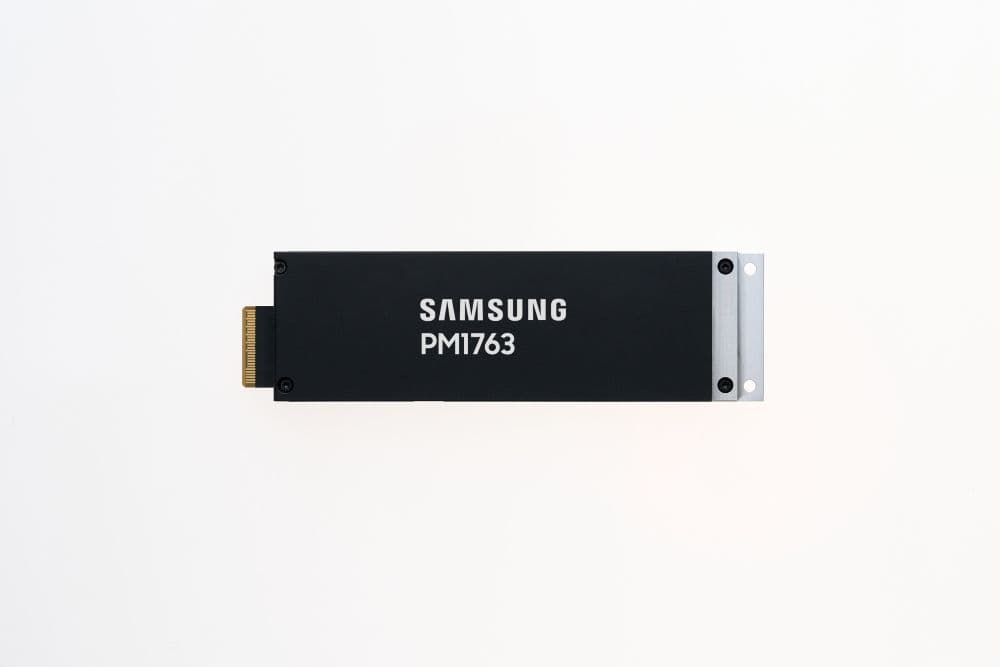
Samsung has announced the PM1743 enterprise SSD, which utilizes the PCIe 6.0 interface to achieve read speeds of up to 28.4GB/s and 16TB of capacity. Designed for data centers and high-performance computing, the drive focuses on power efficiency to help manage infrastructure costs in analytics and AI-heavy workloads.
Key Takeaways
- Peak sequential read and write speeds reach 28.4GB/s and 21.9GB/s, respectively.
- Storage capacity scales up to 16TB using eighth-generation V-NAND technology.
- Hardware power efficiency is improved by 20% over the prior-generation PM1733a.
- The drive requires PCIe 6.0 architecture, currently unavailable on consumer-grade motherboards.
Why It Matters
The introduction of PCIe 6.0 storage directly addresses the IOPS and throughput bottlenecks slowing massive data ingestion for AI and high-resolution video analytics. By doubling previous-generation bandwidth, Samsung enables faster staging of datasets for GPU clusters, reducing the idle time of expensive compute resources. For the streaming ecosystem, this hardware provides the infrastructure required to manage real-time generative AI video and petabyte-scale 8K content libraries more efficiently. Watch for broader adoption as server-grade CPUs from Intel and AMD begin hitting general availability with native PCIe 6.0 support in late 2026.
Additional Context
The launch of the PM1743 positions Samsung against a growing field of PCIe 6.0 competitors as data centers shift toward faster interconnects. Per Tom's Hardware (June 2026), Silicon Motion recently began sampling its SM8466 enterprise SSD controller, which is designed to align with upcoming server platforms such as AMD’s Epyc 'Venice' and Nvidia’s 'Vera Rubin' CPUs. Additionally, Micron entered mass production of its competing 9650 PCIe 6.0 SSD in early 2026, offering similar 28GB/s read speeds but significantly lower write performance at 14GB/s, according to TechRadar (July 2026).
Infrastructure demand for high-bandwidth storage is being driven by a surge in AI compute requirements and the high-bitrate needs of next-generation media. According to Forbes (May 2026), AI-related buildouts are expected to account for 18% of all storage capacity shipments this year, rising to nearly 60% by 2030. In the streaming sector, raw 8K video production at 60fps can generate 4–6 TB of data per hour, necessitating edge servers with the high-performance interfaces provided by PCIe 6.0 to handle real-time playback and ingest (per MwareTV, March 2026).
Despite the rapid adoption in enterprise environments, consumer-grade PCIe 6.0 hardware remains years away. Industry analysts at Digital Journal reported in June 2026 that while all-flash arrays now account for 52.6% of the enterprise storage market, component shortages and the high cost of PCIe 6.0 retimers continue to limit use in desktops and laptops. Leading controller manufacturers like Phison and Silicon Motion have indicated that high-volume client-side PCIe 6.0 support may not materialize until 2027 or later, leaving current mid-market users on the PCIe 5.0 standard.
Read full article at techradar.com
Enjoy our coverage?
Add StreamingMeme as a preferred source on Google to see more of our streaming news at the top of your Search results.
Add as preferred source