

Ross Production Services integrates Clear-Com IP intercoms across mobile production fleet
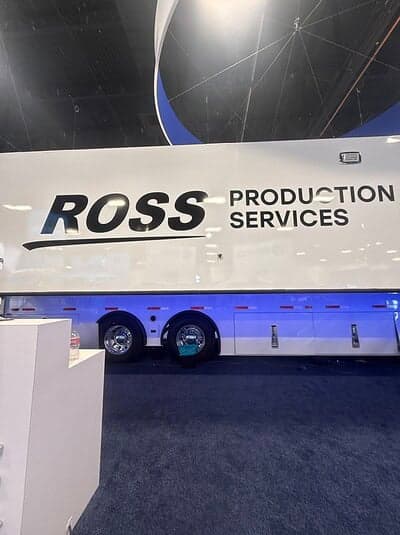
Ross Production Services (RPS) has standardized its mobile production and control room infrastructure on Clear-Com digital matrix and wireless intercom systems. This deployment integrates intercom signals directly into Ross Ultrix routing environments to facilitate remote and at-home production workflows.
Key Takeaways
- Deployment includes Eclipse Omega and Delta digital matrix frames with IrisX panels and Agent-IC mobile apps.
- RPS is transitioning to IP-based wireless workflows using high-density E-IPA cards and FreeSpeak Icon beltpacks.
- LQ Series IP interfaces enable simultaneous two-wire and four-wire connectivity for field-to-truck communication.
- The EHX software's 'Go LIVE' feature allows instantaneous configuration changes without requiring full system reboots.
Why It Matters
The move to a unified IP-intercom stack addresses the industry's shift toward hybrid REMI (Remote Integration Model) production. By integrating comms directly into the Ultrix routing layer, RPS reduces hardware sprawl and latency for distributed teams. Concretely, this allows engineers to manage remote contributors with the same visibility as on-site crew, a necessity as broadcasters look to scale event volume without increasing travel overhead. As regional sports networks and tier-2 events increasingly adopt remote-first models, the robustness of IP-based 'fail-safe' connectivity is becoming a competitive benchmark. Watch for further adoption of high-density IP transceiver cards to replace legacy standalone proprietary wireless systems.
Additional Context
The standardization by Ross Production Services reflects broader growth in the broadcast intercom sector, where technology is rapidly shifting from hard-wired voice panels to IP-enabled multimodal systems. Per Mordor Intelligence (January 2026), the global wireless intercom market is projected to reach $8.12 billion in 2026, driven by higher demand for low-latency (<3ms) systems and hybrid analog-IP workflows. Clear-Com remains a dominant player in this space alongside Riedel and RTS, with the trio collectively controlling over 65% of the global broadcast gateway market as of late 2025 according to Market Growth Reports.
Ross Video has positioned the Ultrix platform as the central hub for these hyperconverged environments. Per Ross Video’s own reporting (June 2026), the company recently delivered its 5,000th Ultrix frame, underscoring its role as the industry’s infrastructure of choice for integrating routing, multiviewers, and media processing. The addition of the FreeSpeak Icon beltpack in February 2025 further expanded these capabilities by introducing Bluetooth 5.3 support and high-density networking specifically designed for the Eclipse HX matrix, allowing for extensive channel management in long-duration live productions like those managed by RPS.
This infrastructure update also aligns with RPS’s ongoing use of remote production technologies to serve major clients like CBS Sports and ESPN. According to historical data from BitFire (July 2026), RPS operates a fleet of six mobile units and three control rooms in Connecticut that rely on ultra-low latency return feeds. By standardizing on IP-based intercoms, RPS is able to minimize on-site personnel while maintaining real-time coordination between those six units and its headquarters, continuing a 34-year trend of consecutive growth for its parent company, per NAB 2026 reports.
Read full article at sportsvideo.org
Enjoy our coverage?
Add StreamingMeme as a preferred source on Google to see more of our streaming news at the top of your Search results.
Add as preferred source