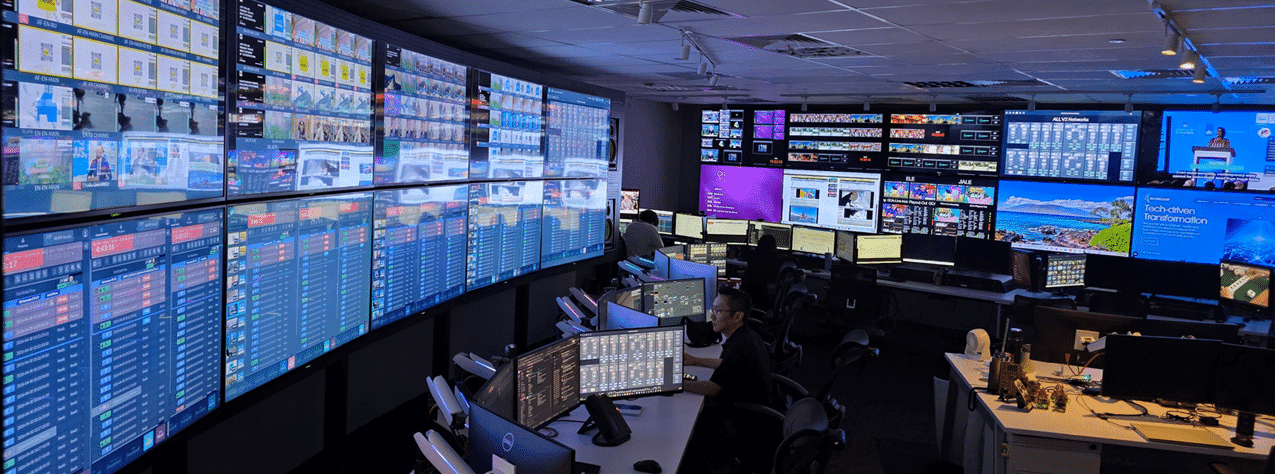
TVC and Globecast have partnered to launch The Matrix, a Singapore-based remote production centre. The facility integrates TVC's AI-powered automated production software with Globecast's IP-based media infrastructure to support REMI and cloud-native live sports workflows.
The launch of this facility signals a shift toward software-defined broadcast models that decouple live production from rigid hardware constraints. By integrating AI-powered automation with Globecast's global fiber and satellite network, the partnership aims to lower operational costs for Tier-1 sports rights holders while maintaining high production values. This move reflects a broader industry transition where cloud-native architectures and REMI workflows are becoming the standard for international distribution rather than experimental alternatives. The success of this model will likely influence how regional hubs compete for global sports contracts. Watch for the results of the validation trials in late 2026 to see if the AI-driven automation meets the latency requirements of live international broadcasts.
Globecast has been steadily building out its remote production and cloud-native media infrastructure portfolio across Asia-Pacific. In early 2026, Globecast announced a partnership with Singtel to deliver managed live video services across Southeast Asia, leveraging Singtel's regional fiber network to reduce latency for cross-border sports and news contributions. The company has also expanded its Content Exchange platform, which enables rights holders to distribute live feeds to multiple broadcasters simultaneously without dedicated point-to-point circuits. TVC, meanwhile, has been refining its AI-driven automated production software for sports, with the company's automated camera and graphics system deployed at the 2025 Southeast Asian Games in Thailand, where it handled multi-camera switching and real-time graphics insertion for over 40 hours of live coverage with minimal human intervention.
The commercial model behind The Matrix reflects a broader trend in remote production economics. A 2025 report from Omdia estimated that REMI workflows can reduce on-site production costs by 40 to 60 percent for multi-venue sports events, primarily through lower travel, accommodation, and equipment logistics expenses. Globecast's parent company Orange has also been investing in IP-based media transport as a strategic priority, with Orange Business announcing in March 2026 that its media division would invest EUR 150 million over three years in cloud-native broadcast infrastructure, targeting the Asia-Pacific and Middle East markets specifically. This investment aligns with The Matrix's positioning as a hub for international sports federations seeking to produce events in the region without deploying full outside broadcast units.
On the technical side, The Matrix's architecture relies on low-latency IP transport protocols that have matured significantly over the past two years. TVC demonstrated its AI production system achieving end-to-end latency of under 800 milliseconds during a live football broadcast trial in Singapore in June 2026, a figure that approaches the threshold required for real-time director decision-making in live sports. Globecast's contribution layer uses SMPTE ST 2110 for uncompressed video transport and SMPTE ST 2022-7 for seamless path protection, standards that the Video Services Forum certified for interoperability across 14 vendor implementations in April 2026. These certifications reduce integration risk for facilities like The Matrix that combine equipment from multiple vendors into a single production chain.
TVC and Globecast are launching The Matrix, a Singapore-based remote production facility, in October 2026. By integrating AI-driven automation with IP-based infrastructure, the hub supports REMI and cloud-native workflows. This partnership aims to reduce operational costs for international sports rights holders while shifting the industry toward software-defined, flexible broadcast models.
The Matrix is scheduled to begin commercial operations in October 2026, following the conclusion of technical commissioning and validation trials.
The facility integrates TVC's proprietary AI-driven automated production software with Globecast's IP-based media infrastructure and Content Exchange orchestration.
The hub aims to lower operational costs for Tier-1 sports events by utilizing REMI workflows, which can reduce on-site production expenses by 40 to 60 percent by minimizing travel and equipment logistics.
The Matrix utilizes SMPTE ST 2110 for uncompressed video transport and SMPTE ST 2022-7 for seamless path protection to ensure reliable, low-latency live broadcasts.
Add StreamingMeme as a preferred source on Google to see more of our streaming news at the top of your Search results.
Add as preferred source
