

Radxa previews Qualcomm-powered modules for high-density edge video processing
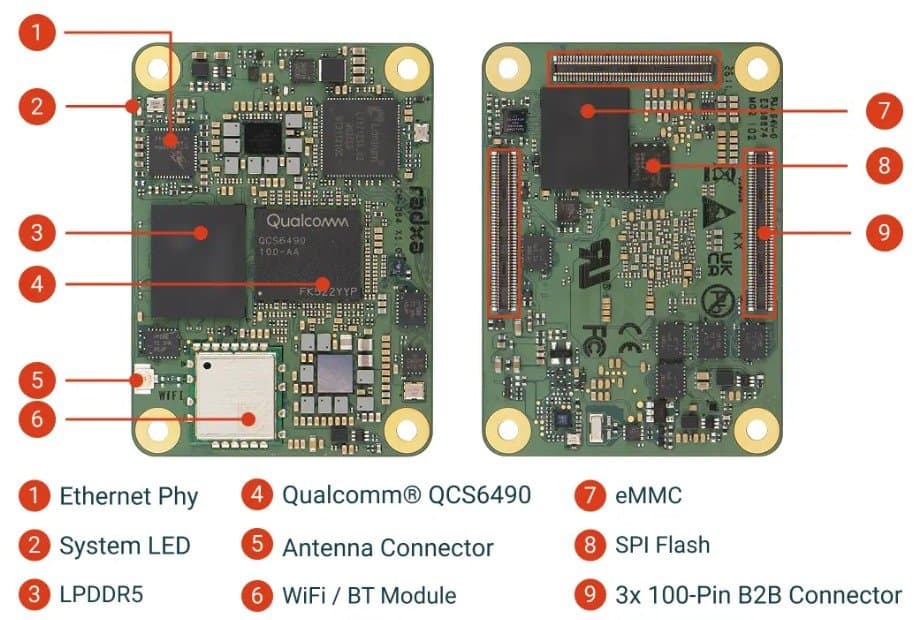
Radxa has introduced the CM-Q64 and VMARC-Q9075 compute modules powered by Qualcomm Dragonwing processors. These modules provide hardware-accelerated processing for multiple video streams and edge AI, targeting industrial and machine-vision applications with support for common AV1, HEVC, and VP9 codecs.
Key Takeaways
- VMARC-Q9075 module features 200 sparse TOPS of AI performance and supports 32 concurrent 1080p30 video streams.
- CM-Q64 integrates the Qualcomm QCS6490 6nm processor, offering 12 TOPS of compute and support for four 1080p60 streams.
- Hardware codec support across both modules includes AV1, HEVC, and VP9 for efficient high-resolution playback and encoding.
- Long-term industrial availability is guaranteed through July 2036 for the CM-Q64 and January 2031 for the VMARC-Q9075.
Why It Matters
The introduction of these modules marks a shift toward localized, high-density video processing that reduces the bandwidth and latency costs of cloud-based transcoding. By integrating 200 TOPS and massive multi-stream capacity into a SMARC form factor, Radxa is enabling enterprise-grade edge workstations for complex vision tasks. Within the broader ecosystem, this pressures traditional server-side encoding by moving the 'heavy lifting' to the capture point. Watch for Radxa’s disclosure of B2B pricing to determine if these modules can undercut current x86-based edge gateways in cost-per-stream metrics.
Additional Context
The launch of these modules aligns with Qualcomm’s broader strategy to diversify beyond handsets into industrial IoT and edge AI. Per a June 2026 analyst briefing from The Futurum Group, Qualcomm expects its non-handset business to reach $40 billion by fiscal 2029, with industrial and robotics segments contributing $8 billion. This growth is driven by a shift toward 'Agentic AI,' where distributed edge devices perform autonomous localized decision-making rather than relying on centralized cloud processing.
Market demand for this specialized hardware is accelerating as industrial sectors move away from high-latency cloud architectures. Data from Mordor Intelligence in March 2026 estimates the edge AI hardware market will grow at a 17.46% CAGR through 2031, reaching $68.73 billion. This expansion is particularly pronounced in the Asia-Pacific region, where manufacturing centers in China and Korea are prioritizing self-sufficient, decentralized computing infrastructure to support smart factory environments and real-time machine vision.
To solidify its position in the vision processing stack, Qualcomm also emphasized its acquisition of Augentix, a developer of specialized ISP and camera technologies. Per industry reporting from January 2026, this move was intended to strengthen Qualcomm’s 'video-first' edge strategy. By combining these enhanced vision silos with Radxa’s open-hardware form factors, the companies are directly challenging NVIDIA's dominance in the autonomous and robotics markets, specifically where low-power AV1 and HEVC processing are required for dense camera arrays.
Read full article at linuxgizmos.com
Enjoy our coverage?
Add StreamingMeme as a preferred source on Google to see more of our streaming news at the top of your Search results.
Add as preferred source