

Radicait CEO fixes autonomous agent plateau with hierarchical problem decomposition
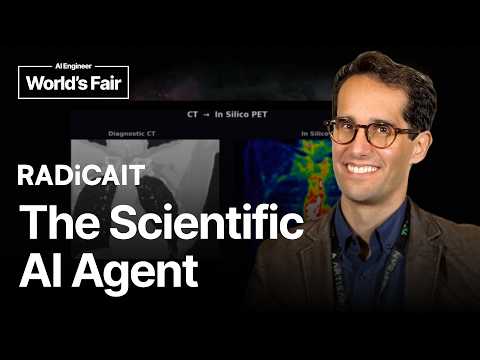
Radicait CEO Sina Shahandeh discusses a hierarchical problem decomposition method intended to improve the performance of autonomous AI agents tasked with complex scientific image processing. The framework addresses stalling in hypothesis generation by structuring codebases into discrete components, while acknowledging that current multimodal models lack the perceptual depth required for nuanced scientific analysis.
Key Takeaways
- Hierarchical problem decomposition inducing up to 100 distinct solution candidates per iteration compared to standard flat-prompt optimization.
- Integrated multi-model orchestration using Gemini for visual quality control and GPT-5.5 Pro via Oracle CLI for hypothesis critique.
- Conversion of Radicait's PET scan generation model from 2.5D to 3D convolutional architecture driven by autonomous agent reasoning.
- Multimodal LLMs currently lack the perceptual granularity to perform expert-level scientific observation of medical imagery without human intervention.
Why It Matters
This framework moves autonomous AI from simple code execution to high-level strategic reasoning, a critical shift for industrial-scale video and image processing workflows. For the streaming industry, this suggests that the bottleneck for AI-driven codec optimization or automated content analysis isn't the ability to write code, but the 'research taste' to evaluate non-obvious improvements. As agents start using test-time compute to explore the full design space—including data pipelines and metrics—vendors should watch for a decline in the need for specialized human engineering to iterate on proprietary encoders and metadata extractors. Watch for the emergence of fine-tuned multimodal models trained specifically on scientific datasets to close the perception loop.
Additional Context
The trend toward fully autonomous scientific discovery is accelerating across the U.S. research landscape. Per AI World Today (July 2026), the Genesis Mission recently launched to deploy autonomous agents across material science and biotechnology, aiming to double scientific productivity within a decade through closed-loop automated workflows. This mission aligns with Sina Shahandeh's observations that while implementation is largely solved, the industry is now pivoting toward automating the 'scientific thought' process itself. Earlier in 2026, Sakana AI’s 'The AI Scientist' achieved a milestone by becoming the first system to have a paper published in Nature for approximately $15 per paper, demonstrating that end-to-end automation from hypothesis to manuscript is already technically viable. However, the 'perception gap' cited by Shahandeh remains the critical failure point for high-stakes clinical and industrial applications. Per James M. Blog (May 2026), current multimodal frontier models like GPT-4V and Gemini still under-deliver on precise spatial reasoning and subtle scientific imagery, requiring specialized models for niche accuracy. This has led to a split in the ecosystem between multi-modal generalists and domain-specific agents. Simultaneously, the toolchain for these agents is maturing: developer Peter Steinberger recently updated the Oracle CLI to support native integration with GPT-5.5 Pro and Gemini 3.1 Pro via Browser Mode, facilitating the kind of multi-model orchestration loops described in the Radicait use cases (GitHub, July 2026). This infrastructure allows agents to treat complex APIs and browser-based interfaces as addressable nodes within a wider reasoning hierarchy.
Read full article at finance.biggo.com
Get this in your inbox → Subscribe
Enjoy our coverage?
Add StreamingMeme as a preferred source on Google to see more of our streaming news at the top of your Search results.
Add as preferred source