
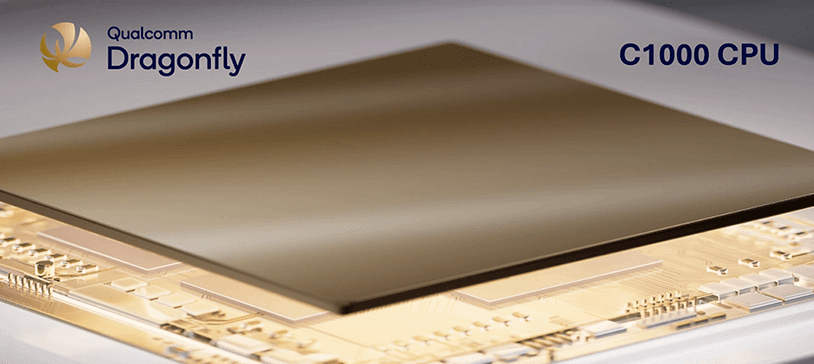
Qualcomm has introduced its Dragonfly data center portfolio, featuring the C1000 CPU and AI300 inference accelerator, designed to support high-performance AI workloads. Meta has signed a multi-year deal to adopt the C1000 processors for its next-generation server infrastructure beginning in 2028.
Qualcomm’s pivot toward high-performance inference represents a direct challenge to the data center status quo, shifting the focus from model training to the high-efficiency 'agentic' AI workloads dominated by hyperscalers. By bypassing traditional high-bandwidth memory (HBM) in favor of 3D-stacked low-power memory, Qualcomm aims to resolve the 'memory wall' that currently handicaps video and language model processing at scale. For the streaming ecosystem, this could significantly lower the total cost of ownership for real-time AI video enhancement and recommendation engines. Watch for the mid-2027 sampling of HBC Gen 1 as an early indicator of whether this 3D-stacking architecture can reliably deliver its promised efficiency gains in live environments.
At its June 2026 Investor Day, Qualcomm framed the Dragonfly launch as part of a broader diversification strategy to reach $15 billion in data center revenue by fiscal 2029, up from just $300 million in 2026. Per Counterpoint Research in June 2026, the company also confirmed the $3.92 billion acquisition of AI software firm Modular. This move integrates the Mojo programming language and MAX inference engine, allowing developers to run optimized code across heterogeneous hardware without the typical switching costs associated with Nvidia’s CUDA ecosystem.
Simultaneous with the Meta deal, Microsoft confirmed it would deploy Qualcomm’s High Bandwidth Compute (HBC) architecture within its Azure cloud infrastructure, according to reporting by Wccftech in June 2026. These hyperscale commitments are fueled by a shift toward agentic AI, which demands high-throughput sequential reasoning and rapid context switching — tasks that Qualcomm’s 5 GHz+ Oryon cores are specifically designed to address more efficiently than traditional GPUs.
Financial analysts note that Qualcomm is currently targeting a non-handset revenue goal of $40 billion by 2029, indicating that mobile chips will shrink to roughly one-third of company earnings. Per TechInAsia in late June 2026, the alignment with Meta also coincides with the social media giant raising its 2026 capital expenditure outlook to a range of $125 billion to $145 billion to support the infrastructure required for 'personal superintelligence' across its platforms. Combined with two unnamed $1 billion custom silicon contracts, these developments signal that Qualcomm has successfully transitioned from a mobile-first provider to a primary challenger in the high-stakes AI infrastructure market.
Add StreamingMeme as a preferred source on Google to see more of our streaming news at the top of your Search results.
Add as preferred source