
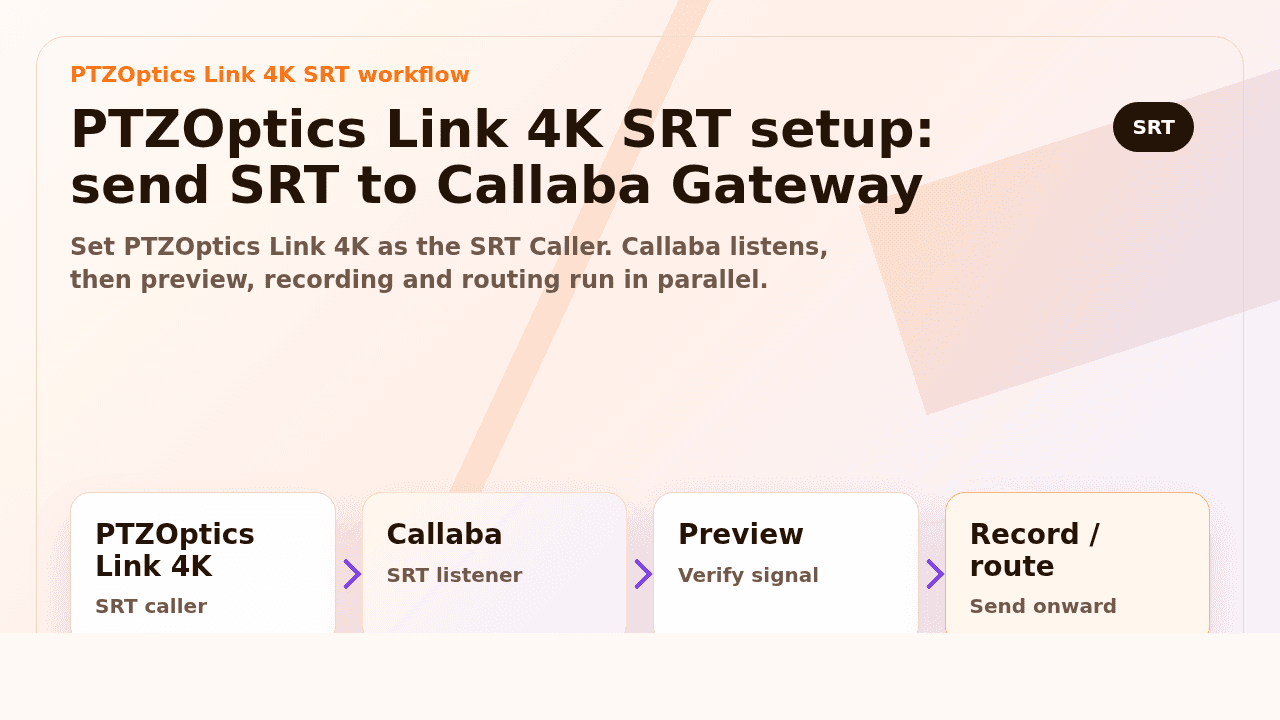
PTZOptics Link 4K cameras can now stream SRT directly to Callaba Gateway, enabling cloud ingest for routing, recording, and monitoring. This workflow simplifies remote production by configuring the Link 4K as an SRT Caller to Callaba's cloud-based Listener. The article provides detailed setup instructions and troubleshooting tips for this specific integration.
This integration solidifies SRT as the dominant protocol for remote contribution, providing a structured alternative to localized hardware-heavy workflows. By moving routing and monitoring to a cloud gateway, production teams reduce the burden on venue uplinks while gaining proactive diagnostics like RTT and packet loss tracking. For the broader ecosystem, this move highlights the shift toward hardware-to-cloud infrastructure that favors interoperable standards over proprietary NDI-only environments. Industry observers should watch for PTZOptics firmware updates that may expand HEVC/H.265 stability across more downstream decoders in high-bandwidth 4K scenarios.
The trend toward cloud-native transport is accelerating as remote production needs outpace traditional SDI and local-only IP workflows. Per The Broadcast Bridge in March 2025, engineers are increasingly moving away from reactive troubleshooting toward proactive monitoring, as SRT handles roughly 85% of remote video contribution compared to just 15% for NDI. While NDI excels in local, bi-directional studio environments primarily due to its support for tally and PTZ control, SRT remains the preferred standard for traversing the public internet due to its robust error recovery and AES encryption.
Callaba's recent 8.4 release in April 2026 introduced critical building blocks for this architecture, including a browser-based multiviewer and a failover switcher. These tools allow operators to manage main and backup SRT feeds from any location, shifting the complexity of signal redundancy from the venue to a managed cloud surface. This follows a broader market move toward unified observability; per Mordor Intelligence in January 2026, the cloud monitoring market is projected to reach $10.95 billion by 2031, driven by the need to normalize telemetry and performance data across increasingly fragmented hybrid-cloud stacks.
Meanwhile, PTZOptics continues to expand the versatility of its Gen 3 hardware. Recent firmware updates in early 2026 added G.711 audio encoding and HIVE Linked integration for remote management, while maintaining the brand's pivot toward Dante AV-H for high-fidelity local networking. By supporting both Dante for the studio and SRT for contribution, manufacturers like PTZOptics are facilitating a hybrid model where local production speed coexists with global cloud distribution.
Add StreamingMeme as a preferred source on Google to see more of our streaming news at the top of your Search results.
Add as preferred source