

Prysmian and Relativity Networks scale hollow core fiber for AI clusters
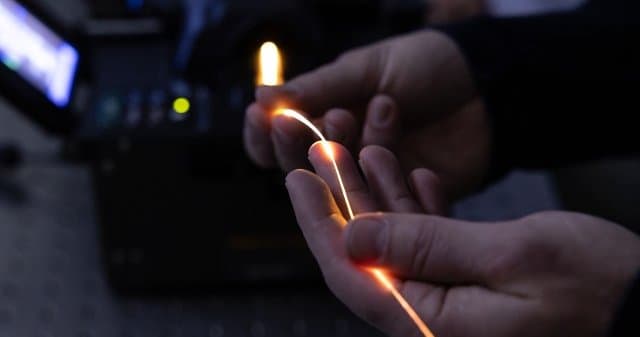
Prysmian and Relativity Networks have successfully deployed a high-density hollow-core fiber cable, utilizing Sirocco architecture and ChronoCore fibers to extend data center reach to 90km. The collaboration focused on proving the installation readiness and scalability of this infrastructure for high-bandwidth, low-latency AI and hyperscale data center environments.
Key Takeaways
- Tests at Dura-Line's Tennessee facility confirmed reliable cable installation at speeds of 350 feet per minute.
- HCF technology extends the maximum synchronized distance between clustered data centers by 50%, reaching 90 kilometers.
- Prysmian is scaling HCF production with investments in its Eindhoven, Netherlands, facility and successful manufacturing in Claremont, North Carolina.
- The 10mm diameter cable incorporates 24 Relativity Networks ChronoCore fibers within Prysmian's Sirocco architecture.
Why It Matters
Extending data center reach to 90 kilometers fundamentally changes the geography of AI infrastructure. By moving beyond the 60km glass-fiber latency limit, operators can site massive clusters near cheaper power or water sources without sacrificing the microsecond-level synchronization required for distributed training. This shift solves critical land and power bottlenecks as AI demand forces data centers into more remote locations. For the broader ecosystem, it signals that experimental optic technologies are transitioning into standardized, massive-scale infrastructure. Watch for the initial hyperscaler adoption rates of these 10mm cables as a signal for the next phase of regional AI campus expansion.
Additional Context
The deployment follows a massive €5.5 billion ($6.4 billion) agreement signed between Prysmian and Molex in July 2026 to supply optical cables for internal data center racks. Per Reuters and Bloomberg, this 10-year deal includes a €550 million upfront payment, a rare level of cash certainty designed to fund capacity expansion. Prysmian plans to invest €1.25 billion through 2031 to double its fiber capacity in the United States, where it remains one of only three local producers. This aggressive expansion is directly tied to the projected 36-fold increase in fiber requirements for AI-focused GPU clusters compared to traditional CPU-based racks, as reported by Fierce Network in late 2025.
Market demand for high-density interconnects is surging; per Tom's Hardware, data center fiber demand grew 76% year-on-year in 2025. This growth has attracted significant capital from AI hardware leaders, including a $300 million investment from Nvidia into Corning for new manufacturing plants in May 2026. While traditional glass fiber remains the volume leader, hollow core fiber is carving out a high-performance niche due to signal propagation speeds nearly 50% faster than solid glass. According to Strategic Market Research, the global hollow core optical fiber market is expected to reach $3.74 billion by 2030, driven by its ability to reduce jitter and thermal amplification demands in 5G and hyperscale environments.
Read full article at datacenterdynamics.com
Enjoy our coverage?
Add StreamingMeme as a preferred source on Google to see more of our streaming news at the top of your Search results.
Add as preferred source