

NVIDIA GQE reference architecture delivers 7.5x database speedup on Blackwell
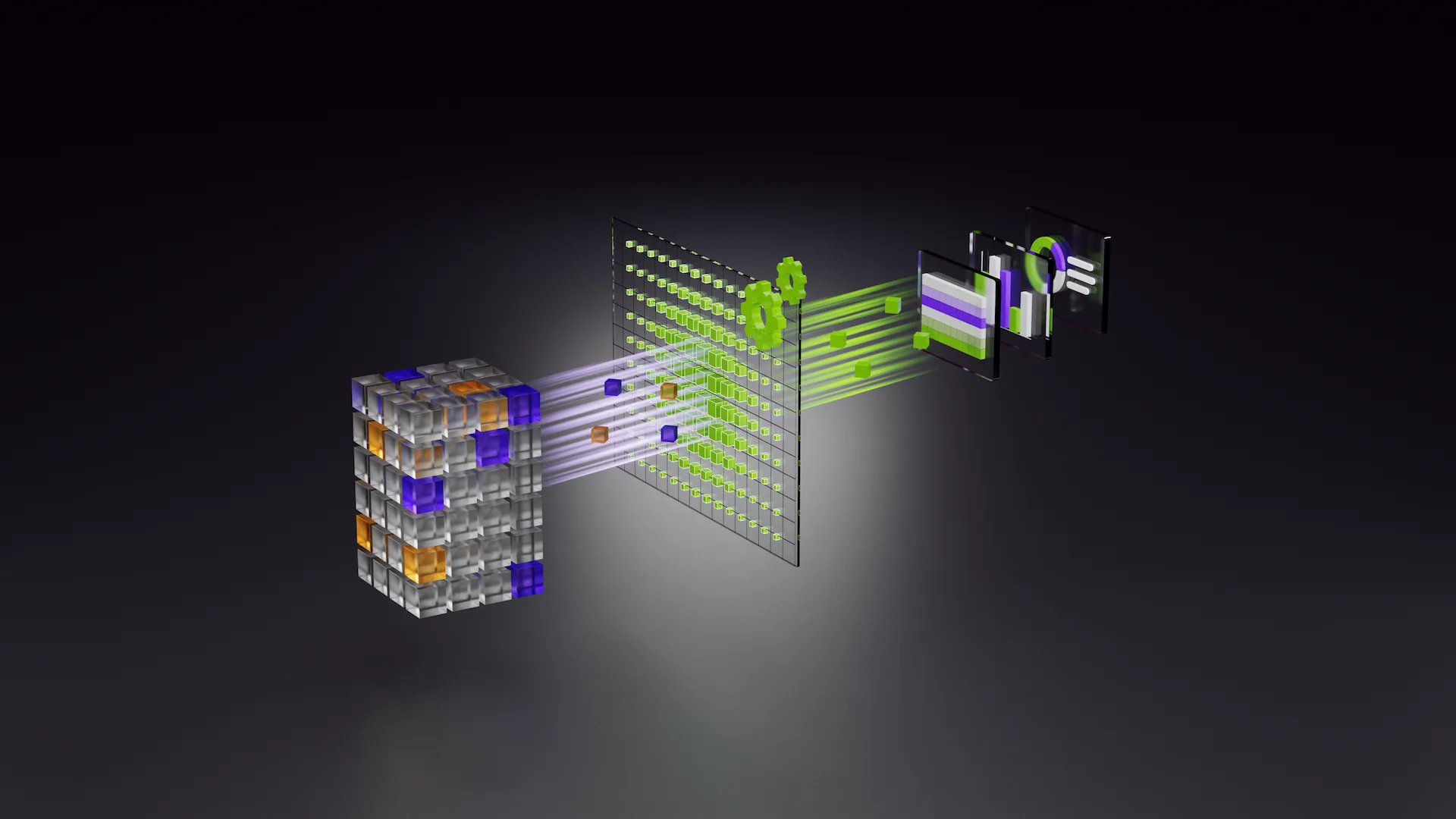
NVIDIA released a technical blog detailing its GPU Query Engine (GQE) reference architecture, which utilizes Blackwell hardware, cuDF, and nvCOMP to accelerate SQL query execution. The post provides optimization strategies including hybrid compression, partition pruning, and pipelined data transfer to improve database performance.
Key Takeaways
- Dedicated Blackwell Decompression Engine reaches 400 GB/s throughput without consuming streaming multiprocessor resources
- GQE outperformed DuckDB on 20 of 22 TPC-H queries, with individual gains exceeding 25x on GB200 NVL4 hardware
- Partition pruning optimization reduced data movement by 31%, contributing to a 1.43x end-to-end performance lift
- GQE query layer natively accepts Substrait plans, enabling Apache DataFusion to offload logical plans to GPU-accelerated physical execution
- Hybrid compression leverages both LZ4 and Cascaded algorithms to balance memory capacity and interconnect bandwidth
Why It Matters
NVIDIA is moving beyond generic AI compute into specialized database acceleration, targeting the memory and I/O bottlenecks that have historically neutralized GPU gains in SQL workloads. By offloading decompression to fixed-function hardware and using pipeline parallelism, GQE effectively bridges the performance gap between CPU-bound storage and GPU-bound execution. This shift allows streaming platforms and data providers to process massive, fragmented datasets natively on Blackwell clusters without the latency overhead of traditional ETL. Watch for wider adoption of Substrait-based offloading as standard database engines like DuckDB and Spark look to leverage Blackwell's 900 GB/s bidirectional NVLink-C2C bandwidth.
Additional Context
The release of NVIDIA's GQE reference architecture comes as the GPU database market experiences a significant growth trajectory. Forecasts from Mordor Intelligence in January 2026 estimate the sector will reach $870 million this year, driven by a 38.9% CAGR in vector and analytical databases. This demand is increasingly tied to the infrastructure requirements of large language model (LLM) inference and real-time analytics, where traditional CPU architectures struggle to maintain throughput. Per Bizon Tech, NVIDIA's GTC 2026 announcements further established this roadmap by introducing the Vera Rubin architecture, which is slated to succeed Blackwell in late 2026 with HBM4 memory and a 3.3x throughput leap.
Simultaneously, the open-source community is standardizing the handoff between query planners and execution engines. Apache DataFusion and DuckDB have expanded their support for Substrait—the intermediate representation GQE uses—to decouple the front-end SQL API from back-end hardware. Per GitHub reports from Q2 2026, DataFusion is prioritizing ClickBench Parquet performance and asynchronous UDF work to improve integration with high-bandwidth accelerators like the GB200. This ecosystem alignment is critical as hardware vendors such as AMD also enter the fray; MLPerf Training v6.0 results from June 2026 show AMD’s Instinct MI355X reaching within 5% of B200 performance in fine-tuning tasks, intensifying the pressure on NVIDIA to deliver vertically integrated software stacks like GQE to maintain its competitive moat in the data center.
Read full article at developer.nvidia.com
Enjoy our coverage?
Add StreamingMeme as a preferred source on Google to see more of our streaming news at the top of your Search results.
Add as preferred source