

NVIDIA adds midrange Jetson Thor modules to 2027 robotics roadmap
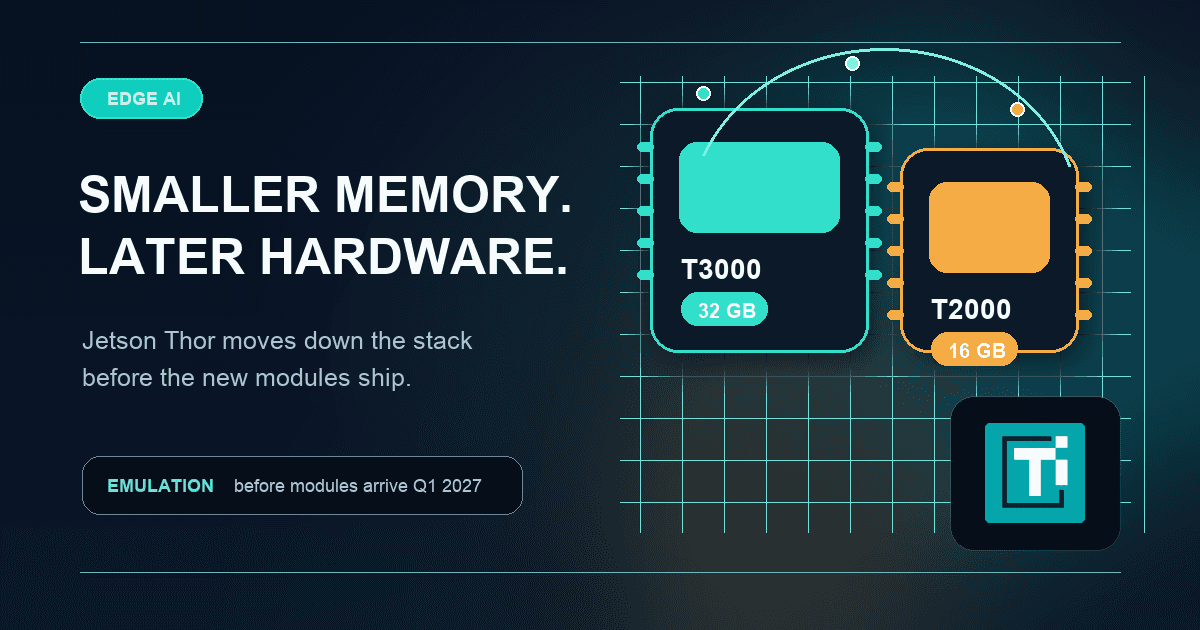
NVIDIA has announced the Jetson T3000 and T2000 modules for edge AI and robotics, scheduled for release in Q1 2027. The company claims the 32GB T3000 offers comparable multimodal performance to the 128GB T5000, though independent verification is currently hampered by a lack of published benchmark methodology.
Key Takeaways
- The 32GB Jetson T3000 retains the 273GB/s memory bandwidth of the premium T5000 despite having only 25% of its memory capacity.
- Hardware is scheduled for Q1 2027, with T3000 software emulation arriving in JetPack 7.2.1 later in July 2026.
- The 16GB Jetson T2000 is rated at 400 FP4 teraflops, though NVIDIA has not yet disclosed its specific bandwidth, CPU, or power range.
- T3000 compute is rated at 865 FP4 teraflops, roughly 42% of the T5000’s peak 2,070 sparse FP4 teraflops.
Why It Matters
NVIDIA is attempting to bridge the gap between high-end developer kits and mass-market production robots by offering Blackwell-class performance at lower memory and power budgets. Maintaining identical memory bandwidth (273GB/s) across the T3000 and T5000 suggests that for memory-bound tasks common in streaming and real-time vision, smaller modules could deliver outsized value if properly optimized. This signals a shift toward physical AI products that prioritize data movement over raw compute density. Watch for the July release of JetPack 7.2.1; developer feedback on T3000 emulation will provide the first real evidence of whether 32GB can effectively handle the foundation models currently requiring 128GB.
Additional Context
The expansion of the Jetson Thor lineup follows the general availability of the flagship T5000 module in August 2025. Per VideoCardz (August 2025), the Jetson AGX Thor developer kit launched at $3,499, and independent testing by HotHardware (August 2025) highlighted the module's Blackwell GPU and 14-core Arm Neoverse-V3AE CPU as a major leap for humanoid robotics. However, ServeTheHome noted in late 2025 that while the T5000 outshines the previous Orin generation by 7.5x in AI compute, managing its 130W peak power envelope remains a significant deployment challenge for mobile robotics.
Software optimization has recently become the primary driver of performance gains for the Thor platform. Per NVIDIA (October 2025), software updates and the adoption of vLLM containers delivered a 3.5x increase in throughput on Llama 3.3 and DeepSeek R1 models within just two months of the platform's launch. These improvements often rely on the NVFP4 format, a four-bit floating-point precision specific to the Blackwell architecture that helps preserve accuracy in large language and vision-language models at the edge.
NVIDIA is also deepening its involvement in the physical AI software stack through partnerships with regional robotics leaders. In July 2026, per TechPowerUp and SiliconANGLE, NVIDIA CEO Jensen Huang announced a physical AI push in Japan involving 20 companies, including SoftBank and Fujitsu. This initiative centers on the new Cosmos 3 Edge world model, a 4-billion-parameter vision-reasoning model optimized to run on the T3000 and T2000. These efforts aim to move AI from simulation-only environments—such as the Isaac GR00T platform—into production-scale machines capable of real-time environmental reasoning.
Read full article at techi.com
Enjoy our coverage?
Add StreamingMeme as a preferred source on Google to see more of our streaming news at the top of your Search results.
Add as preferred source