
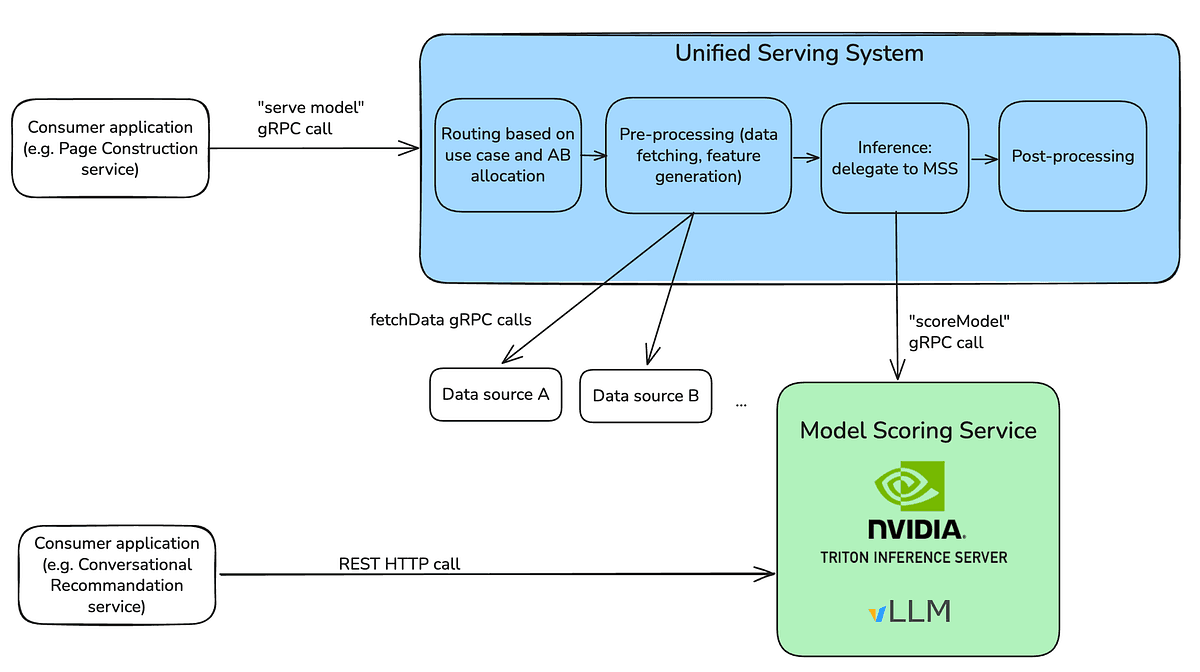
Netflix's AI Platform team details their in-house infrastructure for serving LLMs using vLLM and NVIDIA Triton Inference Server. The architecture allows engineers to migrate from hosted APIs to self-hosted models by standardizing on an OpenAI-compatible API and a custom Java-based control plane.
The transition to local LLM serving indicates that market leaders are moving away from proprietary API dependency toward high-performance, open-source orchestration. By integrating LLMs into the unified MSS architecture, Netflix eliminates the 'AI silo,' allowing engineers to swap hosted models for fine-tuned internal versions with minimal code changes. This strategy optimizes for the high-throughput requirements of personalization and ranking where latency budgets are often under 200ms. For the streaming ecosystem, this shift highlights a growing need for infrastructure that supports both real-time autoregressive decoding and massive-scale embedding generation. Watch for whether Netflix open-sources its proprietary Java control plane or specific vLLM patches to set new industry standards for enterprise-grade LLM operations.
The move toward in-house LLM serving follows a broader technical consolidation at Netflix. Per the Netflix Technology Blog (May 2026), the company recently deployed 'Switchboard,' a custom ML serving router capable of handling over 1 million requests per second for its 250 million members. This infrastructure expansion is critical as Netflix reported in its 2026 second-quarter shareholder letter that generative AI workflows are now utilized in approximately 300 of its titles. Use cases range from natural language voice search to 'VOID,' an internal model specifically designed for post-production object removal.
Industrial shifts toward self-hosting are increasingly driven by the economic break-even point for high-volume inference. Per analysis from VDF AI (July 2026), large-scale enterprises with sustained workloads of more than 30 million tokens per month can achieve 50% to 85% lower blended costs by moving from frontier cloud APIs to self-hosted, quantized open-weight models. Netflix’s adoption of vLLM aligns with these findings, prioritizing hardware flexibility across NVIDIA and multi-cloud environments.
Competitive pressure is also mounting as rival services modernize. Per ClickIT Tech (November 2025), Netflix transitioned to a zero-configuration service mesh to simplify routing for personalization models. This aligns with recent efforts by peers like Spotify and LinkedIn, who have published research on moving beyond standard fine-tuning to unified transformer-based architectures for recommendation. According to Neuroscale Engineering (May 2026), these 'foundation models' now drive roughly 80% of consumption at Netflix, necessitating the highly efficient, low-latency serving infrastructure detailed in the latest platform reveal.
Add StreamingMeme as a preferred source on Google to see more of our streaming news at the top of your Search results.
Add as preferred source