
StreamingMemeStreamingMemeBuyers Guide
LeaderboardsEventsSubmit News
Subscribe

Daily Brief

The streaming industry in your inbox every morning.

Daily Brief

The streaming industry in your inbox every morning.

StreamingMemeStreamingMeme

The independent buyers guide and news aggregator for the streaming technology industry.

Explore

Buyers GuideLeaderboardsEventsSubmit News

Stay updated

Weekly digest of new companies and streaming news.

Categories

Encoding & SoftwareVideo Delivery & CDNStreaming PlatformsAI for VideoProduction HardwareBusiness NewsMonetization & Ad TechRegulatory & Policy

© 2026 StreamingMeme. All rights reserved.

AboutPrivacy PolicyTermsContact
EncodingCDNPlatformsAI & VideoHardwareBusinessAd TechPolicy
← Streaming Platforms
PlatformsTechnical DevelopmentJuly 8, 2026

Netflix leverages IMF to decouple media essences for global localization efficiency

Netflix leverages IMF to decouple media essences for global localization efficiency
YouTube

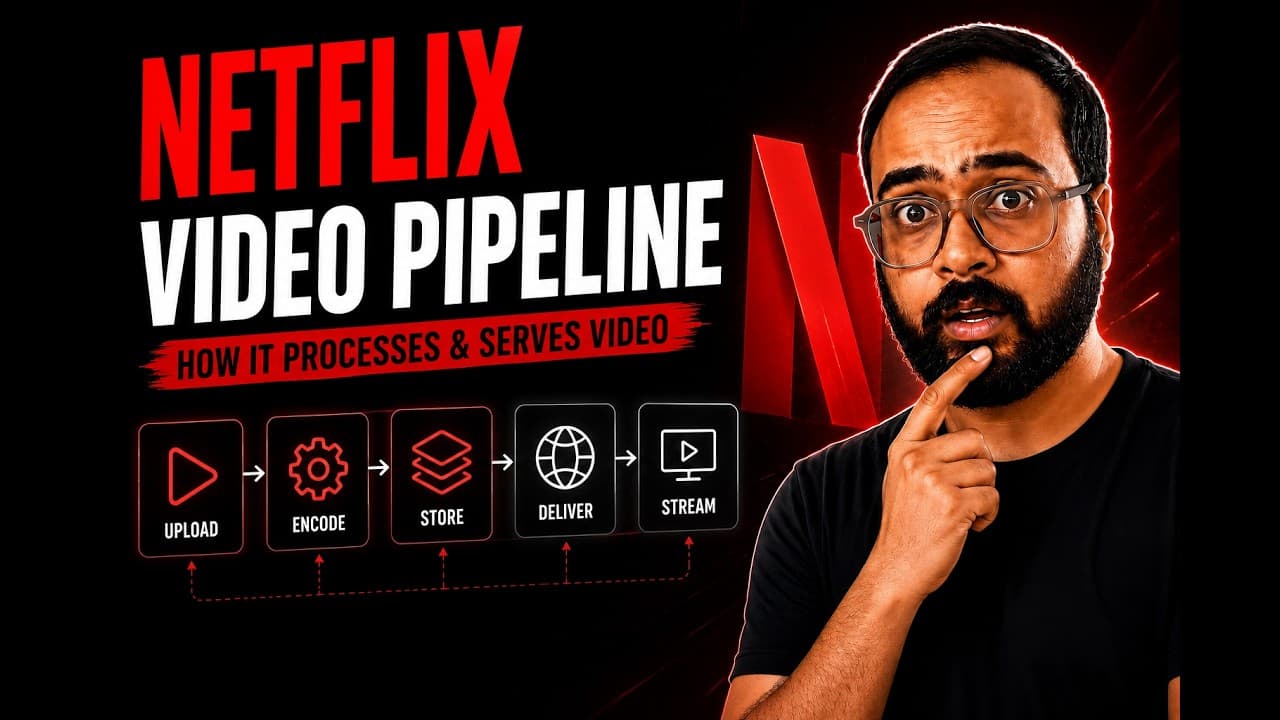
This video breaks down Netflix's internal video processing pipeline, highlighting the use of Interoperable Master Format (IMF) to decouple video, audio, and metadata into separate essences. This architectural approach allows for efficient regional versioning, localized audio support, and content editing without the need to re-encode and store multiple full video master files.

Key Takeaways

  • IMF extracts video, audio, subtitles, and metadata into separate track files rather than storing a single monolithic video container.
  • Metadata files serve as instructional recipes to handle regional versioning, allowing for frame-specific edits without re-rendering original masters.
  • The 3-stage pipeline architecture (Ingest, Processing, Distribution) validates formats and audio-video sync before parallelized encoding begins.
  • Component-based storage allows 30+ language versions to share one visual essence, minimizing redundancy for Netflix's 17,000+ title catalog.

Why It Matters

The move to essence-based media management represents a shift from high-capacity storage to metadata-driven agility. For technical teams, decoupling content from delivery formats enables rapid regional adaptation and significantly lowers the computational overhead of global launches. As the industry faces rising costs for localized 4K/HDR assets, this approach sets the standard for how large-scale streamers handle 'versionitis' while maintaining quality control. Competitors trailing in IMF adoption risk escalating storage costs and slower time-to-market for international expansions. Watch for whether smaller streamers shift to similar vendor-neutral standards to compete with Netflix's internal infrastructure scale.

Additional Context

The standardization of IMF has accelerated as streaming platforms prioritize efficiency and content provenance. Per Broadband TV News in December 2025, Netflix’s shift toward the AV1 codec now accounts for roughly 30% of total viewing traffic, significantly reducing the bitrates required for these IMF-sourced essences while maintaining high visual quality. This transition is supported by a robust hardware ecosystem; approximately 88% of large-screen devices certified between 2021 and 2025 now support AV1 natively, allowing the platform to push high-fidelity master content more efficiently through its Open Connect CDN. Simultaneously, the industry is moving toward greater interoperability in the transport layer. According to Net Insight in January 2026, protocols like SRT and RIST have anchored contribution workflows, complementing file-based formats like IMF by ensuring reliable delivery over IP. This technical maturity allows the industry to move away from legacy tape-based or proprietary monolithic formats. Furthermore, per Fortune Business Insights in June 2026, the global video processing platform market is expected to reach $9.73 billion this year, driven largely by the adoption of cloud-native microservices and decentralized pipelines that mirror the architecture Netflix has refined. Beyond basic encoding, the integration of AI is reshaping the validation stage of the pipeline. CDNetworks reported in January 2026 that AI-driven tools are now used for real-time automatic subtitle generation and error detection within streaming ingestion. For Netflix, these advancements reinforce its long-standing develop-and-open-source strategy, notably with the June 2026 release of VMAF v1, an updated version of its perceptual video quality metric designed to better handle the complexities of new codecs like AV2 and the demands of high-concurrency live streaming events.


Read full article at m.youtube.com

Enjoy our coverage?

Add StreamingMeme as a preferred source on Google to see more of our streaming news at the top of your Search results.

Add as preferred source

Related Articles

The Broadcast Bridge: Broadcasters transition to NATS messaging for scalable cloud-native microservice orchestration
PuppyGraph: Columnar storage and Apache Parquet anchor modern media data pipelines
Cord Cutters News: Disney+ to add Hulu + Live TV for unified 'Super App' experience

Newest

in 4 months
The Broadcast Bridge: Broadcasters transition to NATS messaging for scalable cloud-native microservice orchestration
about 22 hours ago
Kavout: Nvidia posts $81.6B Q1 revenue as institutional caution slows momentum
about 23 hours ago
POLITICO: U.S. AI Export Program underwhelms with only 78 corporate applications
1 day ago
PRIP Strategy: TCL challenges InterDigital's AV1 patent as litigation targets hardware manufacturers
1 day ago
AVIXA: Corporate media demand doubles as enterprise and broadcast standards converge
1 day ago
Portada: Omnicom and NBCUniversal launch AI-driven dynamic contextual advertising for CTV
1 day ago
APNIC: IPv4 routing table hits 1.06M prefixes as Amazon expands footprint
1 day ago
Fora Soft: Streaming operators pivot to three-layer AI stack for viewer retention
1 day ago
Newsshooter: Magewell launches $2,099 Director Plus for 4K60 mobile production bonding
1 day ago
Preprints.org: LF-MAE framework uses self-supervised learning to reconstruct 4D light-field data
1 day ago
AI Engineering Insider: Reference architecture for streaming recommenders adds layered LLM guardrails
1 day ago
Artificial Code by Jacopo Perfetti: Optimization focus shifts to AI harness as model weights reach parity
1 day ago
IBC: Banijay and All3Media complete $8 billion merger to form production giant
1 day ago
IndexBox: Hyperscale expansion to drive 4.8% relay rack market growth through 2035
1 day ago
MarketBeat: Veritone taps Oracle Cloud for 20% savings amid deep restructuring
1 day ago
The Tech Buzz: Apple Neural Engine development traced back to failed self-driving car program
1 day ago
I-Programmer: SIGGRAPH 2026 debuts Games Summit and neural rendering pipeline breakthroughs
1 day ago
Substack: OpenAI, Meta, and SpaceXAI launch frontier models in major agentic shift
2 days ago
IndexBox: POL module market to hit 7.5% CAGR as data centers densify
2 days ago
IndexBox: AI infrastructure surge to drive 7.2% annual growth for network and server market through 2035

Upcoming Events

Jul
16
ADWEEK House Sports SummitNYC
Jul
29–30
Buffer-Free VideoSeattle
Aug
17–20
SET EXPOSao Paulo
Sep
11–14
IBCAmsterdam
Sep
13
SportsPro Streamtime Sports LiveAmsterdam
View all events →

Top Sources

  1. 1.BoxxTech79
  2. 2.Sports Video Group68
  3. 3.AdExchanger68
  4. 4.SiliconANGLE65
  5. 5.PPC Land40
  6. 6.YouTube36
  7. 7.TechCrunch26
  8. 8.Tech Times26
Full leaderboards →

Newest

in 4 months
The Broadcast Bridge: Broadcasters transition to NATS messaging for scalable cloud-native microservice orchestration
about 22 hours ago
Kavout: Nvidia posts $81.6B Q1 revenue as institutional caution slows momentum
about 23 hours ago
POLITICO: U.S. AI Export Program underwhelms with only 78 corporate applications
1 day ago
PRIP Strategy: TCL challenges InterDigital's AV1 patent as litigation targets hardware manufacturers
1 day ago
AVIXA: Corporate media demand doubles as enterprise and broadcast standards converge
1 day ago
Portada: Omnicom and NBCUniversal launch AI-driven dynamic contextual advertising for CTV
1 day ago
APNIC: IPv4 routing table hits 1.06M prefixes as Amazon expands footprint
1 day ago
Fora Soft: Streaming operators pivot to three-layer AI stack for viewer retention
1 day ago
Newsshooter: Magewell launches $2,099 Director Plus for 4K60 mobile production bonding
1 day ago
Preprints.org: LF-MAE framework uses self-supervised learning to reconstruct 4D light-field data
1 day ago
AI Engineering Insider: Reference architecture for streaming recommenders adds layered LLM guardrails
1 day ago
Artificial Code by Jacopo Perfetti: Optimization focus shifts to AI harness as model weights reach parity
1 day ago
IBC: Banijay and All3Media complete $8 billion merger to form production giant
1 day ago
IndexBox: Hyperscale expansion to drive 4.8% relay rack market growth through 2035
1 day ago
MarketBeat: Veritone taps Oracle Cloud for 20% savings amid deep restructuring
1 day ago
The Tech Buzz: Apple Neural Engine development traced back to failed self-driving car program
1 day ago
I-Programmer: SIGGRAPH 2026 debuts Games Summit and neural rendering pipeline breakthroughs
1 day ago
Substack: OpenAI, Meta, and SpaceXAI launch frontier models in major agentic shift
2 days ago
IndexBox: POL module market to hit 7.5% CAGR as data centers densify
2 days ago
IndexBox: AI infrastructure surge to drive 7.2% annual growth for network and server market through 2035

Upcoming Events

Jul
16
ADWEEK House Sports SummitNYC
Jul
29–30
Buffer-Free VideoSeattle
Aug
17–20
SET EXPOSao Paulo
Sep
11–14
IBCAmsterdam
Sep
13
SportsPro Streamtime Sports LiveAmsterdam
View all events →

Top Sources

  1. 1.BoxxTech79
  2. 2.Sports Video Group68
  3. 3.AdExchanger68
  4. 4.SiliconANGLE65
  5. 5.PPC Land40
  6. 6.YouTube36
  7. 7.TechCrunch26
  8. 8.Tech Times26
Full leaderboards →