
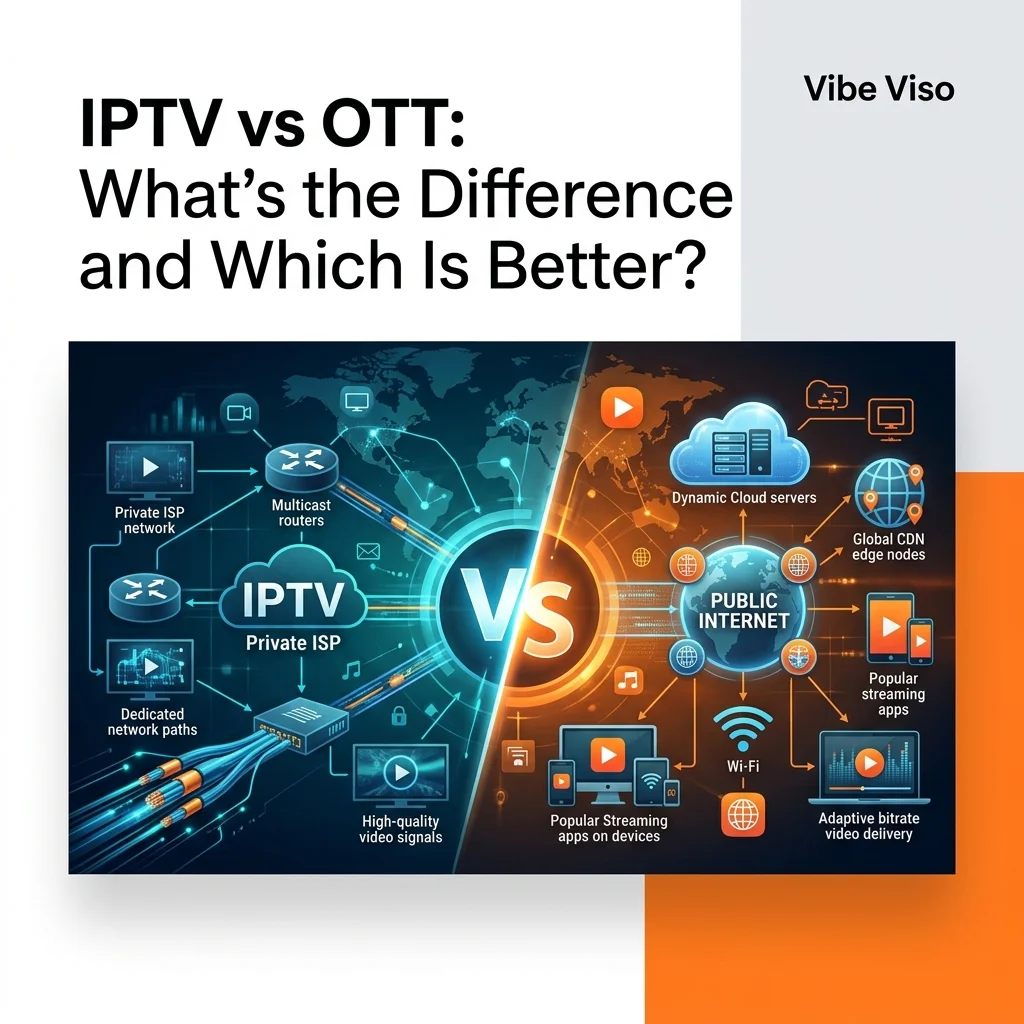
A technical explainer from VibeViso compares IPTV and OTT architectures, detailing differences in network topology, protocols, scaling, and quality controls. It highlights how Canadian telecoms like Bell implement hybrid models, providing a reference for streaming technology professionals.
The article quantifies why IPTV remains structurally dominant for live linear delivery: multicast's O(1) bandwidth scaling is mathematically impossible to replicate over unicast CDNs, no matter how many edge nodes are added. For streaming engineers, the 50,000x backbone efficiency gap explains why telcos retain managed IPTV backbones rather than migrating fully to OTT. The hybrid model now standard at Bell and Rogers — managed multicast for live, OTT apps for on-demand — signals that convergence, not replacement, is the industry trajectory. Watch whether LL-HLS production deployments, currently landing at 3–5 seconds per BlazingCDN benchmarks from early 2026, close the gap enough to erode IPTV's live-sports latency advantage.
The convergence pattern the article describes is accelerating. In November 2024, Rogers formally rebranded its Ignite TV service as Rogers Xfinity TV under a decade-long agreement with Comcast, deploying Comcast's Entertainment OS platform across its footprint (per Comcast Technology Solutions, November 2024). The platform uses managed unicast over DOCSIS with QoS prioritization rather than traditional multicast, a middle ground between pure IPTV and open OTT. Bell, by contrast, maintains its FTTH multicast architecture built on the MediaKind Mediaroom platform, upgraded to Mediaroom Play in 2022 with Android TV integration (per Grokipedia, citing Bell's 2022 platform upgrade).
On the OTT side, the low-latency gap is narrowing but not closing. The global LL-HLS streaming CDN market was valued at $4.8 billion in 2025 and is projected to reach $14.2 billion by 2034 at a 12.8% CAGR, driven primarily by live sports demand (per Dataintelo, 2025 market report). However, production reality lags the theoretical floor. Mux's published 2024 benchmark measured LL-HLS at 4.0 seconds average glass-to-glass across 35,000 sessions, with a p95 of 6.1 seconds — well above IPTV's 1–3 second range. A Q1 2026 measurement by a major European broadcaster found that 68% of total LL-HLS latency budget was consumed by CDN edge behavior, not encoding or ingest (per BlazingCDN, early 2026).
HTTP/3 and QUIC adoption at CDN edges crossed 40% of live-stream traffic globally in 2026 industry measurements, which matters because QUIC's stream-level multiplexing eliminates the head-of-line blocking that HTTP/2 over TCP imposed on LL-HLS partial-segment fetches (per BlazingCDN, 2026). The CDN Alliance's Low Latency Working Group published a standardization whitepaper in September 2025 that categorizes latency into four tiers — Low Latency (3–12s), Ultra-Low Latency (1–3s), Sub-Second Streaming (0.5–1s), and Real-Time Streaming (under 0.5s) — in an effort to create common terminology the industry has lacked. Whether these protocol improvements and standardization efforts will compress OTT latency enough to challenge managed IPTV's structural advantage for live delivery remains the central architectural question for streaming operators.
Add StreamingMeme as a preferred source on Google to see more of our streaming news at the top of your Search results.
Add as preferred source