

Monash University develops integrated valleytronic chip using light-based data processing
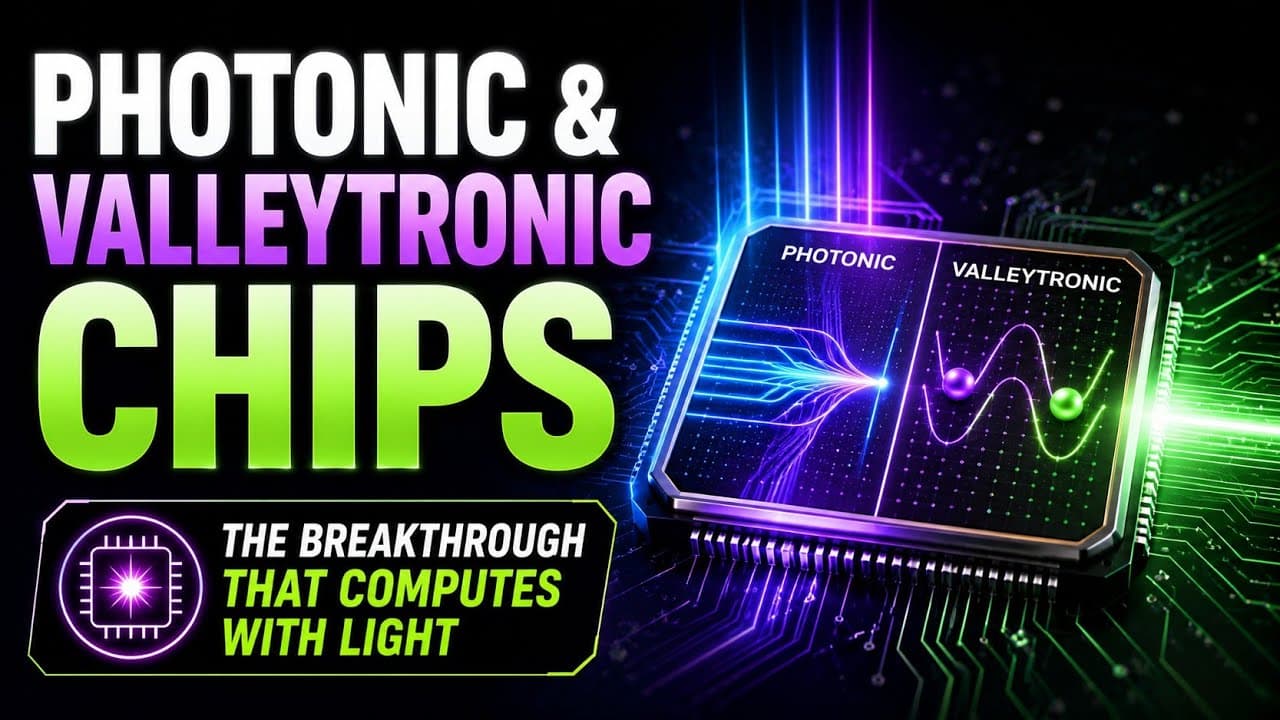
Researchers at Monash University have demonstrated a programmable valleytronic nanocircuit that uses light instead of electricity to process information on a single chip. This experimental chip architecture could eventually improve power efficiency and performance in hardware used for high-performance computing, AI training, and quantum infrastructure.
Key Takeaways
- Integrated all-in-one chip architecture handles light generation, routing, and reading on a single programmable circuit.
- Uses 'valleytronics' to encode information in the quantum energy states of photons rather than electron flow.
- Operates at room temperature, distinguishing it from conventional quantum hardware that requires extreme cryogenic cooling.
- Experimental demonstration processed two images simultaneously to prove multi-stream handling capabilities.
Why It Matters
This breakthrough provides a architectural path to bypass the 'Von Neumann bottleneck' and thermal limits of silicon-based electronic chips. For the streaming and AI sectors, where data centers consume megawatts of power for cooling, light-based computing offers up to 80% lower energy consumption per bit. While currently a lab-scale demonstration, integrating these functions onto one chip is the critical precursor to commercialized high-performance computing hardware. Watch for the translation of this 'stacking' manufacturing approach into standard semiconductor foundries over the next 3-5 years.
Additional Context
The push for photonic integration comes as AI infrastructure reaches a critical energy threshold. Per TSMC (September 2025), AI accelerators have seen power demand per package triple over the last five years, making optical I/O and photonic interconnects essential for sustainable scaling. TSMC is currently targeting a 2026 roadmap for co-packaged optics (CPO) with switch engines capable of 6.4Tbps throughput to address these bottlenecks.
Market demand for these technologies is accelerating rapidly. Per Precedence Research (July 2026), the global photonic integrated circuit market was valued at $14.85 billion in 2024 and is projected to reach approximately $97.62 billion by 2034. While traditional silicon photonics dominates today, specialized platforms like thin-film lithium niobate and valleytronics are emerging to handle the parallel processing requirements of large-scale AI training clusters.
Institutional investment reflects this urgency. During 2024 and 2025, AI chip startups secured over $7.6 billion in venture capital, according to Future Markets Inc. (September 2025). This funding is increasingly directed toward non-traditional architectures, such as neuromorphic and photonic processors, that aim to deliver the sub-nanosecond latency required for real-time AI inference in 5G networks and autonomous systems.
Read full article at youtube.com
Enjoy our coverage?
Add StreamingMeme as a preferred source on Google to see more of our streaming news at the top of your Search results.
Add as preferred source